
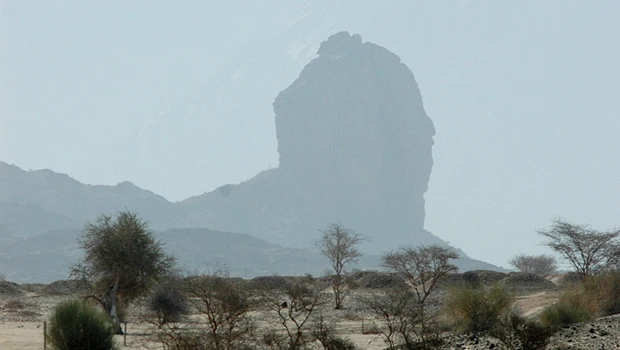
- JEDDAH: A few kilometers south of the Khawajat (non-Muslim) Road leading from Jeddah to Taif stands Jebel Shayam.
- Known locally as Sugar Loaf Rock it is an unusual 150-meter high pillar standing on the eastern end of a low outcropping of sandstone.
Its characteristic pillar shape is easily seen to the south from the main road about 100 km from Jeddah. Typically, sandstone often splits into free-standing towers such as this that are further eroded by fracturing from the huge temperature changes that cause internal stress in the rock and the sand filled winds of the desert.
Sometimes they end up as weird and fantastical shapes. The pinnacles of sandstone that stud the skyline near Al-Ula are perfect examples of this.
As a challenge to climbers, the best that can be said of Jebel Shayam is that it is certainly doable even by moderately experienced climbers. However, the sandstone that comprises the pillar is friable and unpredictable.
There are several 4th class routes up the west slope and according to local intelligence, some easy 5th class bolted routes up gullies on this face as well. For the casual visitor, a climb up the 40-meter slope of rock that has fractured and fallen from the jebel is a relatively easy challenge.
For the non-climber, the jebel is only a destination at a stretch, perhaps an hour or two stop for a picnic. Its real value comes as a break point to keep young passengers interested in the trek to Taif, because it comes at about the halfway point and, since a good tarmac road leads directly to it from the main road, it is eminently accessible.
Even more importantly it is safe, clear of litter when last we checked and rarely visited.
For a little four wheel fun, the sandy track, just about drivable in a two wheel but more safely in a four-by-four vehicle starts on the north side of the jebel and reaches the main road after about five kilometers and passing near an abandoned battery hen farm.
The jebel takes on an interestingly mysterious presence on sandy or cloudy days, looming darkly a rocky silent sentinel over the surrounding desert and silhouetted against the massive foothills that indicate the distant presence of the Taif Escarpment.