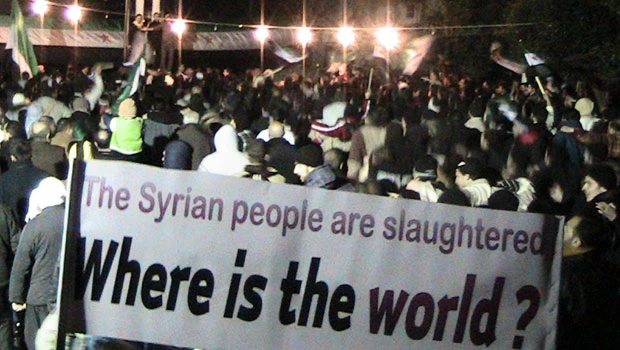
- AMMAN/BEIRUT: Syrian forces unleashed new tank and rocket bombardments on opposition neighborhoods of Homs on Saturday while diplomats sought UN backing for an Arab plan to end 11 months of bloodshed in Syria.
At the United Nations, a new diplomatic showdown was shaping up this weekend. Saudi Arabia circulated a draft resolution backing an Arab peace plan for Syria among members of the UN General Assembly on Friday, diplomats said. The text echoed the one vetoed by Russia and China in the Security Council.
Like the failed resolution, the assembly draft “fully supports” the Arab League plan floated last month, which among other things calls for Assad to step aside.
Gulf Arab states, the United States, Europe and Turkey are leading diplomatics effort to force Assad to end his 11-year rule. But they have ruled out a military intervention of the kind that helped bring down Libya’s Muammar Qaddafi last year.
Russia and China said the Security Council draft was unbalanced and failed to blame Syria’s opposition, along with the government, for violence in which thousands have died.
The United Nations, which says it can no longer tally casualties, estimated in mid-December that the security forces had killed more than 5,000. A week later, the government said armed “terrorists” had killed over 2,000 soldiers and police.
The assembly draft, seen by Reuters, calls for an end to violence by all sides, but primarily blames Syrian authorities for “continued widespread and systematic violations of human rights and fundamental freedoms.”
The 193-nation body’s resolutions have no legal force, unlike those of the Security Council, but were the Syria text to pass it would add to pressure on Assad and his government.
The assembly is due to discuss Syria on Monday, with a vote on the resolution expected later in the week.
Assad can count on the support of Russia, Syria’s main arms supplier and an ally stretching back to the Soviet era, as well as Iran. Moscow, which is keen to counter US influence in the Middle East, insists foreign powers should not interfere.
Deputy Foreign Minister Sergei Ryabkov, accusing unspecified Western states of arming the rebels, said on Friday: “The UN Council is not a tool for intervention in internal affairs and is not the agency to decide which government is to be next in one country or another.
“If our foreign partners don’t understand that, we will have to use drastic measures to return them to real grounds.”
In Syria, activists said seven people were killed in the latest attacks in a week-long government siege of Homs, a battered city at the heart of the uprising to oust President Bashar Assad.
“The four included a 55-year-old woman. They were killed by shelling that hit their building in Bab Amro,” a Homs opposition activist, Mohammad Hassan, told Reuters by satellite telephone.
Syria’s state-run news agency, meanwhile, said gunmen have assassinated an army general in the capital Damascus. It’s the first killing of a high military officer in the Syrian capital since the uprising began in March.
The SANA news agency says three gunmen opened fire at Brig. Gen. Issa Al-Khouli on Saturday morning as he left his home in the Damascus neighborhood of Rukn-Eddine. Al-Khouli was a doctor and the chief of a military hospital in the capital. The attack indicates that violence in Syria is reaching the tightly controlled capital, which has been relatively quiet compared to other cities.
The bloodshed followed a day of violence across Syria on Friday, when bombings targeting security bases killed at least 28 people in Aleppo and rebel fighters battled troops in a Damascus suburb after dark.
Assad has ignored repeated international appeals, the latest from the European Union, to halt his violent crackdown.
“I am appalled by the reports of the brutal attacks by the Syrian armed forces in Homs. I condemn in the strongest terms these acts perpetrated by the Syrian regime against its own civilian,” EU foreign policy chief Catherine Ashton said.
The government offensive on opposition-held, mostly Sunni Muslim areas of Homs has killed at least 300 people in the past week, according to activists. Food and medical supplies are running low in blockaded areas, where many people are trapped in their houses, fearful of coming under fire if they step out.
Accounts could not be independently confirmed as Syria restricts access by most foreign journalists.
Youtube footage provided by activists showed a doctor at a field hospital next to the body of the woman. “Shrapnel hit her in the head and completely drained her brain matter,” he says.
In Damascus, Free Syrian Army rebels fought for four hours on Friday night against troops backed by armored vehicles who had entered Al-Qaboun neighborhood, activists said.
The rebels said they had sustained several casualties but it was not known if any had died of their wounds..
The fighting showed how opposition to Assad, whose family, from the Alawite minority, has ruled Syria for 42 years, has increasingly evolved from street protests to armed insurrection.
World powers fear a slide into all-out civil war which could inflame a region already riven by revolts and rivalries from Bahrain and Yemen to Iran and the Israeli-Palestinian conflict.