- BRUSSELS/GENEVA/AMMAN: European foreign ministers increased the pressure yesterday on Syria's regime to stop its crackdown on opponents, freezing the assets of several Syrian government officials and imposing sanctions on the country's central bank.
They also banned the purchase of gold, precious metals and diamonds from the country, and banned Syrian cargo flights from the European Union.
The EU had previously imposed several rounds of sanctions on Syria, freezing the assets of 100 people and 38 organizations, and trying to cut the country's supply of equipment for its oil and gas sectors.
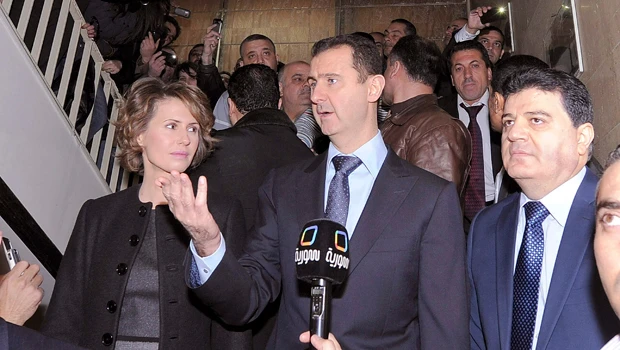
So far the EU sanctions have had little effect on the regime of Syrian President Bashar Assad. Activist groups estimate nearly 7,500 people have died in 11 months of unrest.
The names of the Syrian officials sanctioned yesterday will be made public today in the EU's official journal. The new sanctions were adopted yesterday morning by the foreign ministers of the 27 EU countries, meeting in Brussels, said Maja Kocijancic, an EU spokeswoman.
Syrian artillery pummeled rebel-held areas of Homs on Monday as the government announced that a vote — decried as a sham by the opposition and the West — has approved a new constitution proposed by Assad.
Around 89 percent of Syrians approved the new constitution in the referendum on Sunday, state television said yesterday. Turnout in the referendum was 57.4 percent, state television said.
Shells and rockets crashed into Homs that have already endured weeks of bombardment as Assad's forces try to stamp out an almost yearlong revolt against his 11-year rule. “Intense shelling started on Khalidiya, Ashira, Bayada, Baba Amro and the old city at dawn,” opposition activist Mohammed Al-Homsi told Reuters from the city on the Damascus-Aleppo highway.
“The army is firing from the main thoroughfares deep into alleyways and side streets. Initial reports indicate at least two people killed in the souk area,” he said.
The London-based Syrian Observatory for Human Rights said later at least seven people had been killed by shellfire in Baba Amro. The accounts of opposition activists were echoed by those from other observers, including the Red Cross.
At least 59 civilians and soldiers were killed on Sunday in a violent backdrop to a referendum on a constitution that offers some reforms, but could enable Assad to keep power until 2028.
The International Committee of the Red Cross, which has said conditions in parts of Homs are worsening by the hour, has failed to secure a pause in the fighting to allow the wounded to be evacuated and desperately needed aid to be delivered.
“We are still in negotiations. Since the beginning, the objective has been to go in and evacuate people and bring in assistance. Every hour, every day makes a difference,” ICRC spokesman Hicham Hassan said in Geneva.
The relief agency has been pursuing talks with the Syrian authorities and opposition forces for days to secure access to besieged neighborhoods such as Baba Amro, where local activists say hundreds of wounded need treatment and thousands of civilians are short of water, food and medical supplies.
Four Western journalists are trapped in Baba Amro, two of them wounded. French President Nicolas Sarkozy said he hoped the journalists could be rescued soon. “It's very tense, but things are starting to move, it seems,” he told RTL radio.
The ICRC evacuated 27 people, seven of whom were badly wounded, from Baba Amro on Friday.
The ICRC and Syrian Arab Red Crescent volunteers distributed aid supplies in Hama, another restive city under army attack, yesterday for the first time in six weeks, the ICRC spokesman said.
The outside world has proved powerless to halt the carnage in Syria, where repression of initially peaceful protests has spawned an armed insurrection by army deserters and others.
Iran has objected to the UN Human Rights Council holding an emergency debate on the violence and repression in its ally Syria, as requested by Arab and Western states, the Geneva forum's president said yesterday.
Qatar marked the opening of the Council's annual four-week session by asking for an urgent debate on Syria today, a request that was backed by most Arab League members, as well as the European Union (EU) and the United States.
Russian Prime Minister Vladimir Putin again warned the West against military intervention in Syria, Moscow's long-time ally, but US Secretary of State Hillary Clinton made clear there was no enthusiasm in Washington for war. Russia and China have blocked action against Syria by the UN Security Council.
There were signs of rhetorical escalation in the international confrontation over Syria — Clinton's description last week of the Russian and Chinese veto as “despicable” earned her a reproach from Beijing's Foreign Ministry that such language was “totally unacceptable.”
A Chinese newspaper, noting the chaos in Iraq after the US occupation, accused Washington of “egotistical super arrogance.”
Sarkozy said, however, that Western powers hoped diplomacy could change minds: “We are putting pressure on the Russians first and the Chinese afterwards so that they lift their veto.
“You can't continue to massacre a people. The next Syrian government is not up to us but things can't continue like this.”
While the West dismisses talk of a Libya-style NATO role to support Assad's opponents, Gulf Arab states have pushed for a more forceful stance. Saudi Arabia said on Friday it would back the idea of arming rebels — a proposal likely to alarm Moscow.
“I very much hope the United States and other countries ... do not try to set a military scenario in motion in Syria without sanction from the UN Security Council,” said Putin, for whom a strong profile in world affairs may play well in Sunday's presidential election, which he is expected to win comfortably.