
- As part of an ambitious plan to boost cooperation in manpower sector, Nepal urged the Saudi government yesterday to set up a world-class vocational training institute in the country with the mandate to provide training and qualifications to the Nepali workers before they are deployed in Saudi Arabia.
The Nepali government has also requested the Kingdom to endorse a standard labor agreement and open its embassy in Katmandu as early as possible.
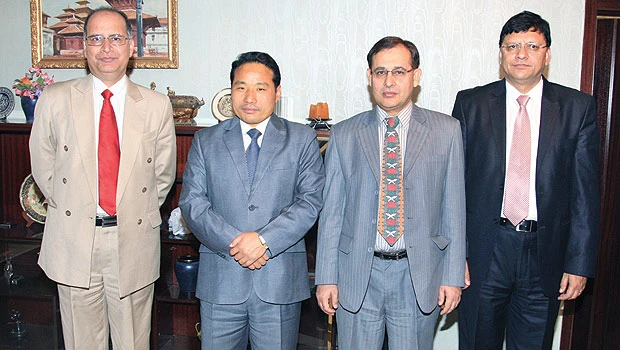
Addressing a press conference here Saturday, Nepali Finance Minister Barshaman Pun said his talks with Dr. Sulaiman Al-Turki, deputy minister responsible for international financial affairs at the Ministry of Finance, focused on a range of bilateral issues, including the need to fund some infrastructure projects in Nepal.
The Kingdom, he said, earlier financed some projects in his country, where several schemes in the fields of hydropower generation, road construction and river management are awaiting funding from donor states and international agencies.
The press briefing at the house of Nepali Ambassador Udaya Raj Pandey was attended by top Nepali diplomats and a number of other dignitaries. Harish Chandra Ghimire, deputy chief of the Nepali mission; Chandreshwar Acharya, labor attaché; and Umesh Kumar Mudvari, attaché, were also present.
Pun underlined the need to map out a comprehensive cooperation strategy, while seeking Saudi support in the fields of education, tourism and agriculture.
Asked about the details of the proposed vocational training center in Katmandu, the visiting minister pointed out this proposed Saudi-funded center would design a market-relevant curriculum in consultation with the Saudi business community to ensure that its graduates fit in the Saudi market well. "In fact, Nepal is keen to diversify its bilateral relations, as the demand for Nepalis coming to work in the Kingdom has increased over the past few years," he added.
He said his country has become one of the largest suppliers of manpower to the Kingdom. However, Saudi Arabia is yet to open its diplomatic mission in Katmandu. “We earnestly want the Saudi government to open its mission in Nepal, which will help a great deal in improving bilateral relations,” said Pun, while referring to his talks with Al-Turki. He said the absence of a Saudi embassy is causing a big hassle to everyone, especially migrant workers.
Over 600,000 Nepalis are currently working in Saudi Arabia, one of the most popular labor destinations for semi-skilled and unskilled Nepali workers. Nepal established its embassy in Saudi Arabia in 1978.
Pun said a number of workers, especially Nepali maids, face difficulties in the absence of an embassy and direct flights between Katmandu and the Saudi cities of Riyadh, Jeddah and Dammam.
If Saudi Arabia opens its embassy in Katmandu, then it will also help to facilitate the growing Umrah and Haj traffic from Nepal, he observed.
Of late, many Nepali women were stopped in India because as they did not have foreign employment permits from the Nepal government, he explained.
Moreover, a nexus of outsourcing agencies and agents in Nepal and India is involved in illegal recruitment practices ignoring regulatory provisions, said a Nepali diplomat present at the press conference.
Pun voiced his concern over the issue and said the number of illegal Nepali workers, especially maids, has gone up in Saudi Arabia. "Hence, I requested the Saudi side to give a special six-month amnesty for Nepali expatriates to be repatriated back to our country," said the minister. Many of the workers became "illegal" because of problems with their employers.
Pun said: "Nepal wants to send domestic helpers to Saudi Arabia, but without any hassle."
The number of Nepali maids in the Kingdom exceeds 70,000 at the moment.
Asked about plans to boost cooperation in the tourism sector, Pun pointed out Nepal has a lot to offer to Saudi Arabia and all Gulf countries. "Nepal is the land of Mount Everest, which fascinates everyone," said the minister, adding normalcy has returned to the country now after a period of unrest.
An investment board, chaired by the prime minister, has been constituted to attract foreign capital for major projects in Nepal, Pun said.