
- Commodore of the Union Castle fleet William Byles, captain of the venerable Royal Mail steamer Edinburgh Castle had his thumb on the fire alarm button.
- Through the ship, short bursts of clanging bells shrilled and skittered into the unconscious ears of a thousand or more sleepy passengers in the South Atlantic pre-dawn.
The ships intercom crackled into life with Byles’ gravelly voice. “On deck all of you. You won’t want to miss this.” Wrong Sir! We wanted to miss it — why not want to miss a fire?
As we passed up the companionways the crew were rather too relaxed for our taste. Thinking it just might be another one of the commodore’s little jokes — he was blessed with a tangential sense of humour when he got hold of a microphone — we stumbled grumbling onto the portside deck where we were greeted with a view of a necklace of lights suspended in the inky blackness.
In the still cold utter quiet of dawn, as the sky began to suggest grey-green first light, a huge rectangular slab of darkness above the necklace solidified into even darker reality. The passengers stared transfixed as around the edges of the emerging silhouette, the faintest green gave way to a gentle pink haze over the flat-topped shadow. In a matter of seconds the haze brightened into a glowing salmon-pink cloud, a ‘tablecloth’ spread across the top of the iconic Table Mountain. The sun rose out of our sight behind the monolith and glowing tendrils of mist that probed the lower reaches and reflected in the oily flat sea retreated and disappeared. In just a few minutes, the scene transformed into a backlit picture postcard that for many centuries has greeted seamen to the southern end of Africa.
Too soon, the transforming mirage and the tablecloth were gone, the rumbling of the engines restarted and we got under way. No one moved. For some, it was a moist-eyed moment of homecoming; for most of us, it was our unforgettable introduction to Africa.
So nearly 40 years after I had left the continent it was with a welling sense of anticipation that I craned toward the window of the aircraft to see that same fabulous mountain.
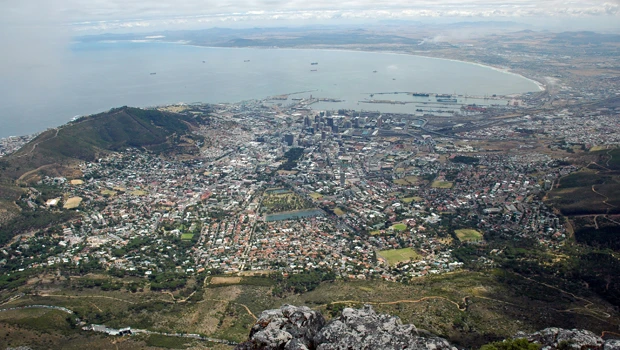
It was still there, unchanged and with a hint of the table-cloth draped over the plateau, 1,100 meters above sea level, with the city lapping against the mountain’s craggy flanks.
Once off the aircraft, the unchanging permanence of the mountain became the backdrop for a Western Cape Province and a South Africa that in every human aspect had changed out of all recognition.
The thick end of twenty years after the final demise of apartheid and the election of a majority government, the sleeves-rolled-up muscularity of the country is still very much in evidence. Now, however, everyone is involved and there is electricity in the air.
With the mountain forming a backdrop, the journey through the well-watered lushness of the Cape refreshes the soul after the arid deserts of Arabia. The agricultural area surrounding Cape Town is full of history, much of it evident in the unique Cape Dutch architecture.
In completely contrasting style is modern Cape Town. The glossy office blocks and redeveloped waterfront area have transformed the city into a vibrant and exciting place to be. Scattered among the office blocks and hotels are little gems of peace and quiet, all carefully preserved and incredibly clean. Many reminders of the city’s colorful and sometimes cruel past hide away in side streets and squares waiting for tourists to discover them. That is typical of the place; vastly different cultures and histories jostling in a glorious setting, reconciling with the past. Company Gardens with ancient trees, manicured lawns and shady bowers are littered with book reading students. In the largely Muslim Malay quarter, incandescently bright houses are restored and occupied. The minarets of mosques pop over the roofs of Cape Dutch houses — one mosque located in Church Street and another next to a Hindu temple — it is an eclectic mix of African, Asian and European cultures rubbing along comfortably together with a tangible purposefulness.
Muslims arrived in the Cape soon after the Dutch. They were brought in from Indonesia where the Dutch had vast interests. Cape Town’s first purpose built mosque, the Owal mosque, was opened in 1794. Now there are scores integrated into the community with the Muslim community getting along just fine. They really are having fun building their new nation.
The energy and work ethic that Europeans brought with them to the Cape 350 years ago has been carried forward into the new rainbow society who have taken to the new social structure with gusto.
Woven into the fabric of the society are reminders of what happened only half a century ago and with it, the implications of what might have been. Getting rid of the apartheid system and establishing an equitable society that works for all appears to have succeeded. A lasting monument to the giants — Mandela, Tutu, Sebukwe, Biko and hundreds of others — is the historical fact that the transition took place with almost no violence. A visit to Robben Island, the prison island 11 kilometers off Cape Town, is now a tourist must. It is also a very sobering experience. To see the miserable grey cells, barbed wire and slate covered grey walls of the prison and to ponder the fact that intelligent farsighted men were incarcerated in sight of one of most beautifully situated cities on the planet only generates wonder at the peace of the changeover. Respect and Reconciliation worked. It might have been Revenge instead, but it wasn’t.
Against half the world’s expectation, South Africans managed to teach an object lesson to other cultures with diametrically opposed beliefs, which live in lands delineated by geriatric colonial powers and seem unable to agree on the future. They should simply visit South Africa and look at the past. They need giants on whose shoulders they can stand, not the carping and conniving of dwarves and look for reconciliation, not retribution.
With their sleeves rolled up, the antipodean buzz is back and it looks like the new generation of South Africans can see the future as theirs. They are certainly out to make it work.