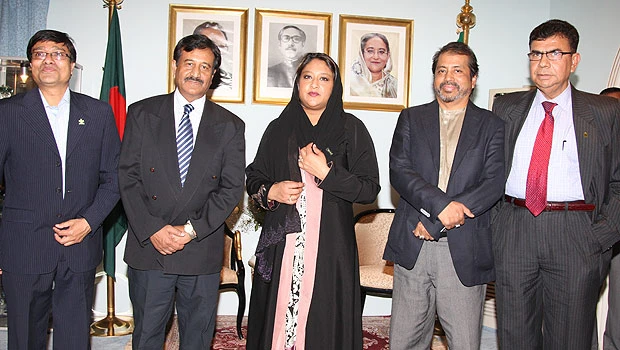
- Bangladesh has a lot to learn from the Kingdom's rich experience in the field of autism, said Saima Wajed Hossain, daughter of Bangladeshi Prime Minister Hasina Wajed, who wrapped up a five-day visit to the Kingdom last week.
Hossain, currently the chair of the National Advisory Committee on Autism in Bangladesh, was in Riyadh on an invitation from Princess Samira bint Abdullah Al-Faisal, head of the board of directors of the Saudi Society for Families of Autistic Children.
During her stay in Riyadh, she held talks with Princess Samira about the steps and challenges to be taken to address the problems of autistic children and their families in their respective countries. They also shared their experiences in the concerned field and expressed their desire to extend more services to mentally challenged children and their families in the Kingdom.
“Saudi Arabia has achieved a great deal in looking after autistic children,” Hossain said, pointing out that Princess Samira had done a great service through her organization over the last 17 years, which could be emulated by other countries. The princess’ charitable institution is geared to serve people with autism and their families.
Hossain pointed out that the Kingdom had adopted the US evidence-based model to treat autistic children as well as their parents. “The Kingdom has modified the model to suit the religious environment of the country,” she said, indicating that the modified version could be used in a Muslim country like Bangladesh, since the two countries share common religious and cultural values.
Hossain, a school psychologist, attended the global autism program in New York in 2008.
The King Faisal Specialist Hospital and Research Center (KFSH &RC) is conducting research on autism based on local experiences. “We would like to have similar programs in Bangladesh to deepen our knowledge and experience,” said Hossain.
More than 9 percent of children in Bangladesh, a country of 150 million people, have disability problems. Of them, two percent are estimated to suffer from autism.
Autism is a complex neurobiological disorder that inhibits a person's ability to communicate and develop social relationships. It is often accompanied by behavioral challenges. Autism spectrum disorders are diagnosed in one out of 110 children in the United States. The prevalence of autism has increased 600 percent in the past two decades. The Centers for Disease Control and Prevention has called autism a national public health crisis whose cause and cure remain unknown.
In July last year, Autism Speaks, the world’s largest autism science and advocacy organization, in collaboration with the Bangladesh government, the Centre for Neurodevelopment & Autism in Children and the Bangabandhu Sheikh Mujib Medical University hosted the first regional conference titled Autism Spectrum Disorders and Developmental Disabilities in Bangladesh and South East Asia.
"The World Health Organization also participated and provided technical support. The two-day conference brought together regional politicians, international organizations, and academics to discuss the current state of autism research and advocacy within the region as well as opportunities for future collaboration. The conference served to launch the South Asia Autism Network; a multinational network of governments, organizations and private citizens committed to combating autism throughout South Asia,” said Hossain.
At the conclusion of the conference Autism Speaks convened the first Advisory Board meeting of Global Autism Public Health (GAPH) Bangladesh. Autism Speaks Vice President of Scientific Affairs Andy Shih said, “GAPH Bangladesh made significant inroads toward crafting a strategic plan to implement a national needs assessment and to pilot awareness efforts. These are important first steps toward defining the scope of autism in Bangladesh and needs of the community.”
Suzanne and Bob Wright, the grandparents of a child with autism, founded Autism Speaks in February 2005. Since its inception, Autism Speaks has made enormous strides, committing over $160 million to research and developing innovative new resources for families. The organization is dedicated to funding research into the causes, prevention, treatments and a cure for autism, increasing awareness of autism spectrum disorders and advocating the needs of individuals with autism and their families. Autism Speaks’ international research and collaborations involve over thirty countries and the World Health Organization.
The Bangladeshi prime minister offers 100 percent cooperation to Hossain in all her activities toward serving autistic children. She said that she plans to set up a mental health center for autistic children in Dhaka under her grandfather's Bangabandhu Memorial Trust. “Such a center could coordinate the various countrywide services connected to autism,” said Hossain.
Hossain also visited Prince Faisal bin Fahd’s Mother Center for Autism and she had discussions with experts at the organization. During her visit, she also delivered a lecture on autism at a gathering of Bangladeshi Medical Professionals in the Riyadh Palace Hotel, where she advised the audience on how to take care of autistic children. In Riyadh, she visited the Prince Sultan Humanitarian City and also attended a seminar at the KFSH.
She said autism is a complex disorder, which has to be addressed from various angles such as education, awareness, research, family and welfare. A wide range of governmental and non-governmental assistance is necessary for the successful implementation. “We need the support of the Kingdom in the implementation of our programs in the field of exchange of expertise, research, training of professionals and in other fields to serve these less fortunate children in Bangladesh,” she concluded.