
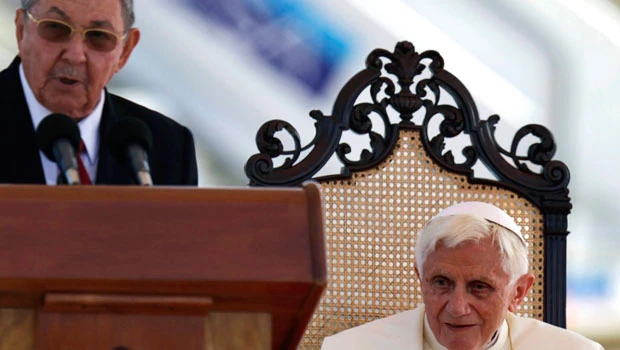
- SANTIAGO DE CUBA: Pope Benedict arrived in Cuba on Monday for a three-day visit to showcase improving Church-state relations and push for a larger Church role at a time of change on the communist island.
The pope was warmly greeted in the eastern city of Santiago de Cuba at the steps of his plane by Cuban President Raul
Castro, dressed in a dark suit, accompanied by a full Honor Guard and artillery gun salute.
Visiting 14 years after Pope John Paul II’s landmark trip to Cuba, Benedict will lead Masses in Santiago and in Havana before
flying home on Wednesday. He comes to Cuba at a time when Church-state relations have
warmed after decades of hostility that followed the island’s
1959 revolution.
In a brief arrival speech before heading off in the popemobile for a Mass in Santiago’s Revolution Square, Benedict
recalled the previous papal visit, saying it left “an indelible mark on the soul of all Cubans,” whether believers or not.
John Paul’s visit “was like a gentle breath of fresh air which gave new strength to the Church in Cuba,” the 84-year-old
pope said.
The 1998 visit had marked “a new phase” in Church-state relations, “in a spirit of cooperation and trust, even in many
areas in which greater progress can and ought to be made, especially as regards the indispensable public contribution that
religion is called to make in the life of society.”
In his welcoming remarks, Castro delivered a firm political lecture about the injustices of the United States’ hostility
toward Cuba, and the island’s “tenacious resistance” to preserve its independence and “follow its own path.”
The two men are due to meet for talks in the capital Havana on Tuesday, after the pope visits the figurine of the Virgin of
Charity, Cuba’s patron, at a basilica in El Cobre near Santiago.
After years of Church-state hostility following Cuba’s 1959 revolution, Castro has used the Church as an interlocutor on
issues such as political prisoners and dissidents, while moving forward with reforms to Cuba’s struggling Soviet-style economy.
They include slashing a million government jobs and freeing up some sectors to small-scale private enterprise.
Benedict, who visited Mexico over the weekend, will try to cement those gains in Cuba and offer more help from the Church
in assuring that whatever transition comes is buffered by its social programs, such as care centers for the elderly and
limited after-school and adult education programs.
It has supported Castro’s reforms and urged him to move farther and faster in modernizing Cuba, both economically and
politically.
Benedict fired an unexpected salvo on Friday when he said communism in Cuba had failed and a new economic model was
needed, adding that the Church was willing to offer its help “to
avoid traumas.”
The Cuban government offered a diplomatic response to the Pope’s criticism, saying that Cuba would “listen with all
respect” to the Pope and welcomed “the exchange of ideas.”
In his arrival remarks on Monday the pope was less direct in his criticism of Cuba’s one-party political system, although he
did offer some thinly veiled phrases addressing Cuba’s hotly debated human rights records.
“I carry in my heart the just aspirations and legitimate desires of all Cubans, wherever they may be,” he said, including
the “sufferings” of prisoners and their families, a reference likely to be well received by political dissidents on the island
as well as Cuban American exiles in the United States.
In a clear effort to balance his remarks, Benedict made an apparent dig at capitalist greed, blaming the global economic
crisis on “the ambition and selfishness of certain powers which take little account of the true good of individuals and
families.”
Cuba was going through a key moment in its history,“ Benedict said, hinting that with the advancing age of the Castro
brothers the island was “already looking to the future.”
Echoing the words of Pope John Paul who in 1998 urged Cuba to “open itself up to the world,” and “the world to open itself
up to Cuba,” Benedict also recognized that Cuba was making an effort to “renew and broaden its horizons.”
Church officials say Benedict’s schedule has not allowed for meetings with dissidents, who say Castro’s government flouts
human rights and suppresses their voices.
The dissident movement Damas de Blanco, or Ladies in White, a group of Catholic women that campaigns for the release of
political prisoners, said it had been told by Cuban authorities to keep clear of the pope’s Mass in Santiago.
“They are going to present the pope with a facade, not with the true Cuba,” said Ana Celia Rodriguez, a 42-year-old mother
of three who is planning to try to attend anyway. “I really don’t expect much change from the pope’s visit.
He’ll see a Cuba that doesn’t exist. My message for the pope is that he ought to see how things really are.”
More than 70 members of the Ladies in White were detained briefly last week, fueling concerns that the government, which
views opponents as mercenaries of the United States, might clamp down to prevent public demonstrations during the pope’s stay.
While many Cubans complain about the failings of the socialist economy, not everyone agrees with the Pope’s bleak
assessment of Cuban communism. “We’re so happy the Pope is coming, it makes us feel as
though the world is noticing us,” said Alejandro Linares, a 23-year-old university student from the eastern province of
Guantanamo, a small image of revolutionary icon Ernesto ‘Che’ Guevara dangling around his neck.
“We want him to see our Cuba. We want him to see that we live pretty well here and that we want to be socialist, not
capitalist.”
Earlier on Monday two airplanes arrived in Santiago from Miami carrying 310 mostly Cuban American faithful on a special
Church-organized package to attend the papal Masses. The Miami pilgrims brought a message of reconciliation, said the
Archbishop of Miami, Thomas Wenski. “It’s important that we overcome the resentments and hatred of the past,” he said.