
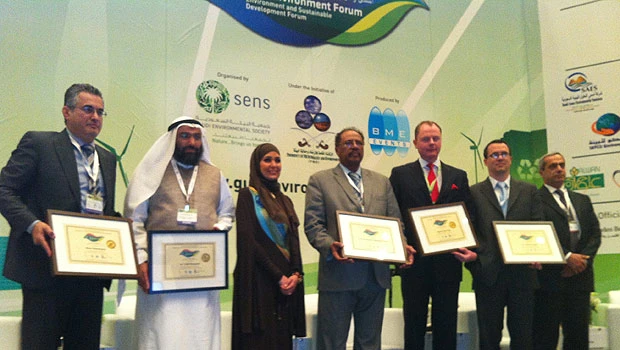
- The 2012 Gulf Environmental and Sustainable Development Forum (GEF) dedicated ample space on its closing day to the analysis of advanced water strategies and reuse in the MENA region.
President and Vice Chairman of Saudi Asma Environmental Solutions (SAES) Fadil Basyyoni, Advisory Board Member of the German Seawater Desalination Association (DME) Robert Flaechsig, Managing Director of DESERTEC Foundation (Germany) Thiemo Gropp and CEO of Suido Kiko Middle East Nizar Kammourie gave presentations with case studies to highlight the most advanced strategies for safe and eco-friendly potable water production.
Basyyoni opened the session stressing Saudi Arabia’s leading role as desalinated water producer and the country’s absolute need to preserve its scarce water resources due to the low average of annual rainfall and high evaporations. He then focused his intervention on the evaluation of potable water quality in building storage tanks and presented data from several studies implemented by SAES between 2007-2011.
“We collected 1,000 drinking water samples: Desalinated water from distribution points and truck tanks and drinking water from building storage tanks in urbanized and non urbanized areas. Water samples collected from truck tanks showed higher values of TDS, EC, turbidity, and nitrate due to the tanks’ inappropriate materials and poor maintenance. Also, drinking water samples collected from house storage tanks in non-urbanized districts showed higher values for all tested parameters,” explained Basyyoni.
Among the urgent actions required to ensure water quality, Basyyoni mentioned the necessity to ensure a better coordination between governmental authorities and adopt a pollution prevention program, effective monitoring procedures, strict regulations for water service vendors, best available techniques for truck tanks, efficient drinking water distribution pipe network, standard storage tank codes, awareness programs, and installation and maintenance of household plumbing systems.
The objective of Flaechsig’s presentation was to describe desalination strategies and technologies for potable water in the MENA region and outline Saudi Arabia’s urge to design the right solutions that will ensure quality living and national wealth for the generations to come.
“Population growth and development are causing water supply shortages and Saudi Arabia is in the heart of the most seriously affected zone. More, in general, all the countries in the MENA region are in urgent need to implement sustainable supply and demand management methods,” said Flaechsig.
“Mathematical models, taking various parameters and variables into account (cost, supply and demand types, minimum flow requirements, storage capacity), are at the core of decision-support systems for optimizing water allocation and management,” he added.
“Sun and land power are the other two assets available in the MENA region. The production of drinkable water through desalination is possible with a variety of technologies for large-scale and small power plants. In the MENA region the main solar technologies will be Photovoltaic and Concentrated Solar Power (CSP),” he said.
The issue related to the use of solar and renewable energies for water production was efficaciously handled by Gropp, managing director of DESERTEC, an independent foundation aiming at ensuring energy and climate security, resources supplies and socioeconomic development by addressing the civil society and the political, industrial and scientific community.
Gropp reminded the audience of the important challenges the world has to face from energy security to war for resources and climate change. He also highlighted Saudi Arabia’s potential to become a global leader in the transition to renewables and the production of drinking water from desalination of seawater by solar energy.
“One sq km of desert land using concentrated solar thermal power can produce up to 250 million kWh/year of electricity and 60 million m3/year of desalinated seawater,” explained Gropp.
“Solar energy in desert areas is highly abundant compared to fossil and nuclear resources. Saudi Arabia could sell all its oil on the world market instead of partially burning it on air conditioning, heating, transportation and desalination processes. The revenues could be used to finance the transition to renewables (mainly PV and CSP) and become a global leader in this field,” he added.
Kammourie contributed to the discussion and closed the session explaining all the procedures that since July 2011 led to the clean up of Nazeem Sewage Lake, a site 40 km east of Riyadh that has been used to receive domestic and industrial wastewater tankers during the last 20 years.
Covering a total area of 5.8 million sq m, the environmental project was considered one of the largest in the region.