
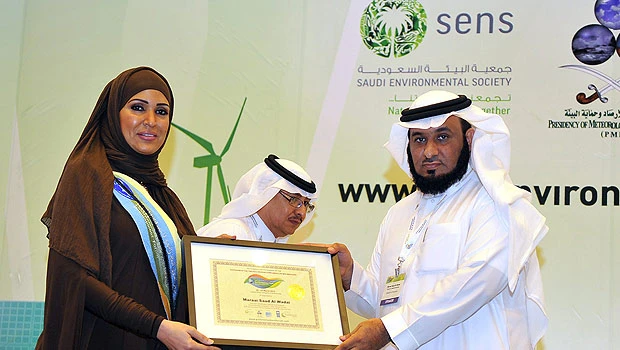
- JEDDAH: Curtains were drawn on the 3rd Gulf Environment Forum (GEF 2012) in Jeddah yesterday, with a roundtable networking session on the ‘Road to the 2012 Rio Earth Summit.’
The Presidency of Meteorology & Environment hosted the forum in preparation for participating in the Earth Summit, also called the Rio+20, in Rio de Janeiro later this year.
The day’s earlier sessions focused on ensuring the economic viability of alternative methods of energy generation in the Gulf region and also a reduction of emissions from the prevailing methods; establishing environmental awareness as a key learning objective in the region’s education system; advanced water strategies and reuse in the Middle East North Africa (MENA) region; and green innovation in this part of the world.
A questioner appeared to be quizzing the panelists on the issue related to alternative sources of energy when he said there had been no progress on exploring solar energy. “Which is our alternative source of energy, is it nuclear or solar,” he asked and recalled a symposium he attended in 1982 when it was strongly indicated that solar would be the alternative energy source and the Kingdom would start exporting it by 1992. “There is as yet no definite move in this regard,” he said. “Do you want to pursue nuclear energy as the alternative source after the recent nuclear disaster in Japan,” he asked.
“We should consider solar as the alternative energy source as it is in abundance in the Kingdom,” he said.
The panelists agreed with the questioner that the Kingdom is the best for developing solar energy, which is also in the interest of the environment.
Abdulrahman Jastaniah, environment protection division manager at Saudi Electricity Company (SEC), spoke about setting and translating environmental policy into an effective strategic plan to ensure a successful environmental management system at the company.
With its 70 power plants and 4,000 substations, SEC is successfully meeting the challenges posed by rising electricity demand and promoting energy saving, thanks to its own environment policy and dedicated team of environmentalists.
“We have brought about a five percent reduction in electricity and also that of water consumption at our SEC facilities. By the same token, we increased greenery around them by several percentage points,” he said, adding that 800 of the company employees have been trained in environment. One measure that paid off was we integrated the environment system into the contract system.”
Naif M. Al-Abbadi, director general, Saudi Energy Efficiency Center, King Abdulaziz City for Science and Technology (KACST), speaking on “Energy efficiency: A source of energy and emission abatement,” said if there had been no energy efficiency programs, 60 percent energy would have been consumed more than its present level.
He said the Kingdom’s visionary holistic national energy efficiency program would go a long way in both limiting the consumption of energy and promoting the environment.
Maher Alodan, consultant, research, development and innovation at King Abdullah City for Atomic and Renewable Energy (KACARE), discussed the implications of the Kingdom’s renewable energy program to the environment.
Majdah Aburas, assistant professor of environmental biotechnology and microbiology at the faculty of science of King Abdulaziz University and board member and deputy executive director of Saudi Environmental Society (SENS), chairing a session said establishing environmental awareness was a key learning objective in the Gulf’s education system.
She outlined the various campaigns and programs run by the society, which is a national non-profit society run under the leadership of Prince Turki bin Nasser, president of the Presidency of Meteorology and Environment (PME).
Prince Turki addressed the GEF’s opening ceremony on Sunday, along with Prince Abdulaziz bin Salman, assistant minister for petroleum affairs at the Ministry of Petroleum & Mineral Resources, and Egyptian Minister for Environmental Affairs Mustafa Hussain Kamel Ahmed.
Prince Turki said the PME hosted the GEF 2012 in preparation for participating in the June 20-22 Rio Earth Summit, which is also referred to as the Rio+20 due to the initial conference held in Rio de Janeiro in 1992. The objectives of the summit are to secure renewed political commitment to sustainable development, assess progress toward internationally agreed goals on sustainable development and to address new and emerging challenges.
The summit will also focus on two specific themes: A green economy in the context of poverty eradication and sustainable development, and an institutional framework for sustainable development.
Prince Turki also opened an exhibition held on the sidelines of the conference.
Among the exhibitors were national and international companies adhering to the highest national and international environmental standards for their projects.
They included Royal Commission for Jubail and Yanbu, Maaden (Saudi Arabian Mining Company), Saudi Electricity Company (SEC) and Saudi Geological Survey (SGS), aside from United Nations Developing Program (UNDP).