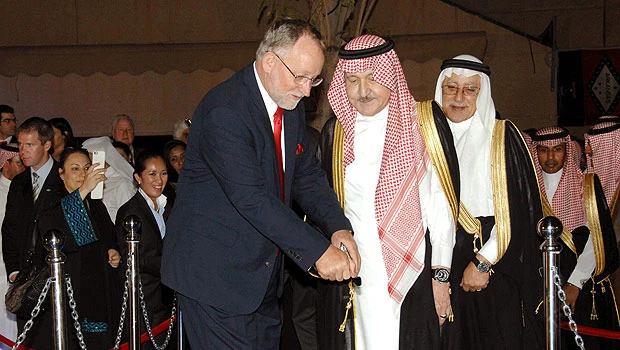
- Americans and other invitees marked America’s 236th Independence Day celebrations held here on Monday.
- Riyadh Gov.
The reception was hosted by US Ambassador James B. Smith and his wife Dr. Janet Breslin Smith at their Quincy House residence in the Diplomatic Quarter.
Members of the diplomatic corps, senior government officials including Deputy Foreign Minister for Protocol Affairs Alauddin Askary were also present.
A musical group entertained the guests before and after the speech-making ceremony. Introducing the chief guest to the audience,
Smith said Prince Sattam is a great friend of America. “He is someone we look to advice and wisdom in the Kingdom,” the envoy said.
He said Saudi-US bilateral relations are growing from strength to strength. Trade delegations are regularly organized for mutual benefits. Last year, he said bilateral trade increased by 25 percent and during the past two years 238 American companies have exported their goods and services for the first time.
The US Fish and Wildlife Service is partnering with the Saudi Wildlife Authority to exchange conservation techniques for protected natural areas. This year, the US Embassy will coordinate visits by Fish and Wildlife Service officials for multiweek training programs with SWA officials on managing protected areas particularly grazing habitat and fisheries.
“You will see that we both share open expanses, sands of many hues, and the great bodies of water that beckon us to our shores.”
For those of you who have not had the opportunity to experience the Saudi wildlife protected areas or the National Parks of the United States, the envoy encouraged them to do so.
“Janet and I have certainly had a wonderful time exploring the many riches that Saudi Arabia has to offer as we have traveled extensively around the Kingdom,” he noted.
“Janet and I are truly honored to be a part of the enduring partnership between the United States and the Kingdom of Saudi Arabia. It has been an endlessly fascinating time here so far,” he added.
In his speech, Prince Bandar said that the US and the Kingdom work hand in hand in the field of biodiversity. “Saving biodiversity is saving humanity and also saving mother earth,” the prince said.
He said that the SWA under its Saudi System Planning, has been operating 16 protected areas at present which include three marine reserves.
He said that the SWA has been conducting a successful breeding program which had enabled the authority to breed some endangered species such as Arabian oryx, and gazelles and houbara bustard.
He recalled that the United States helped the Kingdom to bring back an Arabian oryx from the Santiago zoological gardens under the breeding program.
“Since then, we have re-introduced a number of species into the wild under the breeding program carried out in National Wildlife Center in Taif and at the King Khaled Research Center in Thumamah, located in the outskirts of the capital.