
- Plenty of sun, the most delicious tapas along with passionate flamenco dancing and music, wrapped in a laid-back lifestyle — all stereotypes about Spain thrive in the Andalusian city of Seville
. The city’s charm lies in the numerous civilizations that inhabited the area throughout history and all left their footmark. Seville flourished during the reign of the Tartessians and the Romans, under the Arab influence as well as after Christopher Columbus discovered America. Its prosperity saw a decline in the 17th century, but revived in the two following centuries and has remained up till now. When visiting the fourth largest city in Spain, located in the southwest of the country, one will find the appealing remains of most of these civilizations.
Roman Empire
According to historians, the Seville area was first inhabited by the Tartessians, Phoenicians and Greeks, whose descendants created a city on the shores of the Baetis river, nowadays known as the Guadalquivir river (from the Arabic “Wadi Al-Kabir” or “big river”), and called it Ispal. Little remains from this period of history. The city was later occupied by the Carthaginians, originating from present-day Tunisia, who in their turn were defeated by the Romans. The latter built roads, aqueducts and bridges, created irrigation systems and sewers and altered the name of the city to Hispalis. The area became an important trade center.
Seville recently opened an “Antiquarium” where on-site discovered Roman remains of the city are shown, including streets, sewage system, and mosaic floors and walls. The Antiquarium is part of an enormous wooden building — supposedly the biggest wooden structure worldwide — named “Metropol Parasol.” The building was only completed in April 2011, but has already become a tourist attraction and important meeting point in the center of the city, as it also houses the Central Market, a big square with performance terrace, and on top of it a restaurant and panoramic walkway, which offers splendid views of Seville.
Al-Ándalus
In 410 AD, barbarians invaded the Roman Empire, and Seville was eventually conquered by the Visigoths. During their reign, the city became an important cultural center of the West, but tensions between the Visigoth kings and the Catholic Church as well as succession disputes led to the opposition forging a pact with North African Muslim Gov. Musa ibn Nusair and the entering of Moorish and Arab troops in Iberia three centuries later. Within two years, these troops had conquered Seville, which they renamed Ishbiliah, and the Moorish presence would result in a new period of prosperity.
There are numerous alluring remains of this era. In fact, at first glance, Seville reminisces a One-Thousand-and-One-Nights tale, although most Moorish-style buildings were actually created by “Mudéjares” or Muslims under Christian rule. The most obvious Moorish remains are parts of the Alcázar, a Moorish fort that was later transformed into a palace. Although the royal palace is still in use, big part of it is open to public. Take your time when going there, as one can spend several hours wandering around the numerous chambers in Muslim, Mudéjar and Christian architectural styles as well as the lush green and fragrant gardens decorated with ponds and fountains. Both the palace and the gardens provide a pleasantly cool haven from the scorching sun most of the year.
The second Moorish landmark in Seville is the Giralda, the former minaret of the city’s grand mosque that was later transformed into a bell tower for the cathedral built under Christian rule. Construction of the Giralda was completed in 1198 by the Almohad Dynasty, and the tower, a copy of the Koutoubia Mosque minaret in Marrakesh, Morocco, is one of the few remaining Almohad minarets in the world. Besides climbing the stairs to the top of the tower, which provides a magnificent view over the old city center, the cathedral that replaced the ruins of the grand mosque and still keeps some Arab elements, such as the “Orange Tree Courtyard,” deserves a visit too. It is not only one of the biggest cathedrals in the world — some claim the third largest — but reportedly also contains the final resting place of Christopher Columbus.
The Golden Age
The end of the Muslim rule in 1248 did not make an end to Seville’s fortune. In fact, the city experienced its Golden Age a couple of centuries later. By the end of the 15th century, Christopher Columbus’ journey to America was planned in the Royal Alcázar Palace. Following the discovery and occupation of big part of South and Central America, Spain’s trade relations with its overseas territories were administered by the Seville-based Casa de Contratación or Chamber of Commerce, and everyone who wanted to travel to the new continent had to go from Seville. This monopoly on the trade relations as well as the wealth coming from the Americas made Seville the most prosperous city of Spain. Although the chamber was not located in one building, its documents — including Columbus’ journal — can now be seen at the Archivo de los Indios. Like the Alcázar and the Cathedral, the archive is listed as a UNESCO Heritage Site.
Contemporary Seville
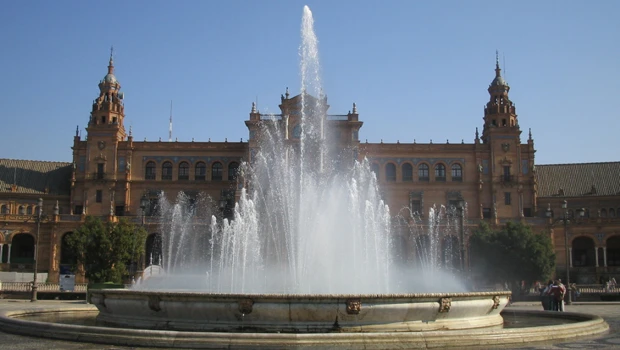
Seville lost its monopoly by the end of the 16th century, and the following decades saw a decline in the city’s wealth. The India fleet was moved to Cádiz, and soon after the Chamber of Commerce went there as well. However, Seville kept its monopoly on tobacco, and a big tobacco plant — the first in Europe — was built. Nowadays, the impressive baroque building houses Seville University and its interior, filled with fountains and patios, is unquestionably worth a visit. During the 20th century, the city hosted two important expositions: the Ibero-American World’s Fair in 1929 and the World Expo in 1992. For the former, the magnificent Plaza de España and adjacent Parque de María Luisa were created. The recently renovated Square of Spain is decorated with ceramic tiles, four bridges and a big fountain. It is a popular place among tourists, who stroll along the 52 benches representing the Spanish provinces or hire a boat to row down the canal.
The green María Luisa Park is rich in plant and bird species and serves as a botanical garden. Its romantic design was inspired by the Moorish gardens of Seville’s Alcázar and the Alhambra in Granada. The numerous ponds, fountains, benches, corners and birds make the park a popular hideout among young couples. Its rich vegetation, in addition, makes the park a welcome escape from the summer sun and heat. The Sevillanos continue to be a progressive people. In the last few years, the city’s municipality has been working on making the city “future-proof” by improving its infrastructure and making the city more sustainable. The city saw the creation of extensive pedestrian areas, 120 km of bike lanes, a tram, metro, and a community bicycle program with 250 parking stations.
All this, in addition to the city’s world-famous flamenco shows, mouthwatering tapas and the labyrinthine Santa Cruz neighborhood with its whitewashed houses and green patios full of orange trees will even enchant the most demanding tourist.
Where to stay: Located in the center, Barrio de Santa Cruz is the most charming neighborhood in town. When the Christians conquered the city from its Muslim rulers, this neighborhood was transformed into the Jewish quarter. Its tangled streets and alleys are filled with souvenir shops, restaurants and bars that often carry out live flamenco shows.
What to eat: Start your day with the typical Spanish breakfast “churros con chocolate” or fried-dough pastry dipped in thick, hot chocolate in one of the coffee bars in Santa Cruz. For lunch, order a paella, a dish of rice, saffron, seafood and/or chicken. As in Saudi Arabia, lunch is traditionally the most important and biggest meal of the day in Spain. Most Sevillanos eat tapas — small savory dishes — for dinner, while going from one bar to another. There is a great variety of choices, but local specialties include fried squid rings and pescaíto frito or fried fish, gazpacho (a cold soup made from tomatoes and other vegetables and spices) and tortilla (a thick omelet with potato and onion).
How to get there: Unfortunately, there are no direct flights from any Saudi Arabian city to Seville. The best way to get there is by flying to Madrid and taking a domestic flight to Seville from there. An alternative is to fly to Málaga and take from there a train or bus to Seville.