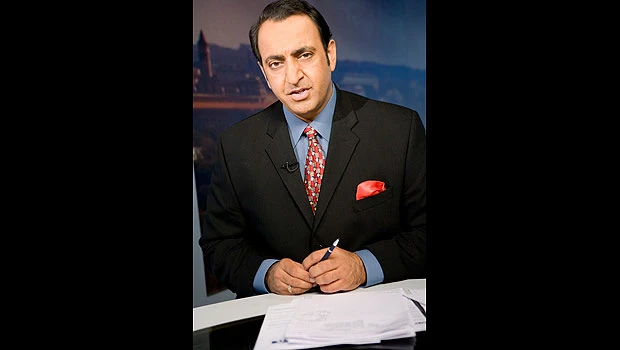
- Veteran journalist and TV presenter Riz Khan needs no introduction.
- He became every South Asian household’s news poster-boy, when he first graced the news screen of BBC in the late 80s.
Born in Aden to an Indian born-Pakistan migrated father and Yemeni mother with Indian roots, he was raised and schooled in Great Britain, while speaking Arabic as first language. A medical physiology graduate who veered toward journalism by a strange twist of fate, his is a personality as colorful as his background and he has since traveled far while making news.
He was recruited as senior anchor for CNN International in 1993 following a successful stint with BBC and later was approached to launch Al Jazeera English in 2006. His acclaimed interactive shows like Q&A with Riz Khan on CNN and One on One with Riz Khan on Al Jazeera bestowed him celebrity-status while he hosted news-making politicians, sports-persons, movie-stars and rock-stars on the hot seat. Currently based in Washington, Riz has been moderating many prominent, high-profile gatherings that have included the World Economic Forum in Davos, UN Human Rights Council, Clinton Global Forum among many others and was featured on the list of World Thinkers 2011 last November at the Festival of Thinkers in the UAE.
A man with a star-studded career profile and no less a creative bone, he continues to surf unchartered waters while hitting the big 50!
He recently moderated the Jeddah Economic Forum 2012 and we cornered him for a quick chat. The excerpts.
I was in a single parent family and couldn’t afford to continue post-graduate studies. The only way I could have paid was if I went out and made some money. So I went to a careers office for the first time in my life, as I always knew I wanted to be a doctor since I was six years old. The counselor thought my English was pretty good to consider journalism. As it happened, a small college was starting a radio journalism course and they asked me to submit a 200-word essay on why I would make a good radio journalist and to record it.
Sometime ago, I played it back and I thought, “…oh God, I sounded like an idiot!” They must have had bigger idiots because they took me in the course. I then got into BBC, but the pay was so bad that I could never save up the money.
Not the best way to put it, but it feels more relaxed. It feels like people know they need to take steps toward modernization. They feel less worried talking about women driving for example. It’s interesting that a lot of people in the West don’t realize how dynamic, educated, capable and societally functional women are in Saudi Arabia. They imagine them locked away in a dark room somewhere having secret women’s parties not knowing what goes on in their world, and I say that with irony. Saudi women by and large, at least the ones I meet are incredibly articulate and opinionated on things they don’t have problems expressing. So I think that overall there is a misunderstanding in the West and I think it’s a good thing the debate has come out. It just shows that the society is more willing to discuss issues that have been touchy until now.
It was quite interesting how it happened actually. I first met him at a strategy forum in Dubai. I interviewed him on stage and that was my first encounter with him. I was very impressed with how he was this unique blend between the East and West, articulate and super-energetic. I requested for an interview with him and that turned into a plan for a film documentary which went on and off for a year and a half and then turned into a book because there was so much material and there was no other way to do it. It was a kind of roller-coaster that went from being an interview into a book over a period of time. It kind of evolved.
I have a lot of respect for him. I find him remarkable and incredibly misunderstood. There’s a lot of jealousy and negativity because of his success, but really, he’s the hardest working person I have ever come across. Perhaps the only guy who advises his advisers, the guy is a dynamo. He actually is a very principled man, eccentric in some ways, but he probably won’t like me calling him that, but I say it in a positive way. I have spent a good amount of time with him and I have seen him pray 5 times a day, not drinking or womanizing, just focused on his business.
Of course, there are times I think he should do things differently especially with the way he engages with the media, because sometimes, he lets bad stories slip through the Internet and they shouldn’t. And that frustrates me purely out of a sincere dislike of people getting misinformation. I don’t have any connection with him other than occasionally bumping into him. We have no business relationship and I have no reason to promote him. I wrote his biography and that was it.
When I was doing breaking news at news channels, I would constantly say, “we interrupt our programming”, on an hourly basis. The way we would constantly break into the programs to bring live breaking news, which is everyone’s obsession in the news industry, as you know. I then thought it would be a great title for a book.
But really, what I wanted to do was poke fun at the industry although it’s a very serious business. I wanted to let people laugh because many in the news industry take themselves very seriously although it’s the job they should be taking seriously. I know of friends where the job took a wear and tear on their lives. I respect them a lot for being on the frontlines. These brilliant people are the people who deserve credit. I was blessed to be on the softer end while they were on the toughest.
Currently, the book is available as an e-book. The proceeds from sales are going to a charity called The World Is Just A Book Away. It will benefit run down areas in Indonesia that will be turned into libraries. The initiative is spreading further.
There are a lot of people who don’t yet fully recognize the power of the Internet. Yes, conventional television is dying. Today everyone has recording equipment, the content being generated is phenomenal, so the platforms for that content has grown. What’s happened through the Internet and cellular communication is that we’ve become so inter-connected with access to information on demand and transfer of content in real time that all this has changed traditional viewing.
Well you know it’s hard because it really depends on how I’m feeling at the moment to think of a particular person. Sometimes, it’s the non-famous people who are out of the public exposure yet doing something on a grand scale who are truly inspiring. I always treat people as people no matter how powerful or famous they are but of course I admire their achievements. For instance, Uri Geller. I’ve read about parapsychology as a young kid and having him on the show was very inspiring.
I’m hoping I’ll get to do something interesting on television, if not, I have a million other ideas already. Doing daily live shows is tough and without the right resources it’s tiring and I’m at the stage that if I do it, I want to do it properly.
When I was younger I taught myself the drums because I couldn’t afford piano lessons. It’s quite bizarre that I did end up playing the drums at a Michael Jackson refugee concert in Munich in 2000 with A.R. Rahman.
I don’t like to look at myself as a serious anything. I can’t do that for a living because if I did, I wouldn’t enjoy it. It’s nice as a hobby. I enjoy the diversity of my life in that respect. Being blessed with travel I’m lucky because I get to experience other cultures, it brings me in touch with new music, new flavors. But of course, writing I’d like to carry on professionally because I enjoy it more.
It certainly helped my confidence. I was a very shy youngster and I still can’t just go chat people up. Talking in public was a great education. You must go with your strengths and handle your weaknesses, but, don’t try to do something you’re not.
You know I always come across new things. I always said I’d want to release an album, write a book and make a movie. If I had been a doctor that would have never happened. I’ve written two books so far, I think I’d like to direct a movie.
Firstly, thank you for paying attention to my shows. You are the people I do it for. I’m really happy to get positive feedback from the people who have been watching me and that they care about the subjects I have been covering in my shows. I was the first South Asian to be doing mainstream news on BBC. You know, suddenly a brown man appears and everybody’s curious. Until this day, I get a lot of Indians and Pakistanis who come up and say to me that they tell their parents, “… if he can do it, then I can do it”, which makes me feel good. Thanks for taking the trouble to follow my work. It’s a blessing I’ve had. I’m very lucky.