
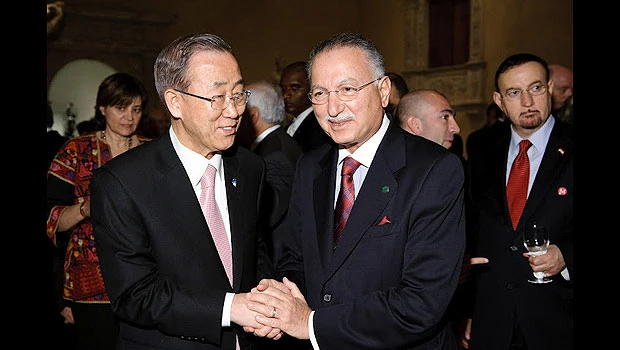
- UN Secretary-General Ban Ki-moon joined OIC Secretary-General Ekmeleddin Ihsanoglu at a reception on March 16 to celebrate the New York Metropolitan Museum’s new galleries for the Art of the Arab lands, Turkey, Iran, Central Asia and later South Asia.
In his welcoming address, Ihsanoglu said, “We should all congratulate the Metropolitan Museum and all those who have contributed to this achievement for their dedicated efforts to Islam’s rich past and the grandeur of its civilization. It spans many continents and different parts of the world are being exhibited here in the most elegant and professional manner.” He added, “I believe it is high time for the nations and peoples representing the Islamic heritage and those representing the Judeo-Christian traditions to continue to set aside their differences and to work together towards developing a culture of mutual understanding, respect and dialogue, built on the commonalities and shared values.”
The museum's President Emily K. Rafferty explained that the suite of 15 galleries showcases works from 22 countries and traces the full course of Islamic civilization, over a span of 14 centuries, from the Middle East to North Africa, Europe, and Central and South Asia.
UN Secretary-General Ban Ki-moon told the audience that the new galleries are a “treasure within a treasure. Ours is a world with ample opportunity for cross-cultural connection. Trade, travel, the Internet, these can bring people together across distances and lines of identity that might otherwise divide us. And yet, all too often, stereotypes and suspicions take hold while layers of misunderstanding stay in place. These galleries are part of the antidote.”
He said the displays “celebrate beauty, art, craft and design in their full glory. What stands out for me is the devotion that courses through every item on display. No matter what the medium – tile or textile, manuscript or metal – the intricacy is remarkable. It all draws you in, closer and closer. The detail almost defies belief.”
The galleries, he indicated, showcase the “remarkable diversity of thought and tradition within Islam, a counterpoint to the unfortunate tendency to view the Islamic world as a monolith. They also offer a window not only onto the past, but onto a world we all must understand today as part of our global mission of peaceful coexistence.”
Sheila Canby, curator, in charge of the Department of Islamic Art at the museum elaborated by saying, “We celebrate the ingenious ways artists from the 7th to the 20th century have used Arabic script and the geometric and vine scroll patterns in objects produced across the Islamic world.”
She expressed hope that the galleries and the art they contain would inspire and remind the visitors of the “great civilizations that have thrived within Islam.”
Highlights of the museum's collection include early and medieval Qur'ans, glass carafes, metalwork, woodwork, ceramics, paintings, architectural elements and carpets from Egypt, Syria, Iraq and Iran.