
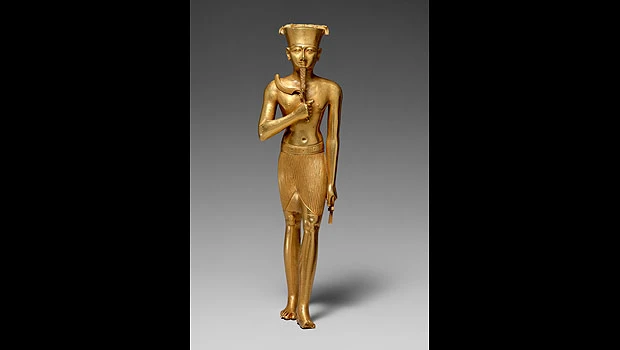
- A jewel-box mansion in the middle of Paris holds an outstanding exhibition that brings together, for the first time, precious treasures from the last Egyptian Pharaonic dynasties.
The exhibition not only breaks new ground in the field of Pharaonic works of art, but refutes the previously accepted academic assumption that there was a decline in the artistic output at the end of the Egyptian Pharaonic dynasties.
Never before has such an exhibition of artifacts — so exquisite and so rare — been assembled under one roof. They are gathered from the most significant international collections of Egyptian antiquities, from museums around the world to hitherto unseen treasures from private collections.
These masterpieces, which date from the last thousand years of Pharaonic history (1069-30 BC), are on display until July at the Jacquemart-André Museum in Paris.
“The Twilight of the Pharaohs, Masterpieces from the last Egyptian Dynasties” is a unique collection that includes an assortment of the world’s finest sculptures, reliefs, sarcophagi, death masks, items of worship and jewelry from tombs and temples.
The curator of the exhibition, Oliver Perdu, an Egyptologist from the College de France and a renowned specialist in the Late Period of Ancient Egypt, took seven years to select and assemble the pieces for the exhibit.
Perdu, whose name ironically means “lost” in French, has spent his lifetime searching for lost and rare Egyptian works of art.
One example is a rare alabaster female figurine from the Louvre, which the curator said he found “badly stocked” in the belly of the museum. “It was cleaned and will now be on permanent display there.”
The masterpieces recount the rich artistic talent in Egypt over the ten centuries of invasions by Libyan, Nubian, Persian, Greek and Roman influence before the Greeks finally took over with the conquest of Alexander the Great in 332 BC.
Although an unstable period militarily and politically, Egyptian art with its long Pharaonic tradition continued under the new foreign rulers.
Previously viewed as a time of decline, it actually was a period of outstanding artistic revival.
“It is very important that we surprise the public with this exhibition,” Perdu told Arab News. “The surprise is that, although the end of the Ramses period was marked by invasions, the exhibit proves that the period did not go directly into decline, as previously thought.”
Perdu has collected the period’s exceptional masterpieces, such as the gold statuette of Amun. “The statue is one of the largest effigies in solid gold ever found in Egypt,” said Perdu. “It is small but exquisitely detailed, and under the stand are three columns of hieroglyphics. This piece was accidently found while digging through the rubbish heap in the temple of Heracleopolis, south of Fayoum.”
Also present is the effigy of Bastet in the form of a cat, known as the “Gayer Anderson Cat”, from the British Museum. “The Gayer Anderson cat has never before left the British Museum,” Perdu said proudly.
“All the museums spoiled us. They gave us their beautiful pieces. Usually one gets about one-third of what they ask for when they want some loans, but we got almost all we asked from them,” said the exhibition’s curator.
The most popular display in the exhibition, says Perdu, is the “Portrait Gallery”, the depiction of faces by Egyptian sculptures. These include rounded juvenile features and — unique to this period in Egyptian Pharaonic history — older faces with realistic wrinkles and lines.
“These are some of the most exquisite pieces in the exhibition, the ‘chefs d’oeuvres’ of the ‘chefs d’oeuvres’”, said Perdu. “Their faces are very expressive; some have smiles on their faces. They are masterpieces. Just imagine how the complete statue must have looked.” Included here is the renowned “Green Head” from Berlin, an undisputed masterpiece of Egyptian art.
Twilight of the Pharaohs is an absolute must-see, and is an opportunity to discover one of Paris’ most wonderful museums. While there, also be sure to have lunch or tea in the mansion’s former dining room. The Jacquemart-André café is one of the most beautiful spots for a light meal in Paris.