- A South Korean expert in education has commended Saudi Arabia for investing heavily in both education and reform of educational institutes.
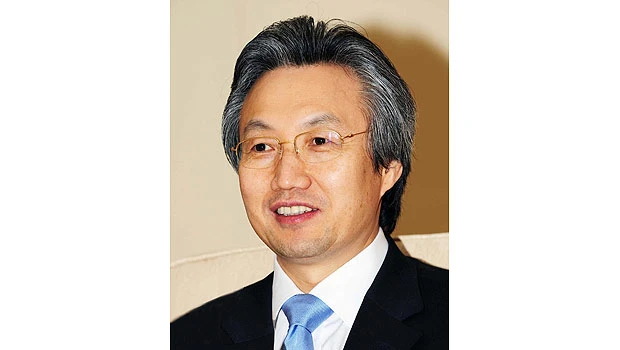
"The Saudi government has also built new universities and financed scholarships worth billions as well as built the infrastructure of the various educational sectors," said Lee Doo-hee, chairman of the South Korean Presidential Council on Nation Building and professor of Marketing at Korea University.
Lee attended the Third International Exhibition and Conference for Higher Education at the invitation of Saudi Minister of Higher Education Khalid Al-Anqari.
The South Korean educator noted that aside from the two new universities — King Abdullah University of Science and Technology in Thuwal, near Jeddah, and the Princess Noura bint Abdularahman University in Riyadh — the Kingdom is also spending much on Saudi students studying under the King Abdullah Scholarship Program (KASP).
"This shows that the Kingdom is using its resources to provide education to Saudi youth who are the country's future," said Lee, who received his doctorate degree in marketing from the Michigan State University in 1990.
He noted that as of June 2012, the Kingdom will teach the basics of science, technology, engineering and mathematics. "These will be in addition to special skills for continuous education designed to suit all age groups," he said.
He said that as far as education in South Korea is concerned, it had played a pivotal role for the country to achieve a strong economy.
"In the 1950s, the economy was in the doldrums. The gross domestic product per head was only $68 compared to $25,000 at present. We relied heavily on education since we did not have many natural resources," Lee said.
In this connection, he invited Saudi youths to visit South Korea and enroll in the universities and colleges.
Aside from the official invitation from Al-Anqari, Lee also attended the international exhibition and conference for higher education as representative of the 1,000-plus member Asia Pacific Association for International Education (APAIE).
Others attending the conference, which ends today, include the Chonnam University, Hankuk University of Foreign Studies, Kongju National University, Kookim University, Korea Advanced Institute of Technical Education, Kyung Hee University, Seoul National University of Science & Technology, Solbridge Int'l School of Business (Woosong University), Sun Moon University, The National Institute for International Education Development and University of Ulsan.