
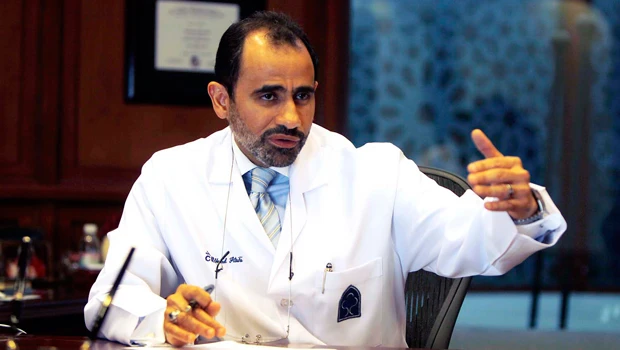
- Dr.
- Walid Fitaihi is the Founder, Chairman of the Board of Directors and Chief Executive Officer of the International Medical Center (IMC) based in Jeddah.
Dr. Fitaihi's integral role in founding IMC included the creation of its mission and vision. He was involved in all steps of the design and construction of the facility, and facilitated its successful accreditation; he helped set up guidelines for recruitment, quality and policy-making with a view to instilling the IMC culture and values in all those involved in running the hospital.
The grand opening of the IMC was held in October 2006 under the patronage of Custodian of the Two Holy Mosques King Abdullah, bringing Dr. Fitaihi's dream into reality.
His mission in life is to enhance the quality of health care and ensure that the IMC truly represents a major paradigm shift in health care services in the region.
Dr. Fitaihi emphasized three major points during the interview with Arab News: Share ideas with youth, develop education, and give freedom to media.
What changes will have a major impact on the lives of Saudis in the coming 20 years?
A study conducted by The New York Times plotted the total natural resources in each country Vs the average performance of 8th grade students in mathematics in that country with the aim of calculating the dependence on national resources worldwide. Countries like Japan and Singapore rated among the highest in math scores with a little, if any, dependence on national resources. Unfortunately, Saudi Arabia scored the highest of any other country in the world, with full dependence on oil and worst math scores worldwide, with only Ghana scoring lower. This relays a message to all of us, especially that the coming years still witnesses a baby boom in the Kingdom, that we have to rethink our educational system, invest in people and depend less on oil. This could only happen at early stages of school, teaching people how to express themselves, feeling their value in the society, and granting them their rightful freedom of expression.
Leadership role
What do you think of the leadership role of organizations in the Kingdom? What are the reasons for their current state?
The whole world is passing through radical change in its governing landscape; and the Arab Spring is nothing but a witness of this change in the Middle East.
If we look around, we will clearly see that all countries have been changed by youth power, and with a country like Saudi Arabia, where more than 70% of our society are under 30 years, we must start listening to youth, as they are shaping our society. One example of this change is an initiative of a petition signed by around 3,000 of the youth of Saudi Arabia putting forth their demands and claiming their responsibilities.
I believe that people should have the right to express themselves through projects they create, and leaders must listen carefully to them, help them and mentor them in their quests. For that, I call for establishing a Ministry for Youth Affairs to channel initiatives and constructive criticism between the youth and the legislators, many countries has such authority lead by one of the youth themselves and I wish to see this in the Kingdom soon.
Challenging tasks
What are the most difficult decisions the Kingdom should take in the next 20 years?
The Kingdom is passing through a critical path in its coming years, where the most difficult challenge is to accommodate the needs of our youth. Only if we listen with our hearts to the voice of our youth and involve them in further changes, the efforts invested in the Kingdom's development will definitely prosper.
What goals would you set for the Kingdom's onward development and how can these goals be achieved?
I believe that boosting our education system is the perfect way toward developing the community. Our current syllabus and its delivery model are both completely outdated to produce an enlightened generation. We should uplift the quality in that vital sector, starting with the teachers, the delivery model and the syllabus itself. I believe in nationalization and Saudization, yet believe in developing Saudis teachers to fulfill what is expected of them, as nationalization will remain a distant dream if we continue taking the same path we have been on for years. Currently, the Scholarship program initiated by the government is correcting these defects in our educational system, so why don't we fix it from its roots to start with.
Communities have realized that the best investment ever is in the early stages of human life, especially in communities where young people constitute the majority. A documentary film entitled "Waiting for Superman" discussed the challenges facing education around the world and stressed that the most important factor for the success of the education system is the teacher. If a student studies one year under a good, well qualified teacher, he can get three times better results than the student who studies three years under a weak teacher. The challenge is how to raise hundreds of thousands of teachers in a few years. We have five million school students who make up about a quarter of the community. Through my efforts, I keep developing health services by depending on qualified staff and experts regardless of the nationality.
Creative project
Give me an example of the most creative project that you wish to do in the Kingdom.
The most creative project is to establish an educational system that graduates students with ability to compete with their peers worldwide, and to develop school that can fulfill this role. I have put together a proposal to His Excellence the Minister of Education, it suggested bringing the top three talented teachers, with their skills and delivery methods, to give the curriculum for elementary schools using their unique ways of teaching. These can be uploaded to applications on handheld devices -such as an ipad- and accessible via interactive website for students. This way, students and their parents can participate in the education process and students will stop depending on private lessons at home.
This idea is not mine. It's available worldwide. There are similar projects around the world, including the Khan's Academy, which are available on the Internet for free. Others have been developed by governmental initiatives in countries such as Turkey and India. If we implement such projects, the teacher's role will become more effective, especially when they know that they will be evaluated by the students when compared to the teacher they have seen online. Another important benefit of implementing this project is protecting our youth from radicalism and fanatic religious views that can be communicated through the teachers, which will protect our children from wrong religious ideas and notions.
The cost of the project is limited to the provision of iPad for each student and payments for teachers, and it doesn't exceed 50% of the Ministry's budget, yet it will give an immediate uplift to the educational system where everyone will start competing to reach up to the quality they see online.
Prominent activities
What are the most prominent economic activities in the Kingdom and what are the 'neglected' sectors that need to be developed?
Unfortunately, businessmen in the Kingdom believe that the most secure investment in the country comes from investing in real estate, where the government should encourage investing in shaping the young minds. We should develop our people's minds and invest in their creative ideas in the interest of the Kingdom's development rather that freeze our assets into buildings and blocks.
Housing growth
Do you believe housing sector needs much attention from the government and private sector?
The demand for housing in the Kingdom is huge because of its rising young population, which is a good indicator in most countries. Yet, the government is always following the path of the market rather than finding creative solutions to address the roots of the problem. The government has allocated SR250 billion in its budget for housing, yet this is a temporary fix as Monopoly of lands by businessmen remains to be the main cause of the housing crisis. Monopoly of the privately owned undeveloped lands, even though the government has equipped the lands with essential services, such as roads, electricity and water without any penalty of leaving these assets frozen for years while prices are on the rise. Since the government doesn't demand zakat or taxes on these lands, owning lands and leaving them barren over the time has become a safe investment.
This practice has become so common in our culture where society believes in the popular saying: "Lands don't require food or drink; even if it falls ill it will not die but will simply live on." Businessmen and real estate agents delay selling these vacant lands to ensure enormous profits. The rapid increase in population leads to a higher demand for lands and, as a result the land prices soar. Businessmen now sell only a small portion of their empty lands to get the cash flow they need. Large stretches of lands remain barren and the society is caught in a vicious cycle. According to latest statistics, 5,000 square kilometer land is available but only 23 percent has been used. In other words, 77 percent of the land that the government has spent money on to provide with roads, electricity, and water are frozen and monopolized.
A similar picture exists in all of the Kingdom's cities. These lands are sufficient enough to meet the needs of hundreds of Saudis. The empty lands have become wastelands because they are not utilized and the society has a right on them as the public money has gone into servicing these lands. The majority of young men in this rich, wealthy country do not own a home. Studies show that with current land prices, only individuals with a monthly salary of SR15,000 or above can afford to buy a home. Unfortunately, more than 90%of Saudi employees have a monthly income of less than SR15,000. Actually, increase in land prices is directly related to the increasing apartment rents and it is the average, hardworking employee that suffers the most. The average person pays 30% of the annual income on residential rent, and it is expected that this number will reach 50% in the future. High prices of land have a domino effect and raise the rents of offices and shops, which in turn will cause inflation. The negative impact of an increase in land costs does not end here. It puts an additional financial burden on the government to adopt developmental projects, such as building hospitals, schools, residential compounds, and community centers with youth programs. Private organizations will be discouraged from investing in such projects that will have immense ethical and societal benefits on the society at large.
Role of SMEs
There is a need to boost the small and medium enterprises (SMEs) sector in the Kingdom as it creates various jobs. What role do you see for SMEs in the Kingdom's economic development?
SMEs are considered to be very important to the Kingdom as they come up with innovative ideas. Actually, we disregard SMEs' ideas and do not implement them. Such ideas need cooperation between the public and private sectors for implementation. For example, Singapore has a track record of successful SMEs, whereby a government agency cares for these young entrepreneurs, helping them with feasibility studies, loan applications, fundraising and planning.
A bright local example is the Foundation of Abdul Latif Jameel, which plays similar role, but we hope that we see an active governmental department catering to this community as they are the stabilizing ingredient to the economy in many countries and hopefully in the Kingdom.
Knowledge hunt
Education is always a priority of the Saudi government. What changes you envisage in the education system for Saudi youth in the knowledge-based economy?
Developing a specialty syllabus is a necessity for boosting education. I already gave an example of the model schools that I dream to see in the Kingdom. In terms of universities, I believe that scholarships' cost could be used in establishing and developing a university of international quality in the Kingdom, and we can do it! KAUST was a dream until we lived it. So such projects are much better than sending students to study abroad.
Fair opportunities
How do you see Saudi women's contribution in the labor, social and political fields in the coming 20 years?
I wish to see a bigger contribution of women in labor, social and political life. It is really sad that even when we have the model for contribution and involvement of women in society in every aspect of it through Islam, we have not been able to implement it fully. As an example, Sayida Khadija, the wife of Prophet Muhammad (Peace Be Upon Him), was basically the running her company. She employed Prophet Muhammad who is the most valuable human being who ever lived on Earth. We have many other examples of women's contributions in every aspect of life throughout Islamic history. Until recently, women in Saudi Arabia were not given the opportunity to practice in fields Islam had granted to them. The good thing is that there are many new laws and changes that definitely will make a difference for working women in Saudi Arabia. However, hiring women makes solid business where we have many intelligent, hard-working, dedicated Saudi women in the market. This has been my experience at IMC. We have more than 50% of our workforce as women working with us. They are successful because they, Saudi women, have a drive to excel and prove to themselves that they can do it and do it better.
How do you think your vision can be pursued?
Saudi women are already working hard and have proved themselves in the labor market. I believe that they need to keep pressing for their rights and continue with their good work. Many Saudi women have proven that they are much more intelligent and successful than their peers abroad.
Saudi media
What measures and standards are yet to be (and must be) applied to Saudi media? And what are your expectations in the next 20 years?
Saudi media is keenly observed and controlled. If we look at Saudi TV channels and newspapers, we will discover an unjustified restriction, with almost complete absence of the youth's voice. Any media can be successful when it delivers the voice of its community and starts solving their problems. This criterion is lacking in Saudi media.
Social media
What impact will social media have regarding change in the Kingdom?
Social media is the platform youth are using to deliver their voice. On such platforms, Saudis can create and promote their ideas. Such platforms are considered the real voice of youth, not the traditional media at all. The youth will find a way to vent, and they found their refuge in social media channels, but I truly hope to see our official channels embracing this use of media toward listening to the people and interacting with them, it is a very important tool that should not be neglected, we can learn a lot from it about the true needs and pains of the community.
What impact will social media have on traditional media?
I would like to mention the importance of competition between traditional and social media, where traditional media has to learn from social media how to be the youth platform. We recently noticed a large number of young Saudis started their programs on the YouTube. These were low budget programs, but attracted many viewers not only in the Kingdom but worldwide.
Learning from the past
What are three or four mistakes that have been repeated in the Kingdom during the past 10 decades and how we could eliminate them in order to further develop the Kingdom?
The most repeated mistake is not hearing the voice of the youth. Youth constitute a sizeable majority in Saudi society, and so we have to involve them in social, economical and political activities. Once we give youth the opportunity to speak out loud, many mistakes will be eliminated.
Sustainable development
What most leaders in both the government and private sectors should do to ensure the Kingdom's growth and sustainable development?
Every leader has to share ideas with the new generation, ask for their problems and needs, and discuss possible solutions. Dialogue is a very important element that we lack in Saudi organizations.
Message to youth
Given that youth make up the majority of the Saudi population, what message would you want to convey to them?
My message to youth is don't give up; change will come sooner or later. Keep working and keep calling for changes and improvement.