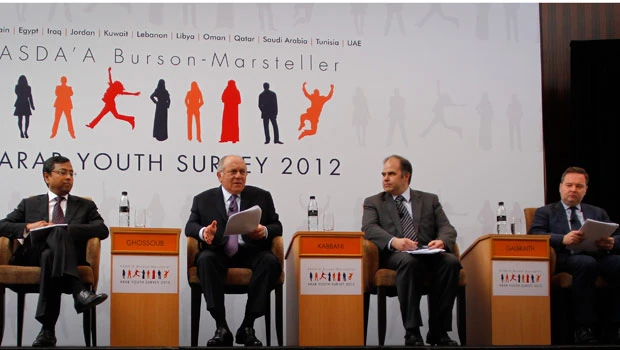
- The rising cost of living is the greatest concern for young people in the Middle East, according to a poll of young Arab men and women in 12 Arab nations, including the six Gulf Cooperation Council members.
A survey conducted exclusively with 2,500 nationals aged 18 to 24 of these countries, including GCC members, Jordan, Egypt, Iraq, Libya and Tunisia said fair pay and home ownership displace democracy as top priority.
The survey highlights how larger political concerns have now been superseded by more personal and economic anxieties.
It reveals youth optimism about future and trust in government is high, but a lack of democracy and civil unrest are seen as obstacles to progress.
Conducted by ASDA'A Burson-Marsteller, the survey said earning a fair wage and owning a home are now the two highest priorities for young people in the Middle East, displacing living in a democracy as the greatest aspiration of regional youth.
According to the findings of the survey, the largest study of its kind of the region's largest demographic:
— The rising cost of living is the greatest concern among Middle East youth; 63 percent of Arab youth now say that they are "very concerned" about the cost of living, up from 57 percent last year, when this was also their greatest concern.
— Forty-one percent of Arab youth say the lack of democracy is the biggest obstacle facing the region; an equal percentage identify civil unrest as the biggest obstacle.
— Seventy-two percent agree that, following the events of the Arab Spring, the region is better off today; 68 percent of Arab youth say they are also personally better off now than they were a year ago.
— Nearly three quarters of Middle East youth believe their government has become more trustworthy and transparent since the events of the Arab Spring. At the same time concerns about corruption have skyrocketed.
— A majority of young people in every Middle East state agrees that traditional values are paramount; however, the percentage of youth who say that such values are outdated and need to be replaced continues to increase.
— When Arab youth look across the region and the world, they see the United Arab Emirates as the country where they would most like to live and as the country they would most like their own nation to emulate.
— Young people in the Middle East today view France most favorably among all countries, with 46 percent of respondents saying they are "very favorable" toward the nation; positive views of China and India have also increased.
— Arab youth are following the news far more keenly than ever before, with 52 percent now saying they update themselves on news and current affairs every day, up from just 18 percent in 2011.
— Television remains the most important source of news for Arab youth, with 62 percent of respondents saying they turn on the TV to get their news but that number has declined from 79 percent in 2011.
— Today, reading or writing blogs is the top online activity among young people in the region, with 61 percent saying they engage with blogs, up from only 29 percent in 2011.
Meanwhile, the percentage of respondents who said living in a democratic country is "very important" to them declined by 10 percentage points in the 2012 survey. This year, 58 percent of Arab youth said that this is "very important" to them, down from 68 percent in 2011.
"Eighteen months after the start of the Arab Spring, we all know that Middle East youth are committed to forging an even brighter future," said Joseph Ghossoub, chairman and CEO of the MENACOM Group, regional parent of ASDA'A Burson-Marsteller.
"While these young people have shared their profound concerns about the cost of living and the price of home ownership, to cite just two examples, they remain firmly optimistic. It is so heartening that when Arab youth look forward, they also continue to look up."
"You can see the great promise of Arab youth throughout this survey: in the level of engagement in current affairs, in the sophisticated use of technology, and in the tempered expectations for the post-Arab Spring era," said Jeremy Galbraith, CEO, Burson-Marsteller, Europe, Middle East and Africa.
"By charting the opinions of young Arab women and men from the modern cities of the oil-rich Gulf to rural areas in the Levant and North Africa, the ASDA'A Burson-Marsteller Arab Youth Survey provides evidence based insights of great value to everyone with a stake in the future of this young and rapidly evolving region."
"Since 2008, we have been conducting the most representative and authoritative study of the attitudes of young Arabs polling opinion, analyzing this data and then sharing these important findings with the public, including governments, private-sector firms and civil society groups," said Sunil John, CEO of ASDA'A Burson-Marsteller.