
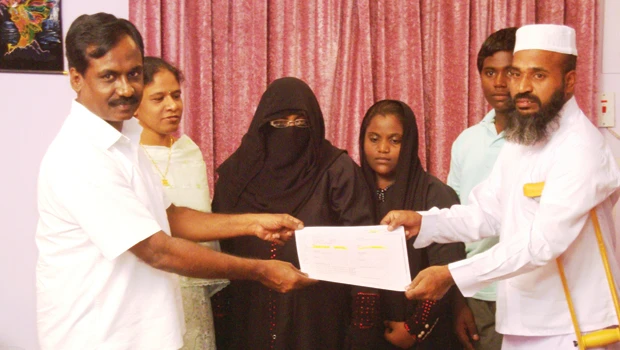
- Riyadh: An Indian domestic worker, stranded in the Kingdom following his sponsor's death 10 years ago, was repatriated together with his family members yesterday, the Indian Consulate General's Office in Jeddah told Arab News yesterday.
Kunhalavi Muthanakkatu Adiparambil came to Jeddah to work as a family driver in 1999. Upon his sponsor's death two years after his arrival in the Kingdom, his Iqama was not renewed and he started doing odd jobs to make ends meet. During that period, he became diabetic and developed serious medical complications which restricted his movements.
S.D. Moorthy, consul — community welfare of the Indian Consulate General's Office in Jeddah told Arab News that Adiparambil and his family had undergone untold hardships during the last 10 years while living in the Kingdom.
The diplomat recalled that Adiparambil's wife and two children, who came for Umrah in 2008 stayed back in the Kingdom following their pilgrimage to look after their breadwinner.
“Because of his illness due to severe diabetes, he was unable to provide for his family," Moorthy said, adding that they were simply living off remnants of food given to them by hotels and marriage festival halls in Jeddah. "They were at the mercy of the passers-by and they have been leading a life of misery in Jeddah," Moorthy noted.
The family's condition was brought to the notice of the consulate by a group of social workers from the Keralite community from the southern India where Adiparambil hails from.
The consulate took up the case with the with Immigration and Tarheel authorities and granted them exit visas on medical and humanitarian grounds. The social workers gave the family financial assistance, while the consulate provided them with the air tickets.
On behalf of Adiparambil, the social workers paid an SR8,500 penalty that had accrued for Adiparambil not renewing his Iqama.