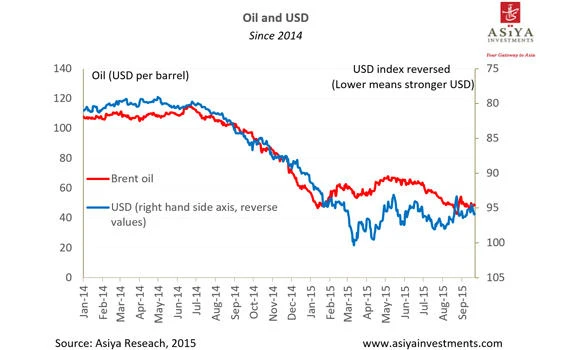
Thanks to the United States and China, oil exporters are finally enjoying a break. August and September gave producers a sorely needed period of stability in prices, after a long year in which oil has been under intense pressure. The barrel trades at around $50, a level reached in early August, and next month will probably be quiet as well, helped by recent policy decisions in the US and China.
The first factor supporting prices in the short term is the decision of the American Federal Reserve to keep interest rates on hold. There is a very strong correlation between oil prices and the exchange rate of the US dollar (USD). The price of oil is set in USD. When the dollar strengthens, oil become more expensive. Buyers need to use more of their own currency to purchase one barrel and demand declines.
Oil price moves down to compensate for the exchange rate appreciation. Had the Federal Reserve decided to increase interest rates in its September meeting, the US dollar would have probably strengthened further. Investment flows would have flocked into the dollar-denominated assets to benefit from higher rates and the appreciation that would ensue.
Over the last 12 months, almost one trillion USD left emerging markets to seek refuge in the United States, according to NN Investment Partners. That’s almost twice the amount that was moved from emerging to developed markets in the aftermath of the 2008 crisis.
A hike in the interest rate in the US would have triggered a new period of outflows, bringing up the dollar and hurting oil exports. The decision to maintain the rate on hold has prevented demand from declining again on account of the USD.
A second factor helping prices is China’s stimulus plan. For a couple of years after the leadership change in 2013, the authorities adopted a tough position, curbing credit to avoid the formation of bubbles, and reducing investment growth. The message was one of discipline: The goal is to restructure the economy, and China was willing to reduce growth to achieve it. In 2015 that position has softened substantially. The 7 percent growth target is at risk and the government decided to pull the lever of investment and credit again.
In late August the Chinese finance minister announced in the G-20 meeting that fiscal spending would increase 10 percent in 2015, up from the 7 percent announced at the beginning of the year. Interest rates have been cut five times since November last year and cash requirements for banks have also been frequently reduced. That is good news for commodity exporters because a large part of this additional funding will be spend in construction and that will sustain oil prices.
But this is only a short term respite. Nothing has changed structurally in the world’s economy. Most experts were overly optimistic about the health of China and the US only a few months ago. The reality is that the economy is decelerating, getting close to the 3 percent threshold that traditionally implies that employment is not being created at the global level. This weakness translates into lower oil consumption. Forecasts are revised every day to capture this trend. For instance, the US Energy Information Administration (EIA) cut — again — its call for 2015 and 2016 in early September, from 1.4 million barrels per day in 2015 to 1.2 million. Similarly, the number for 2016 was cut from 1.5 to 1.3 million extra barrels per day. Most of the change is explained by the deceleration in China. The country’s consumption is still huge, importing 6 million barrels daily, and consuming over 10 million barrels per day (10.1 in July, up from 9.7 a year earlier). But the signs are worrying. In July, Chinese auto sales dropped 7 percent compared to a year earlier, the fourth straight monthly decline.
In summary, oil exporters should enjoy these months and save some dollars because 2016 does not look great for oil prices. The Federal Reserve might not hike rates aggressively, but China will not get any better and, in addition, Iran could increase global output by at least an extra million barrels.
— Francisco Quintana is economist at Asiya Investments Company.
A break for oil prices, but won’t last long