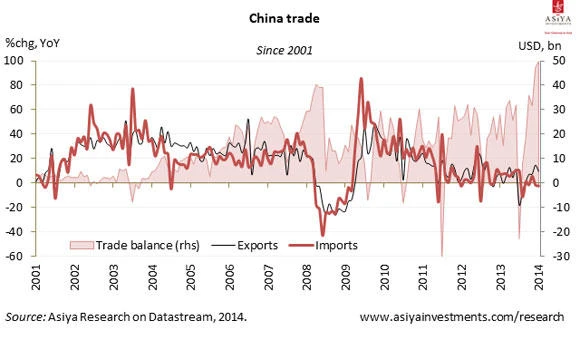
China’s trade surplus reached a record high in August for the second consecutive month. The surplus widened to $49.8 billion in August, from $47.3 billion in July. So far this year, the trade surplus is 30 percent larger than during the same period last year. The combination of rising exports and steady imports has contributed to the wider surplus, which could fuel US demands for more yuan appreciation.
In August, imports contracted 2.4 percent YoY, the second decline in a row — in July, they fell 1.6 percent YoY. The decline reflects weakness in the domestic economy, as it was led by lower ‘ordinary imports’ (those used for consumption purposes), which fell 3.2 percent YoY in July and 6.9 percent YoY in August. If we exclude commodities, the contraction is even more acute, reaching 11.8 percent YoY in August. The growth in ordinary imports excluding commodities has been trending down throughout the year. During the same period, goods imported for processing and assembly, usually intended for re-exports, have trended the opposite way, especially in the last six months, growing 3.5 percent YoY in August. Overall imports were weak throughout the year.
However, recently the downward pressure is coming from lower domestic consumer demand as opposed to weaker external orders, as indicated by the export and trade-related import trends. Domestic demand has not recovered in spite of authorities introducing various mini-stimulus packages this year, in the form of fiscal spending on rail, housing and energy sectors and looser targeted monetary policy.
Despite softening to 9.4 percent YoY in August, from 14.5 percent YoY in July, exports have been advancing since the start of the year. It is clear that the global economy has strengthened in 2014, as indicated by this year’s global trade figures. Although nowhere close to pre-crisis growth rates, a resilient US economy and a gradually recovering eurozone have supported exports worldwide. In fact, the surge in euro zone demand has contributed the most to Chinese export growth so far this year, followed by the United States.
China has shipped to the euro zone and the United States 12.5 percent and 11.4 percent more goods than last year, respectively, as of August 2014. The pace of exports to China’s two largest partners has been robust but remained stable throughout the year, softening slightly in August.
ASEAN also shared a very similar trend to the G2. In its attempts to transition away from an investment driven economy, to a domestic service oriented economy, China has had to accept a lower rate of GDP growth annually. When comparing 2004-2008 with the 2009-2013 period, exports and investments have both shrunk significantly, from 36.6 percent to 27.6 percent of GDP and from 42.8 percent to 23 percent of GDP respectively, with more growth coming from domestic consumption. However, this year’s resurgence of exports and slowdown in ordinary imports reflects China’s reluctance to sacrifice more growth for the sake of reform.
The government is expected to keep spending and the PBoC now has bigger initiatives to ease policy this year, including a reserve requirement ratio or interest rate cut, given the low inflation. The property market is not showing signs of any recovery despite stimulus, nor is consumer demand and the industrial sector. The economic transition is a long one, and what may seem as noise in the short-term reflects a longer term trend that is being well maneuvered.
How does all this affect the Gulf in the short-term? China’s crude oil imports, in terms of volume, surged from a 9 percent YoY decline in July to a 17.5 percent increase in August; but crude oil imports are volatile. Since the start of the year until August, Chinese imports of crude oil have grown on average 8.5 percent YoY versus 3.6 percent YoY in the same period last year, in terms of volume, and 9.5 percent YoY against -0.8 percent YoY in terms of value. China’s temporary return to old-fashioned investment and export led growth will support demand for the Gulf’s oil products.
— Camille Accad is an economist at Asiya Investments, an investment firm investing in emerging Asia.
China’s export-led growth to support demand for Gulf’s oil products