“Solar is the region’s most abundant energy resource”; “Every hour, the sun beams more energy onto our planet than we need to satisfy our total power needs for an entire year.” These are statements that have become the mantra of the solar energy industry and rightly so, since they articulate the sheer potential of sunlight to address our most pressing energy needs.
But it is also true that, today, we’re already experiencing a new energy transition; one that is redefining the global power generation portfolio and is centered on the growing realization that renewables — and solar in particular — are no longer a subsidized extra, but a need-driven necessity. Consider this: At the turn of this century, the total installed capacity for solar photovoltaic (PV) modules was 1.5 gigawatts (GW); less than 15 years later, according to analyst estimates, the global industrywide installed capacity at the end of 2013, was 137GW. This is roughly the capacity equivalent of building nine nuclear power plants a year for 15 years.
Yet, despite the impressive numbers, the world is nowhere near leveraging the full potential of sunlight because of two principle reasons: First, the technologies are still evolving, some — such as First Solar’s thin film — faster than others; and second, the adoption of solar energy is disproportionate to its cost-competitiveness and reliability. In other words, although PV solar is more cost competitive and reliable than ever before, its use is often not as widespread as it ought to be.
While no one can claim that solar alone offers the solution to the world’s energy problems, it can — and should — play an important role in a country’s energy generation portfolio. Going into granular detail, the solar component of an energy generation portfolio can be divided into sub-segments: Centralized utility-scale power plants reliably delivering clean solar electricity in bulk to the high-voltage transmission grid; distributed generation systems that can help rapidly bridge the gap between energy demand and supply on the lower voltage distribution grid that serves customers directly; hybrid solutions, working in tandem with liquid fuel generators to address specific applications; and finally, off-grid systems delivering electricity to remote areas that do not have the benefit of being connected to the grid.
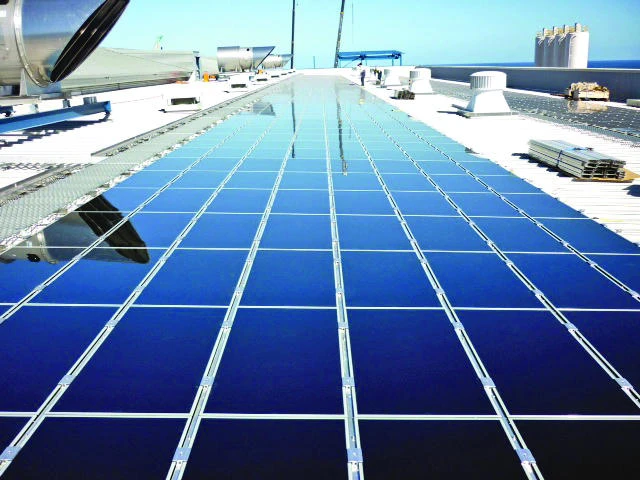
While the region is right to focus its efforts on developing its utility-scale solar portfolio, the benefits of distributed generation should not be overlooked. The concept of generation of solar power at or near the point of utilization, has been gaining ground as a viable means of augmenting the volume of energy that utility-scale plants provide to the grid. Distributed solar energy plants make perfect sense when looking at, for instance, offsetting electricity consumption at peak times, or ‘peak shaving’ as those in the industry know it.
In a reflection of solar PV’s scalability, distributed generation could take the form of a kilowatt-scale system on the roof of a house in Riyadh’s Al Wurud district or a megawatt-scale power plant at or on a factory near the Jubail Industrial City. Considering the fact that 65 percent of the electric utility loads are within buildings, out of which about 70 percent of the peak load is driven by electricity consumed for air-conditioning, a distributed generation approach effectively creates a win-win situation for utility companies and their customers.
Since electricity consumption is highest around the time that the sun is at its zenith, distributed solar generation can help preserve the integrity of the grid by allowing users to self-consume the energy they produce at this critical point of the day, reducing their dependence on the grid. In markets where a feed-in-tariff exists, these distributed solar plants of varying sizes would contribute towards peak shaving, by supplying power to the utility companies, allowing them to minimize power generation from peaking conventional generators. This would not only ease pressure on the rest of the power generation portfolio, saving resources and costs; it would also allow a utility company to optimize the utilization of its conventional assets as base-load generators.
In markets where supply and demand are mismatched, distributed generation offers the opportunity to rapidly ramp up capacity in increments without significant capital investment. The fact of the matter is that installing several, small, kilowatt-scale systems can add up to precious megawatts of additional capacity. For example, installing 5 kilowatt systems on 10,000 rooftops across Saudi Arabia’s Eastern Province will achieve a total of 50MW of capacity added to the grid, in a fraction of the time that it would take to construct a power plant of the same size.
Although this would make it necessary to implement legislation and infrastructure to support the distributed generation model, one can argue that it is still more cost effective and certainly faster than building a conventional power plant of the same capacity. Furthermore, systems designed for self-consumption would provide near instant benefits to their owners.
There is no denying the tremendous potential to be realized from choosing a multi-pronged approach to harnessing solar energy. At the same time, it is also evident that there needs to be a fundamental shift in attitude toward renewables in general and solar energy in particular. The region as a whole needs to move towards a mindset where it is as commonplace to install a PV system, as it is to install an air conditioning or a water heating system in commercial, industrial and even residential buildings.
— Dr. Raed Bkayrat is the vice president for the Kingdom of Saudi Arabia at First Solar.
Distributed generation: Harnessing solar’s unlimited potential