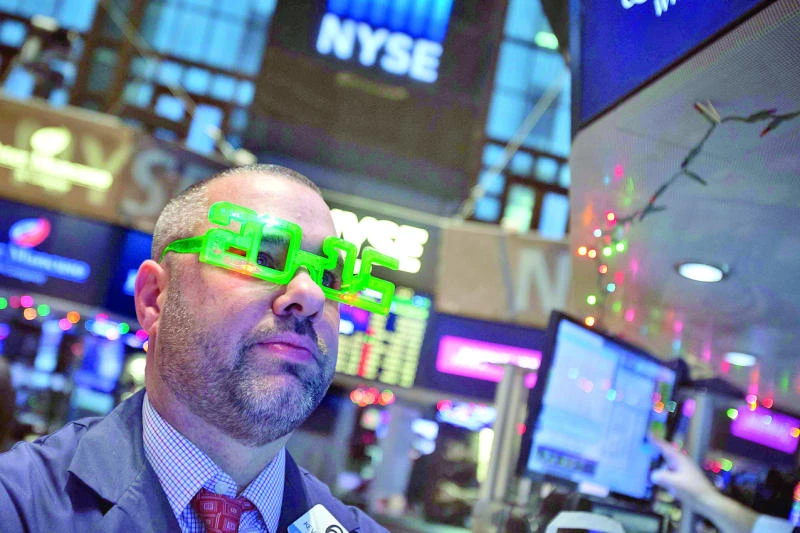
NEW YORK: The bull market continues, for now. Stocks fell on the last trading day of 2014, but the losses were not enough to derail what has been the longest winning streak for them since the late 1990s.
The Dow Jones industrial average gained 7.5 percent in 2014, marking six straight years of gains. Only a slump in afternoon trading Wednesday prevented the Dow from closing out the year above the much-watched 18,000 level. The Standard & Poor’s 500-stock index gained 11.4 percent for the year, making three straight years of gains.
“We’re still really in a bull market,” said David Lafferty, chief market strategist for Natixis.
With the exception of a few major dips, markets climbed steadily higher in 2014, lifted by news of stronger US economic growth.
Even the worsening recession in Europe failed to discourage investors, who also shrugged off the US Federal Reserve ending its bond buying program — a shift that some worried would make investors nervous and lead to increased volatility.
This year, all eyes will still be on the Fed, which is expected to raise short-term interest rates as the economy continues to stabilize. Stocks may keep climbing, thanks to the economy, but the Fed’s move could still lead to volatility as investors adjust to a market that is not bolstered by the central bank.
Not that 2014 did not have its share of scares. Concerns over a slowdown in emerging markets sent stocks sliding in January and February before they rebounded. And at one point in October, it looked as if the bull run might come to a screeching halt as investors worried about political tensions in Hong Kong and Russia, weak retail sales, and the slim chance that Ebola could spread in the United States. The Dow plunged by more than 460 points in one day before recovering much of those losses by the afternoon.
Markets have reached new highs since then, buoyed by the sense that the economic recovery may finally be reaching the average American. Falling oil prices have cut down what drivers spend at the pump, encouraging them to splurge on bigger and newer cars and to hit the stores to snap up holiday gifts.
The economy added 2.7 million jobs in 2014 through November, putting the country on track to have the strongest annual job growth since the late 1990s. Wages are — finally — starting to grow, albeit from pretty low levels. And in a sign that people are feeling more optimistic about the labor market, more workers are quitting their jobs and finding new ones.
“What was interesting this year was the US economy turning the corner in terms of a recovery that would be felt on Main Street,” said Quincy Krosby, market strategist for Prudential Financial, “as opposed to 70 percent of Americans saying they still feel as if we’re in a recession.”
That bump in consumer optimism was a big boost for stock markets, because consumer spending accounts for about two-thirds of US gross domestic product. Indeed, the news that the economy grew by 5 percent in the third quarter — the fastest rate in more than a decade — is what sent the Dow above 18,000 for the first time on Dec. 23.
Yet not all markets have done well. Sinking oil prices dragged down energy stocks, making them the worst-performing equity sector in the US. As the dollar rose against other currencies thanks to a surge of foreign investment in US government bonds, many commodities, such as gold, silver and platinum, plunged.
Investors who diversified their portfolios by taking a stake in international markets were burned as those markets underperformed amid fears of a global economic slowdown.
“Geopolitical headlines certainly were big this year,” said Jim Holtzman of Legend Financial Advisers.
But none of that had much long-term impact on US markets, which were a haven for foreign investors and were often buoyed by reassuring words from the Fed.
The Fed is expected to keep scaling back its role in markets this year. The shift will be spurred on by good news — the thinking that the economy is getting stable enough that it will no longer require as much stimulus from the central bank — but markets could get more volatile if investors overreact to signals sent by the Fed as it retreats.
Investors will also need to keep an eye on the recession in Europe and on whether the European Central Bank is successful at halting the slowdown. Still, the steady economic growth at home could be enough to send markets back up in the end, even if any gains reached are unlikely to be as robust as they have been in recent years.
“The direction is still up,” Lafferty said, “but the ride is going to get bumpier.”
For stocks entering new year, ‘the direction is still up’