Dynamism in GCC countries and the large, next-tier economies of Indonesia, Nigeria, Bangladesh, Mexico and Pakistan is offsetting mixed performance in the BRICS countries that powered emerging markets growth in recent years.
The more balanced picture for growth is reflected in the 2015 Agility Emerging Markets Logistics Index, an annual data-driven ranking of 45 emerging economies accompanied by a separate survey of nearly 1,000 global logistics and supply chain executives.
The Index, now in its sixth year, ranks emerging markets based on their size, business conditions, infrastructure and other factors that make them attractive for investment by logistics companies, air cargo carriers, shipping lines, freight forwarders and distribution companies.
Large BRICS nations Brazil, Russia, India, China and South Africa have accounted for much of the growth and investment in emerging markets and have dominated the Index. Saudi Arabia climbed to No. 2 in the 2015 Index, ranking behind only China, which has 47 times the population and 12.5 times the economic output.
Gulf states the UAE, Qatar and Oman, ranked as having the best market compatibility — the most ideal business conditions — among the 45 countries in the Index. They were followed by Uruguay, Saudi Arabia and Morocco.
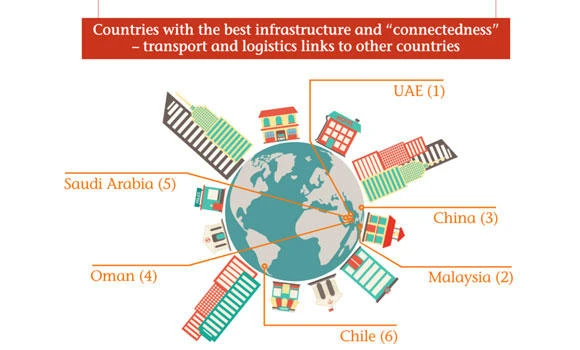
The UAE, Malaysia, China, Oman, Saudi Arabia and Chile led in connectivity, indicating they have the best infrastructure and transport links among emerging economies.
“Infrastructure investment and structural reforms that improve the climate for businesses have positioned Saudi Arabia, the UAE, Qatar and Oman to weather the downturn in energy prices,” said Elias Monem, CEO Middle East and Africa for Agility Global Integrated Logistics. “They continue to pursue smart policies that will help them diversify and make them more inviting to the logistics industry as consumer markets and logistics hubs providing high-value supply chain services.”
Next-tier economies Indonesia (No. 4 in the Index), Nigeria (27), Bangladesh (28) and Pakistan (25) — all with populations topping 100 million — climbed in the Index rankings. The other large non-BRICS market — Mexico — held steady at No. 9.
Elsewhere in the Gulf, Kuwait slipped three spots to No. 21 in the Index, and Bahrain fell two to No. 24. To close the gap with its Gulf neighbors, Kuwait needs to accelerate infrastructure investment and economic reform. Bahrain posted strong growth in the first half of 2014 but continues to deal with the aftermath of sectarian tension.
The picture was mixed for non-Gulf countries of the Middle East. Jordan slipped five spots to 29 in the Index despite strong scores for its business conditions. Jordan has been affected by fighting in neighboring Syria and Iraq, its largest trading partner. Lebanon, also affected by fighting in Syria, fell two spots to No. 42. Turkey, which has a much larger and more diversified economy, was more resilient, holding steady at No. 10 despite fighting on its southern border, concerns about the falling lira and internal political tension.
In North Africa, relatively stable Algeria leaped three spots to No. 34, but Algeria has yet to feel the full brunt of falling oil prices, which have added urgency to calls for economic diversification. Egypt’s slide continued. It dropped from No. 28 to No. 32 despite signs that the current government has halted the decline that began in 2011. Even so, many analysts forecast a strong recovery for Egypt in 2015, and the relative stability brought about by the government has prompted a reconsideration of the country’s prospects among logistics and supply chain executives. It climbed four spots in the survey to No. 20 among markets thought to be emerging as major logistics markets.
Elsewhere, Tunisia (No. 35) shows signs of stabilizing in the wake of political upheaval but is feeling the spillover of ongoing violence in neighboring Libya. Libya, torn by extremism and militia fighting, experienced the biggest slide of any country in the Index, falling seven spots to No. 40.
The Philippines climbed three spots (to No. 16) in the data portion of the Index — after jumping nine spots in the 2014 Index. The country also improved its standing among supply chain executives surveyed. They pushed the Philippines up five spots (to No. 15) among countries they said will emerge as a major logistics market.
Russia’s growing economic isolation has damaged its appeal to logistics and supply chain professionals. More than 75 percent of survey respondents said they were pessimistic about Russia’s prospects.
India continues to divide logistics and supply chain executives. They ranked India as the No. 2 choice to emerge as a major logistics market and ranked it relatively high — No. 17 — among countries least likely to become a major logistics market. In the data portion of the Index, India was leapfrogged in 2014 by Brazil and Saudi Arabia, and it slipped again in the 2015 Index, falling past Indonesia to No. 5. India’s market compatibility — a gauge of business conditions — deteriorated, despite optimism about reform under new Prime Minister Narendra Modi.
The fastest-growing trade lanes linking emerging and developed markets were US-Vietnam (up 42.7 percent by volume) and Cambodia-EU (up 41.9 percent) for air cargo; and Ukraine-EU (up 35.8 percent) and EU-Egypt (up 23.2 percent) for ocean shipments. But for 2015, trade flows between Asia’s emerging markets and other emerging markets are the ones that had logistics professionals most upbeat in the survey.
Survey respondents also identified risks to growth by region and provided views on near-sourcing, e-commerce and other trends affecting emerging markets.
“A year ago, there was talk of an emerging markets meltdown and of a new ‘fragile five’ based concerns about weakness in South Africa, Brazil, India, Turkey and Indonesia,” said Essa Al-Saleh, president and CEO of Agility Global Integrated Logistics. “Emerging markets as a group turned out to be far more resilient - even vibrant - than expected despite continued sluggishness in the global economy.”
Al-Saleh said a number of developing countries have invested in infrastructure and taken steps to address long-standing problems such as labor and tax rules, investor protections, contract law, property rights, capital restrictions, trade and land-use regulations. He said risks to emerging markets growth in 2015 will come from falling commodity prices, the cooling Chinese economy, US monetary tightening and Russia’s economic woes.
For 2015, the International Monetary Fund forecasts average growth for the 45 countries featured in the Index at 4.57 percent.
“The factors driving growth are increases in population, size of the middle class, spending power and urbanization rates, along with steady progress in health, education and poverty reduction,” Al-Saleh said. “That’s why we remain optimistic about emerging markets and continue to see them on an upward trajectory.”
Transport Intelligence (Ti), a leading analysis and research firm for the logistics industry, compiled the Index.
John Manners-Bell, Chief Executive Ti, said: “Five years after the global recession, prospects for all economies, developed and emerging, are still unclear. Economic fragility, a falling oil price and increasing security concerns in Africa and the Middle East have created uncertainty. Despite the challenges, interest remains high in these volatile markets as indicated by increased infrastructure investment, expanding international trade and increased domestic demand. Global manufacturers, retailers and their logistics service providers need to remain cognizant of the shifting dynamics if they are to exploit the significant opportunities which exist.”
GCC countries help drive emerging markets growth