LONDON: Gold slipped on Friday as the dollar advanced versus the yen and the euro, but the metal was still looking to post a weekly gain, while silver was set for its biggest weekly rise in 13 months.
The dollar was up almost 2 percent against the yen on speculation the Bank of Japan was considering applying negative rates to its lending program for financial institutions, effectively starting to pay banks to borrow its cash.
Gold was down 0.5 percent at $1,242.36 an ounce by 1421 GMT, after hitting a five-week high of $1,270.10 an ounce on Thursday.
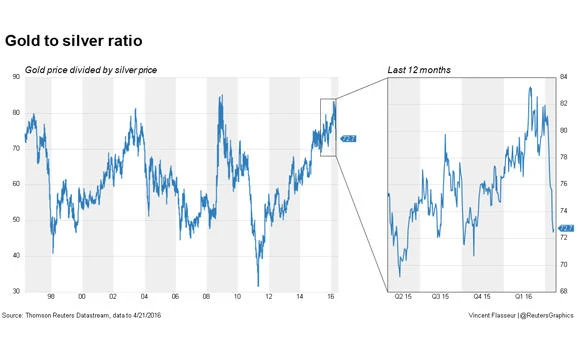
Spot silver rose 1.5 percent to $17.25 an ounce. It had risen to a 11-month high of $17.69 in the previous session and was up more than 6 percent for the week.
"After yesterday's (Thursday's) five-week high, gold today is succumbing to the strength of the dollar against the yen and the euro," ActivTrades chief analyst Carlo Alberto de Casa said.
"Prices should however remain in range and only a close below $1,225 will put on additional selling pressure."
Gold had posted its best quarter in nearly 30 years in the three months to March on expectations that the Federal Reserve would not be able to raise US interest rates this year due to volatile markets and concerns over the Chinese economy.
Recent data from China has showed new debt fueling a recovery in factory activity, investment and household spending, stoking appetite for metals used in manufacturing.
Goldman Sachs maintained its bearish view on gold and other commodities on Friday, and reiterated its recommendation to short gold.
"We continue to expect that the strengthening of the US labor market will force the Fed to hike rates three times this year, which will lead to a stronger dollar and a gradual increase in US real rates, pushing gold down," Goldman analysts said in a note.
Copper jumped to a four-week high, while steel soared to a 19-month top on Thursday.
Silver's rally this week has also been helped by optimism over Chinese growth, and a break above key chart resistance.
HSBC said the gold and silver rallies could be running into headwinds.
"For silver, we favor the market above $17, but expect volatility and further gains may be hard to hold. On the positive side, it appears that solar-panel demand is up and retail demand is solid for silver," it said, adding that gold may need to consolidate around $1,250 before moving higher.
Among other precious metals, platinum was set to log its strongest week in seven with a 4.5 percent rise. It had climbed to a 9-1/2-month high of $1,043.72 an ounce on Thursday.
Palladium was unchanged at $602.21 an ounce and poised for a weekly rise of 7 percent, after climbing to its highest since November on Thursday.
Meanwhile, sterling rose more than 1 percent against the euro to a one-month high on Friday, bolstered by a swing of betting odds and polls toward the campaign for Britain to remain in the European Union as US President Barack Obama waded into the debate.
Sterling rose by 0.8 percent against the dollar to $1.4453 and 1 percent to a four-week high against the euro of 77.95 pence per euro.
The pound was on track for its best week against the single currency since early March.
From 37 percent earlier this week, the chances of Britain voting to leave the EU in the June 23 referendum fell to 32 percent, according to the Betfair betting exchange.
Bookmaker Ladbrokes also witnessed a shift in betting towards the "Remain" campaign.
Traders said that while Obama's appeal for Britain to remain in the 28-country bloc had not visibly moved the pound, it had underlined the weight of argument in recent weeks from global and financial leaders in favor of staying.
"The polls this week were not good for the "Out" crowd and the dominant consensus, if you talk to people in the market, is just that Britain will stay," said the head of one London-based macro hedge fund, managing around $1 billion in assets.
"It's difficult to avoid the impression that sterling has benefited from that this week."
A poor batch of UK retail sales numbers put some pressure on the pound on Thursday, pointing to a weakening of activity as firms and consumers brace themselves for the referendum.
But this week's polls have given a solid lead to the "In" campaign, soothing nerves among investors who worry sterling could sink by as much as a fifth in value against the dollar if Britain votes to leave the EU.
A small rise in oil prices, with which sterling is closely correlated, also played into the mix.
Many bank analysts have virtually abandoned commenting directly on the campaign or its impact on the pound, concerned about breaching the limits British electoral law places on political communication during campaigns.
Sterling has fallen roughly 10 percent since the referendum began to filter into market pricing in November and some major banks earlier warned of a crisis for sterling that would drive it to as low as $1.20 if Britain votes to leave.
Investors worry that a current account deficit of 7 percent of national output leaves the country badly exposed should foreign investors and buyers of its bonds be spooked by a Brexit.
Yet if the odds and polls continue to drift in favor of the status quo, many expect sterling to bounce. In trade-weighted terms, the pound is 1.5 percent higher on the week, its best performance since the start of March and the second best this year.
Analysts from French bank Societe Generale on Friday recommended hedging against Brexit through options profiting from a weaker euro against the dollar.
"Brexit would not only hurt the UK but also its European partners, and the shock would likely pressure EUR/USD toward the bottom of its range and a 1.05 low," they said.
Gold dips as dollar advances against yen, euro