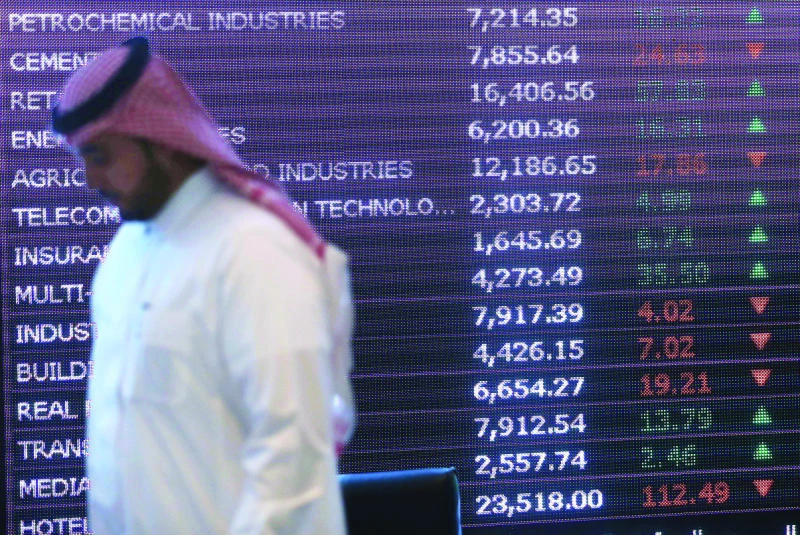
DUBAI: Most Gulf markets fell on Wednesday as uncertainty about oil prices prompted investors to sell stocks, while energy importer Egypt posted strong gains.
Brent crude traded below $79 a barrel on Wednesday after Saudi Arabia signaled it was unlikely to push for a major change in OPEC oil output despite a collapse in prices.
Although oil-exporting Gulf nations have built up large reserves over the last few years when crude traded above $100 per barrel, some investors fear that a sharp decline in budget revenues could trigger a cut in government spending, a key driver of economic growth throughout the region. Saudi Arabia’s Tadawul All Share Index fell 1.7 percent to 9,081 points, its lowest level since early March, as most shares declined. Heavyweights Saudi Basic Industries and National Commercial Bank each fell 1.1 percent.
The market, however, closed well above its intraday low of 8,922 points, which would have been a 3.4 percent decline.
Advanced Petrochemical Co. was one of a few shares to buck downbeat the trend, adding 0.6 percent.
The company said on Wednesday it would pay a 0.75 riyals fourth-quarter dividend, taking the full-year payout to SR3.0, up from SR2.25 last year.
Dubai’s bourse dropped 2.5 percent after losing support from global funds which were buying several stocks on Tuesday because their weightings increased in MSCI’s emerging markets index.
Emaar Properties, which had been the main beneficiary of such inflows, tumbled 5.3 percent to AED10.75, falling below immediate support at AED11.15 which was its November high until this week.
Abu Dhabi’s index fell 0.9 percent and First Gulf Bank was the main drag, dropping 2.4 percent after also losing support from one-off buying related to MSCI index adjustments.
Qatar’s bourse, up 0.7 percent, was the only Gulf market to post gains. Doha usually attracts regional investors near the end of every calendar year as they look for stocks offering good dividends.
At 4.0 percent, according to Thomson Reuters data, Qatar has the third-highest expected 2014 dividend yield in the region, trailing Oman and Abu Dhabi.
But Oman’s market is much smaller and less liquid while in Abu Dhabi a bulk of dividends comes from Etisalat whose shares can only be held by UAE citizens.
Also, bourse data showed strong foreign institutional buying in Doha on Wednesday, indicating some funds may have continued buying local stocks following the MSCI index review.
Egypt’s index rose 1.3 percent in a broad rebound ahead of a central bank meeting widely expected to keep interest rates on hold to support economic growth.
Gulf markets slide on bearish oil outlook