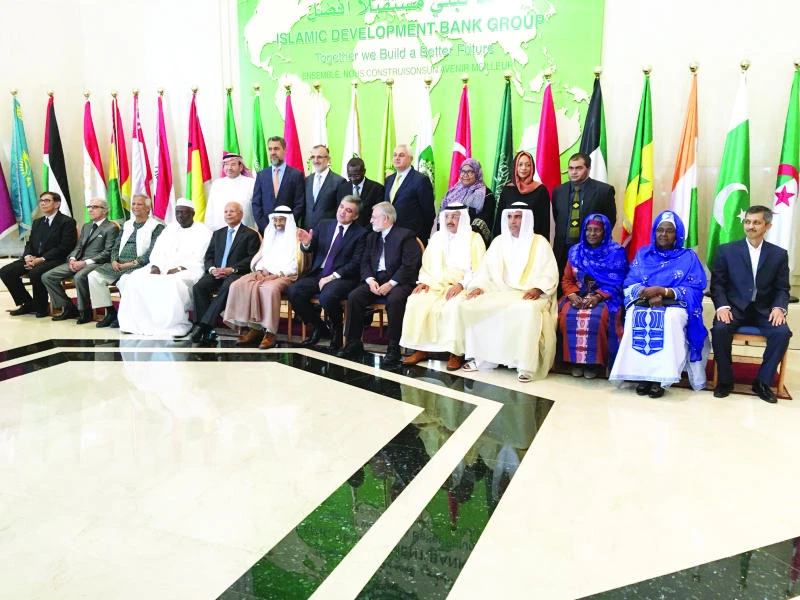
JEDDAH: The digital revolution has created a “new” gap between the advanced economies and others, Islamic Development Bank Group (IDBG) President Ahmed Mohammed Ali said on Saturday.
“Member countries increasingly expect innovative financing solutions from us,” he said.
Ali was speaking at a meeting of the IDB Advisory Panel members at the group’s headquarters in Jeddah.
The panel members are: H. Bacharuddin Jusuf Habibie, former president of Indonesia; Abdullah Gul, former president and prime minister of Turkey, Jabara Al-Seraisary, former Saudi Arabia’s minister of transportation and former vice minister of finance and economy; Aïcha Bah Diallo, former minister of education in Guinea-Conakry; Bintou Sanogoh, former minister of finance in Burkina Faso, and the country’s governor at the IMF/World Bank; Jacques Diouf, former director general, Food & Agricultural Organization (FAO), and former Secretary-General of the Central Bank of West Africa; Saleh Abdullah Kamel, chairman, General Council of Islamic Banks and founder of Albaraka Investment & Company; Abdul Aziz Al-Zaabi, a member of UAE Federal National Council, former CEO & GM of Real Estate Bank, and an ex-director of Arab Insurance Bank; Surin Abdul Halim Pitsuwan, former foreign minister, of Thailand, chairman of the Association of South East Asian Nations (ASEAN), and member of the World Commission on the Social Dimension of Globalization, Ishrat Husain, former governor of State Bank of Pakistan and dean and director of the Institute of Administration, and chairman National Commission of Government Reform; Abbas Mirakhor: first holder of INCIEF chair of Islamic Finance, former executive director and dean of the Executive Board of International Monetary Fund (IMF); Muhammad Yunus, Nobel Laureate and founder of Grameen Bank, a pioneer in microcredit scheme, and Chancellor of Glasgow Caledonian University; and Abdellatif Jouahri, governor of Central Bank of Morocco, former Chairman of Bank Al-Magrib, and director Arab British Commercial Bank.
The president also said that member states also want IDBG to provide non-financing solutions.
They also want IDBG to provide non-financing services such as facilitating cooperation and in providing knowledge-based services.
“We have no choice but to rise to the challenge and seek to meet the needs and requirements of our member countries,” said the president.
Ali said the world we live in today is highly intertwined and changing rapidly around us. It is a world that some describe as “volatile”, “uncertain”, “complex” and “ambiguous”.
“What we are witnessing is a world that is increasingly becoming digital yet more fragile,” he said.
Ali said based on IDB Advisory Panel suggestions we have adopted the theme “Digital Development for Resilience” for 2016 forum. This theme reflects the disruptive yet transformative potential of the digital revolution, and seeks to exploit its potential for the benefit of our communities, especially those living in a state of fragility.
Ali said the digital world will have profound effect on our culture, identity, business and government. Hence, IDBG needs to also leverage the digital revolution to support its member transformation or risk being left behind.
IDB member states seeking innovative financial solutions