LONDON: It wasn’t supposed to be like this.
The price of spot iron ore fell again this week, touching a near three-year low of $ 86.70 per ton, according to The Steel Index.
It has now fallen by 36 percent in the space of a couple of months and in doing so it has shredded the previous narrative for the iron ore market.
That narrative came in two parts, ever-increasing volume demand from China’s massive steel sector and a floor price of around $ 120 per ton, the putative pain threshold for China’s own iron ore miners.
In this particular iron ore rout, however, things are working out differently.
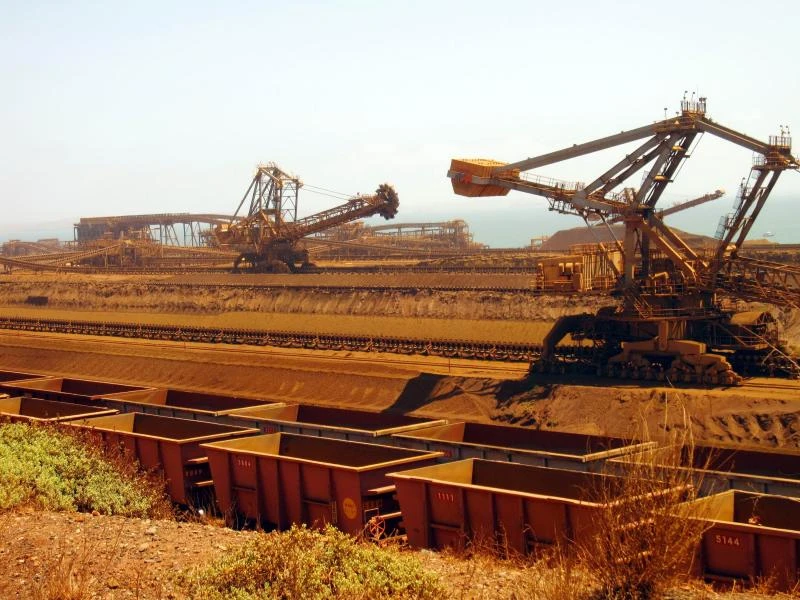
Just ask Fortescue Metals Group, the “new force in iron ore” as the Australian company describes itself.
The world’s fourth-largest iron ore miner has seen its shares slammed after Fitch Ratings put the company on negative watch, citing its exposure to the collapsed iron ore price.
But then, if you live by the sword...
As Fortescue concedes in its most recent financial report, it “has not entered into any forward commodity price contracts at June 30 2012 (2011: nil) and is currently fully exposed to commodity price movements.”
Fortescue, with long-term debt of A$ 11.3 billion, finds itself simultaneously over-exposed and over-leveraged.
It’s the result of a strategy predicated on that narrative of volume growth and a “Chinese put option” on the iron ore price.
Even after a hasty shuffling of the books, the sale of a power station and the deferral of some capital expenditure, Fortescue is still clinging to both strategy and narrative
The company has lowered its production guidance for the financial year through June 2013 but only by the smallest of margins to a range of 82-84 million tons from an original target of 86 million.
In other words, it’s going to keep digging.
Fortescue is not the only one of course.
Asked about hedging their exposure to the iron ore price, officials at Brazil’s Vale told analysts on the company’s Q2 conference call that “we believe that we are the lowest cost producer, even with this level of price, profitability in the iron ore is very good, so we don’t see any reasons to develop this kind of operation.”
This is the last man standing game.
The other two giants of the seaborne iron ore business, Rio Tinto and BHP Billiton, play it as well, relying on the low-cost profile of their giant Western Australian operations.
Fortescue, by contrast, needs the spot price to get back above $ 110 to avoid breaking its loan covenants, according to Fitch.
But will it? And if so, when?
According to the narrative, a price rebound requires China’s own iron ore producers to read the script and start cutting production.
After all, they are widely supposed to be the highest-cost producers around, meaning they should be hemorraging money at current price levels.
In the last man standing game, many of them should already have fallen before the likes of Fortescue were even tested.
The official Chinese production figures for July were ambivalent. Yes, daily iron ore production dropped a notch but only to 3.7 million tons from June’s 4.2 million tons. And June’s run-rate was the fastest so far this year.
Expect the production figures for August to be closely scrutinized.
But China has a habit of not conforming with Western expectations.
Market drivers coexist with social drivers, meaning that what Chinese operators should do and what they actually do are two separate things.
It’s this collision of two worlds, market economy and social economy, that is bedeviling the aluminum market at the moment.
With aluminum prices trading deep into the cost curve, Chinese smelters, some of whom operate at the very top end of that curve, should be cutting production.
What they have actually done is lift collective run-rates by a net 2.9 million tons over the course of 2012.
And the problems in China’s aluminum sector, namely a structural excess of capacity and resulting chronic over-production, pale into insignificance when it comes to China’s steel sector.
This is the root cause of the current iron ore price collapse, the compression of steel-making margins in a domestic market burdened by weakening demand and continued over-supply.
It’s the resulting industry-wide destock of iron ore that has translated into increasing numbers of spot cargoes being offered into a buying vacuum.
Chinese steel mills seem to have collectively gambled that Beijing would come to their rescue again with the sort of infrastructure build-out that followed the 2008-2009 shock-and-awe stimulus package.
This time around, however, Beijing doesn’t seem likely to play ball.
Not only is a dramatic change in policy unlikely before the once-in-a-decade leadership transition. But at a micro level the government is still trying to sort out the excesses of the last time it handed out a lot of cash to the country’s steel sector.
Banks are chasing down bad loans, many of which went into stock market bets or investments in the property sector.
There’s a strong sense that voluntary destocking down the steel chain is being overlaid by the forced liquidation of stocks held by trading houses that have found the credit taps turned off for them.
Barring a government-driven re-acceleration in steel usage growth in China, which currently looks unlikely, the steel sector should start cutting production.
This, ironically, would probably spell more short-term pain for the iron ore price.
But it would eventually help stabilize Chinese steel prices, which in turn would alleviate some of the margin compression.
The problem is that Chinese steel mills still show no signs of doing so.
True, the latest figures from the China Iron and Steel Association, covering the last 10 days in August, indicate a drop in annualized production to under 700 million tons for the first time this year.
But the Shanghai steel rebar price is still falling, suggesting that the cutbacks are nowhere near sufficient to realign supply with demand.
A more profound industry rationalization is necessary and Fitch for one is not convinced it is going to happen any time soon.
In a report on the Chinese steel sector released last month, the agency warned that continued over-production is the most likely scenario due to “larger steel mills’ priority of maintaining economies of scale and market share” and “smaller steel mills taking advantage of the recent fall in raw materials price to ramp up production.”
It is starting to look like China’s steel sector is playing its own game of last man standing, in effect embarking on a potentially protracted margin war.
If so, the iron ore market is going to need a new narrative. And, as far as the likes of Fortescue are concerned, the sooner the better.
— Andy Home is a Reuters columnist. The opinions expressed are his own.
Iron ore price collapse key concern for traders