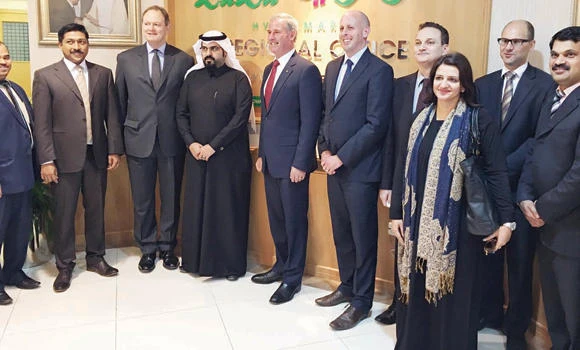
RIYADH: Saudi Arabia and Australia closely work within the framework of G-20 and its mandate, says Australian Minister of Education, Trade and Tourism Richard Colbeck.
In fact, Australia has been putting trade relations with the Kingdom and the rest of the Middle East in focus. “My visit, part of the country’s annual regional trade campaign, aims to generate new demand of services sector, which will be of significant benefit to Australia’s economy,” he told Arab News in an interview.
“The services sector accounts for 70 percent of the Australian economy and even more for employment. It is also important to mention that the Australian economy is now expected to grow substantially in 2015-2016. Saudi Arabia and Australia closely work within the framework of G-20 and its mandate,” he added.
Colbeck was in Riyadh while leading one of the series of road shows organized by Australian Trade Commission (Austrade) that were staged for a week from Jan. 24, across five countries in the Middle East.
He also discussed a range of cooperation plans and projects with Minister of Commerce and Industry Tawfiq Al-Rabiah, Minister of Education Ahmed bin Mohammed Al-Issa, and TVTC Gov. Ahmed bin Fahd Al-Fuhaid, besides officials of the GCC and the Saudi Commission for Tourism & National Heritage (SCTH).
Events related to his tour were to drum up interest in Australia’s trade, health, education, and tourism sectors.
The minister, who was accompanied by Ralph King, Australian ambassador to the Kingdom, outlined his country’s vision of bilateral relations and ties with the GCC as a bloc.
Excerpts:
Q: What is the purpose of your visit to the Kingdom? You are also visiting or have visited a few other countries in the Middle East. Is your visit mainly intended to promote and explore joint business opportunities in different sectors?
A: Well, Austrade is hosting a series of road shows in the Kingdom, the UAE, Kuwait, and Egypt to promote bilateral trade, investment and cultural ties between Australia and the Middle East and North Africa (MENA) region. Australian companies offering solutions to the growing health and medical needs of the MENA region are among the highlights of these trade and investment road shows. In Saudi Arabia, we had several fruitful meetings. The two sides have had keen desire to explore more opportunities to boost trade and investment. Trade between the Kingdom and Australia exceeds SR2.9 billion annually…but there is enough potential to expand it. Our aim is to consolidate commercial relations that can best ensure to utilize the expertise of Australian firms to develop health care and medical sectors, education and tourism sectors. Australian companies are already delivering solutions in the region, but they can offer more in terms of regulation of quality and standards, research and development, clinical trials, medical training and simulation. It is important that the Saudi market understands that we are willing to invest and we are willing to engage extensively. It has been very pleasing for me to see a range of Australian products and services in the Saudi market. The purpose of my visit was to interact with Saudi government leaders and to explore opportunities for growth and expansion of business relations. I have personally seen here in the last two days that there is a significant opportunity for growth. I think so far it has been a very successful visit to the Kingdom for me.
Q: Which are the new initiatives your country has undertaken to boost trade and investment relations between the Kingdom and Australia on one hand, and between Australia and the GCC as a bloc on the other?
A: As regards the GCC, I am committed to recommence negotiations between the GCC and Australia with an aim to eventually endorse a free trade agreement. In fact, we had some discussions with the GCC and also with the ministries of the GCC member states, indicating a common interest to start talks for FTA. We are keen to negotiate the free trade agreement with the GCC countries … we think that’s a big opportunity for us. In fact, Australia is keen on sealing the FTA with the GCC following our similar agreements with China, Japan and South Korea in 2014. Australia’s government hopes an FTA will increase trade and investment, particularly in Australian infrastructure, agriculture and tourism projects.
Q: Australia has been negotiating with the GCC for FTA for several years. What are the factors hampering the progress in FTA negotiations?
A: We see the announcement last weekend as a very positive signal and we hope things will progress. The negotiations were suspended previously for certain reasons. But, it is time to restart it. Australia’s trade and investment priorities in the Gulf region are unlikely to change. Australia has close political and economic relations with many Arab states, including the GCC member states.
Q: What is Australia doing to attract more Saudi and Gulf students to its educational institutions? Is Australia a favored educational destination for Saudi students?
A: Well, there are thousands of Saudi and international students arriving in Australia on annual basis. We have about 10,000 Saudi students currently on the rolls of different Australian universities and educational institutions. So, we are looking forward to growing up. Our institutions can team up with Saudi institutions in the field of education, research, training, and vocational training. In fact, 24 Australian universities have been ranked among the 200 most internationalized universities globally. The Times Higher Education, an agency entrusted with the task for auditing educational institutions, released a list of the 200 most outward-looking universities in the world recently. Australia had 16 in the top 100. The rankings were based on the proportion of international students, staff and research at each university.
Q: There was an announcement late last year about changes to be introduced regarding issuing Australian student visas as part of the process of simplifying it further. What is the status now?
A: One of the issues we are actively looking at is the development of a new policy on visa regime right now. We are certainly prepared to consider changes to visa arrangements to promote international education across Australia. I will have conversation with my colleague at the Australian ministry of immigration when I get back to my country before we make any announcement. Australia is welcomed unprecedented numbers of international students in 2015, and changes to the visa rules will stimulate further growth in enrolment. The introduction of a new international student visa framework — a change designed to make it easier for overseas students to study in Australia — will build further on the growth. In fact, the international education was worth over $12.8 billion to the Australian economy in 2014-2015, making it our fourth largest export earner by value and a major job creator. I welcome international students, who make a welcome contribution to the cultural richness of our education institutions and to the wider Australian community.
Q: Please name the Saudi officials whom you met during this trip and can you give the highlights of your talks with them? Did you sign any agreement or MoU during your visit to the Kingdom?
A: We haven’t signed any particular arrangement, but we do believe that there have been very fruitful discussions on a number of subjects. My visit was used to make contacts, business connections and holding conversation with Saudi government officials. I think it was a very successful visit in that perspective.
Q: Are you visiting other countries in the region as part of the road shows that have been launched by Austrade? What precisely is the agenda during such trips?
A: Australia is putting trade relations with the Middle East in focus. My visit, part of the country’s annual regional trade campaign, aims to generate new demand of services sector, which would be of significant benefit to Australia’s economy. The services sector accounts for 70 percent of the Australian economy and even more for employment. It is also important to mention that the Australian economy is now expected to grow substantially in 2015-2016. Saudi Arabia and Australia closely work within the framework of G-20 and its mandate.
Kingdom and Australia promoting relations within G-20 framework