The economic environment is favorable for local businesses and the depreciation of currencies against the dollar will support a healthier trade balance, a local bank says in its report.
The newly opened Letters of Credit (LC) represent consumer spending prospects as businesses import goods for future demand, the National Commercial Bank (NCB) said
In its Saudi Economic Review.
The Saudi economy witnessed a robust year that has trickled down to the consumer which drove businesses to expand and grow to meet the rising demand. Newly opened LCs grew by 11.8 percent annually during June at SR18.5 billion. Noticeably, opened LCs for building materials grew by 73.7 percent Y/Y in June and, over the first six months of 2014, settled LCs for building materials reached SR12.5 billion, rising by 24.0 percent Y/Y.
The NCB report said over the past few years, a series of global and regional events supported higher oil prices. As the largest OPEC producer and being an economy that is heavily reliant on oil exports, Saudi Arabia has blossomed with fiscal surpluses. The growing economy created substantial investment opportunities for other economies and trade ties are constantly improving. Saudi Arabia is eager to diversify away from oil and implementing various projects to accomplish its goals of developing the nonoil sector. Building refineries to grasp a larger share of the value chain has facilitated growth in manufacturing for consumption and exporting to other regional and international markets.
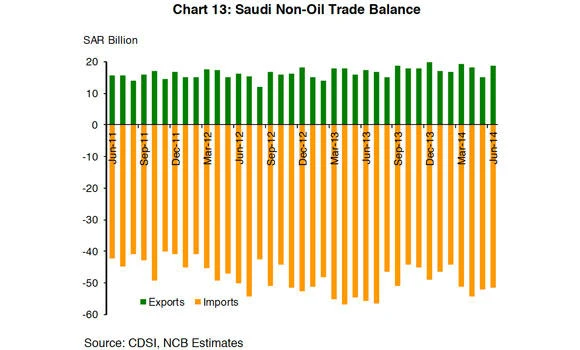
According to the Central Department of Statistics and Information, Saudi nonoil exports by value rebounded and recorded a 14.9 percent annual growth in June, compared to a contraction of 5.1 percent during the previous month, the report added.
During June, exports by weight increased by 3.2 percent which indicates higher pricing for goods. The main bulk of nonoil exports are plastic products which account for SR6.2 billion, a third of the total value. Expectedly, the second largest category is chemical products at SR5.8 billion for the month of June, growing by 11.8 percent on an annual basis. By destination, the UAE is the largest recipient of Saudi goods, growing by a staggering 60.4 percent Y/Y as most of the goods are likely re-exported to reach international markets. The second largest recipient was China at SR2.3 billion, a share of 12.2 percent of total exports by the end of the first half of 2014.
As for imports, the domestic economy imported goods worth a total SR51.5 billion, an annual 8.2 percent decline during June. Furthermore, the NCB report said imports by weight recorded a drastic drop of 20.9 percent annually, declining from 7.1 million tons in June 2013 to 5.6 million tons twelve months later. Over a quarter of Saudi imports consist of machinery and mechanical equipment at SR13.2 billion, dropping by 10.0 percent Y/Y in June. Additionally, transport equipment imports' total value declined by 15.6 percent annually.
As the Saudi economy is heavily reliant on imports for consumer goods, imported inflation influences local prices to a considerable degree. Imports from the European Union represented 27.8 percent of the total import bill during June, SR14.4 billion. Consequently, the recent strength of the US dollar will positively impact Saudi's trade balance and reduce pressures on local consumer prices.
China has recently overturned the US as the top source of Saudi imports. Their consistent growth over the past decade provided a competitive alternative for cheaper goods as they have the edge over advanced economies with regards to costs. Saudi Imported SR7.5 billion worth of goods from China while SR6.0 billion came from the US in June.
Kingdom heading for healthier trade balance