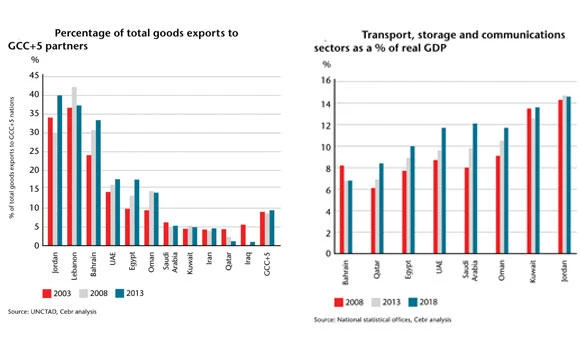
Although Saudi Arabia is the Middle East’s largest goods exporter, accounting for a third of total goods exported in 2013, only 5.3 percent of these were destined for other nations within the region, according to a new report by ICAEW.
According to Economic Insight: Middle East Q3, 2014, the GCC nations are leading the region’s current rail and aviation investment boom as they race to encourage more cross-border trade and address increasing congestion issues in the face of rampant population growth and rapidly-developing tourism markets.
Saudi Arabia is leading the charge with investment plans worth $45 billion in a bid to boost freight and passenger capacity, followed by Qatar and the UAE with investment plans worth $37 billion and $22 billion respectively.
The planned GCC Railway, a 2,177 km project, which will link the networks of the six GCC countries, represents the most ambitious aspect of the region’s railway infrastructure plans. With the Middle East set to become one of the world’s most important aviation centers, expansion of airports in all the major GCC cities has also become a priority.
Saudi Arabia’s plans include the North South Railway linking the capital with mining centers near the Jordanian border and ports on the Gulf, and the Landbridge freight link connecting the Kingdom’s east and west coasts and enabling fast cargo shipments between the Gulf and the Red Sea.
The GCC’s huge infrastructure pipeline is expected to see transport and logistics sectors play an increasingly important role in the region’s economies. They should start to generate significant value from these fixed assets in the form of efficient supply chains, delivery of goods and personnel across borders and supporting the activities of the travel and tourism industries. Kuwait, Saudi Arabia, the UAE and Oman will likely net the biggest windfalls, with logistics forecast to contribute 13.6 percent, 12.1 percent, 11.7 percent and 11.7 percent to their respective economies by 2018.
“While Saudi Arabia currently has some of the lowest levels of intra-regional trade of all the GCC nations, exporting marginally more than Kuwait and Qatar, this situation is expected to change significantly when the Kingdom’s rail and airport projects come online. This diversification will provide a necessary boost to the Kingdom’s nonoil sectors and reduce its dependency on hydrocarbons,” said Michael Armstrong FCA, ICAEW regional director for the Middle East, Africa and South Asia (MEASA).
While the GCC’s goods trade integration lags behind other regions in the world, free trade policies, continued minimization of tariff and non-tariff barriers to trade and transport infrastructure will help foster deeper intra-regional trade links. Currently, Saudi Arabia is the least open trade market in the GCC, scoring 74 percent on the Heritage Foundation’s Trade Freedom Index.
“With global oil prices forecast to fall over the medium-term as global supply increases, the need for economic diversification is becoming more pressing for the GCC countries. Saudi’s huge investment in regional transport and logistics networks should pay off and contribute to stronger growth. However, attention is also needed on trade reforms that will enable greater integration with regional and international markets,” said Charles Davis, director, Centre for Economics and Business Research.
With extensive infrastructure investment and fiscal expansion set to continue in Saudi Arabia, the Kingdom’s GDP is expected to grow 4.3 percent in 2014 and rising to 4.4 percent next year, according to the report.
Real GDP in the UAE is expected to increase by 4.7 percent, with the pace of growth set to decelerate marginally in 2015-2016. This is due to nonoil activities driving job creation and growth.
Kingdom’s diversification aims to increase intra-regional trade