JEDDAH: The Ministry of Finance budget announcement included preliminary macroeconomic data, which provides some insight into the Saudi government’s view on economic performance this year and prospects for next year. Data showed that overall economic growth fell to 3.4 percent year-on-year, slowing from 3.5 percent year-on- year in 2014, according to a report by Jadwa Investment.
Jadwa had forecasted 3.2 percent GDP growth in 2015. According to the budget statement, the oil sector grew by 3 percent year-on-year in 2015, Jadwa had forecasted 3.4 percent. Stripping out the oil and gas sector, nonoil economic growth was at 3.6 percent year-on-year with the private sector expanding by 3.7 percent, compared to Jadwa’s forecast of 3.8 percent. Lower oil revenues contributed to the first current account deficit since 1998. Inflation continued to decline.
Real GDP growth fell to 3.4 percent year-on-year, a trend which Jadwa had anticipated. The oil sector grew by 3 percent year-on-year as the Kingdom increased production. The latter grew by 5 percent year-on-year to an average of 10.2 million barrels per day compared with 9.7 mbd in 2014. Both higher crude exports, from 7.1 mbd in 2014 to an expected 7.4 mbd in 2015, and increased refinery output led to oil sector growth. As oil sector growth accelerated, the pace of growth in the nonoil economy did not fare as well, but nevertheless grew by 3.6 percent. Within the nonoil economy, growth of government services slowed to 3.3 percent.
The nonoil private sector grew by 3.7 percent. The data release showed that the transport sector would be the fastest growing sectors in 2015 at 6.1 percent. Construction sector growth was robust at 5.6 percent year-on-year. Nonoil manufacturing grew by 3.2 percent year-on-year, supported mainly by improved overall capacity, up 2.5 percent year-on-year, but specifically due to a rise in higher value adding specialty chemicals capacity, up 35 percent year-on-year. The wholesale and retail sector also recorded modest growth at 3.8 percent, reflecting weaker sentiment related to lower oil prices. Growth in the finance sector was also in line with expectations, at 2.6 percent.
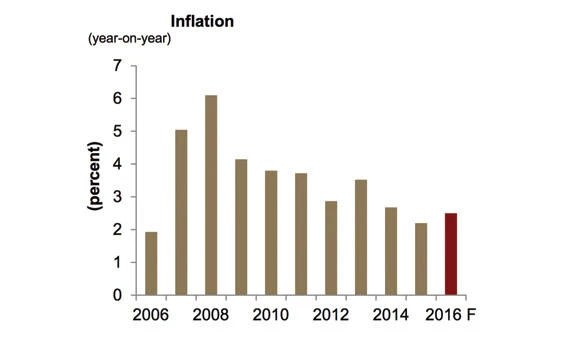
Inflation was put at an average of 2.2 percent, compared to 2.7 percent in 2014. This is in line with inflation data produced on a monthly basis by CDSI and is the lowest since 2006, when inflation reached 1.9 percent. Inflation has remained subdued relative to previous years, but a recent acceleration to rental inflation and the newly announced revision to domestic energy prices all point to a likely upward trend next year.
The current account recorded its first deficit since 1998 at $41.3 billion (6.2 percent of GDP), down from a surplus of $76.9 billion in 2014.
The fall in Saudi oil export price from $95.8 per barrel in 2014 to $49 per barrel in 2015 pushed the oil export revenues to $157 billion, down from $285 billion in 2014. Nonoil exports also fell by 18.8 percent year-on-year, compared to 6 percent growth in 2014. The fall in nonoil exports was mostly due to a decline in plastic and rubber, and chemical product exports.
Petrochemicals and plastics account for more than 60 percent of the Kingdom’s nonoil exports. Imports were also down by 10.5 percent year-on-year, more than the monthly trade data.
The Saudi economy will continue to decelerate in 2016, dragged down by slower growth in both the oil and nonoil sectors. Annual growth in the oil sector will remain positive in 2016 as gas production should support growth in the sector. The nonoil private sector will continue to grow albeit at a slower pace, as reduced government spending should continue to have a negative impact on business activity.
However, according to Jadwa, government will maintain a level of spending high enough to continue supporting positive growth in the nonoil private sector.
Economic growth in Saudi Arabia is forecast to slow to 1.9 percent in 2016, owing to a slower growth in both the oil and nonoil sectors. Based on the available data, oil sector growth to reach 0.9 percent despite a marginal decline in oil production. The forthcoming increases in domestic gas production will support the growth in the sector during 2016. Within the nonoil sector, the government’s real GDP to expand 2.5 percent year-on- year due to expectation of continued spending to meet demand on government services, while the nonoil private sector is expected to expand by 2.8 percent, slowing down from 3.7 percent in 2015.
Jadwa believes that the private sector will continue to feel the sentimental impact of lower oil prices, while lower government spending will limit any potential for an acceleration in growth for some businesses. From a sectorial point of view, Jadwa expects transportation and utilities, the main beneficiaries of government spending on key social infrastructure, as well as the service based wholesale and retail sector, to be the fastest growing sectors of the economy in 2016.
Inflation is expected to record an acceleration in 2016, but remain relatively low compared to previous years. According to Jadwa, reform to energy prices will be a major driver for inflation in the short-term. In addition, the housing segment has been the largest contributor toward headline inflation throughout 2015.
Jadwa said in its report that there will be some local inflationary pressure as a result of the high level of consumer spending. Pressure on domestic foodstuffs will likely remain subdued as international food prices continue their deflationary trend.
Oil exports are forecast to fall slightly, while imports will remain unchanged from their 2015 level. Investment income will rise, benefiting from the higher interest rate environment. This will cause the current account to record a smaller deficit at 6.3 percent of GDP.
Kingdom’s nonoil manufacturing grew by 3.2 percent in 2015