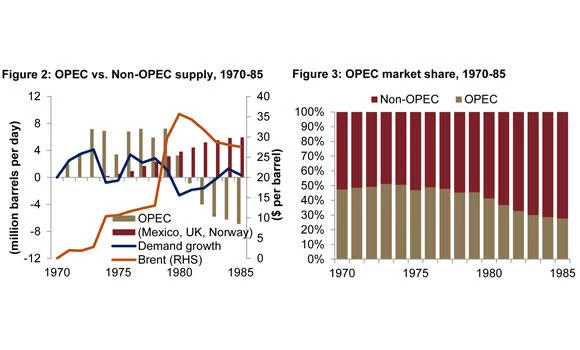
Saudi Arabia’s response to the fall in oil prices has been to decrease its official selling price (OSP), with OSP’s cut across all regions (Europe, America and Asia). In 2014 Saudi Arabia has witnessed increased competition in two of its key export markets, the US and China. In the US, Saudi’s supply of heavier crude has come under pressure from Canadian imports. Saudi exports to the US were steady around 1.2 million bpd in H1, 2014 but dropped to below 1 million bpd in September, whilst at the same time, US imports from Canada totaled their largest ever, at 3.5 million bpd, according to Jadwa Investment.
Saudi Arabia also faces competition in the Asian market with other Middle Eastern suppliers also cutting OSP’s to Asia, underling the trend in discounting prices. A number of countries are vying for market share in this growth region, especially so in China, where Saudi crude has recently lost out to Iraq, Iran and Russia.
The decision to cut OSP’s by Saudi Arabia, rather than production, shows that in a very competitive global oil market, with ample supply from non-OPEC sources, prices are not a priority, for now, rather the expansion, or indeed maintenance, of market share is the primary objective. As a result, based on Jadwa baseline price forecast we do not see Saudi production falling too dramatically in the next two years. Jadwa projects full year average production in 2014 at 9.7 million bpd; this will decline slightly to 9.6 million bpd in 2015 and then to 9.4 million bpd in 2016.
Based on baseline forecast for oil prices, Jadwa projects fiscal deficits of 2.7 percent and 5.7 percent of GDP for 2015, and 2016 respectively.
The strong sovereign balance sheet with foreign reserves of more than 95 percent of GDP and a public debt of less than 2 percent of GDP would put the government in a comfortable position to gradually adjust to the new norm of lower oil prices and avoid drastic cuts in fiscal spending that would disrupt private sector performance. Government spending will thus remain central to the economy.
The nonoil private sector growth is forecast at 4.8 percent and 4.6 percent in 2015 and 2016, respectively, growing at a lower pace compared to the mid-2000s, when a dynamic nonoil private sector grew at an average of more than 6 percent per year. Jadwa forecasts for real GDP growth under this scenario is 3.4 percent, and 3.2 percent for 2015, and 2016 respectively. Lower oil prices will also have a direct impact on the balance of payments which we now expect to record a surplus of 3 percent of GDP next year before turning to a deficit in the year after.
Balanced budget
If there were pressure on the government to avoid the negative sentiment associated with a fiscal deficit, it needs to reduce spending to the level where the budget is balanced. Relative to the baseline outlined, a cut in capital spending of 20.6 percent, and 47.8 percent is needed for 2015, and 2016 respectively. Cutting government spending to achieve a balanced budget has an important implication on private sector performance, especially when considering the high reliance of certain sectors – particularly construction and transport- on large scale public infrastructure projects.
According to Jadwa report, nonoil real GDP growth will slow to 4 percent and 3.8 percent for 2015 and 2016, respectively. This slowdown coupled with negative growth in the oil sector, would drag down overall real GDP growth to 3.1 percent in 2015, and 2.8 percent in 2016, respectively.
The fiscal balance
In high oil price scenario, Jadwa projects smaller fiscal deficits for 2015 and 2016 at 0.8 percent and 4.6 percent of GDP, respectively. The theme in this scenario involves lower oil output by the Kingdom as a main factor behind a stronger rebound in oil prices. While this will pull the oil GDP growth deep into the negative territory, it should eventually lead to slightly higher oil revenues compared to the baseline forecasts. Under such assumptions, overall GDP growth will slow to 2.5 percent year-on-year in 2015 and to 3.2 percent the following year.
A balanced budget under this high oil price scenario would require a cut in capital expenditure by 5.5 percent and 36.1 percent in 2015 and 2016, respectively. In this case, real GDP growth for 2015 and 2016 would slow further to 2.4 percent to 2.8 percent, respectively. Such a slowdown is mainly due to the impact of lower capital spending on nonoil economy. The growth of the latter would record 4.2 percent and 3.8 percent in 2015 and 2016, respectively.
Fiscal balance
Jadwa projects a decline to both oil prices and oil production. It, however, expects only a slight decline in oil production compared with the high oil price scenario leaving the oil GDP growth and consequently overall GDP growth almost unchanged. But, under these assumptions, the fiscal account will record a higher fiscal deficit of 4.6 percent of GDP for 2015 which should slide to 7 percent the following year.
Due to the assumptions that both oil prices and output are lower in this scenario compared with the baseline scenario, the cuts needed to balance the budget are significant in this case. Capital spending needs to be cut significantly, by 34 percent, and 59 percent, respectively, during the forecasted period. Such large cuts would lead to a slowdown in nonoil GDP growth by 3.8 percent and 3.7 in 2015 and 2016, respectively.
Kingdom’s real GDP growth forecast at 3.4%