Saudi Arabia’s revenues tumbled by over 40 percent on the back of low oil prices, settling at SR608 billion. Despite pumping record crude to defend market share, the fiscal balance registered a significant deficit of SR367 billion, 15.0 percent of GDP.
Due to unplanned events such as the royal decrees in 2015 and the war in Yemen, Saudi Arabia’s expense bill remained near SR1 trillion mark for the second consecutive year, registering SR975 billion, a drop of 14.5 percent over 2014, according to a budget report released by the National Commercial Bank (NCB).
Oil revenues reached a 6-year low in contrast to nonoil revenues that posted a record, driven by investment income. OPEC’s strategy, led by the Kingdom, to maintain its 30 million barrels per day output target to pressure high-cost producers has resulted in domestic oil revenues drop- ping by 23 percent to SR444.5 billion. The Saudi-led strategy manifested itself in production peaking at 10.6 mbd in June, which is expected to remain elevated throughout 2016. Conversely, nonoil revenues peaked at SR163.5 billion, a 36.8 percent Y/Y gain, with investment income rising by 81 percent to register SR37 billion.
The expense bill receded from the SR1.1 trillion registered in 2014. Despite the sharp declines in oil revenues, the government maintained expenditures near
record levels at SR975 billion, overrunning the budget
figure by 13.4 percent. The budget announcement revealed
that the Ministry of Finance has approved 2,650 contracts worth SR118 billion in new projects this year, a staggering 39.0 percent Y/Y drop. Additional outlays for ongoing projects will bring the total amount spent on capital expenditures closer to SR243.8 billion, according to NCB estimates.
The current account registered a deficit on the back of lower export revenues, albeit the decrease in the import bill. The current account posted a deficit of $1.4 billion, 6.3 percent of GDP, the first since 1998. The trade balance posted the third consecutive annual drop, declining by an alarming 65.9 percent during 2015. Exports were largely affected by the drop in oil prices, with oil exports representing 77 percent of total exports. Meanwhile, imports registered a contraction of 10 percent as the stronger dollar coupled with pressured commodity prices reduced the import bill. Accordingly, net foreign assets that fell by $84.0 billion in 2015 YTD to $641.2 billion are expected to fall further to $580.4 billion in 2016.
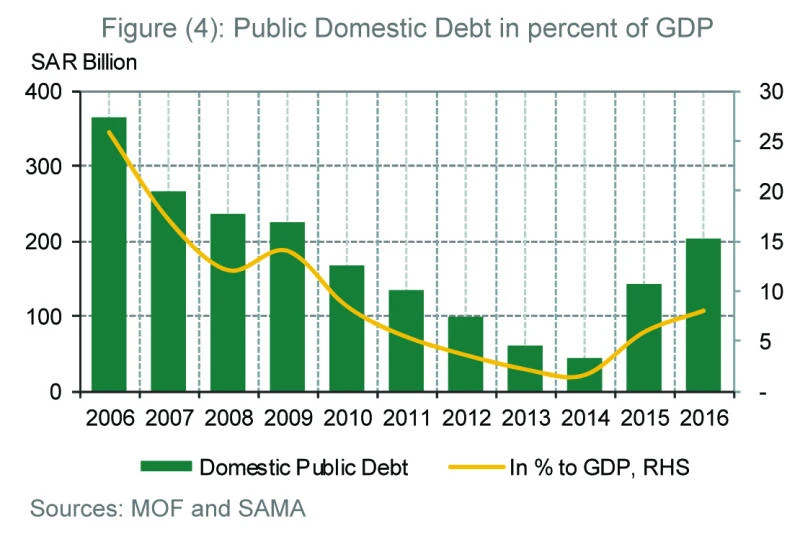
Public domestic debt recorded its first gain since 2002, reaching SR142 billion at 5.8 percent of GDP. The unutilized debt capacity was tapped in tandem with net foreign assets to finance the Kingdom’s funding shortfall. Saudi publicized bond issuances during the second half of 2015, offering maturities ranging from 5-10 years and yields below 3 percent. Further issuances are expected next year, which prompted a one notch downgrade by S&P to A+ from Aa3, contrasting with Fitch that affirmed an AA rating albeit with a negative outlook. According to the NCB report, the capital buffers accumulated prior to the oil collapse will provide stability going forward. Saudi Arabian Monetary Agency (SAMA) will continue to reduce the stock of T-bills to avoid a crowding-out effect and tighter liquidity amid the rising issuances of bonds. Evidently, T-bills have been reduced by 27.3 percent during 10 months of 2015 to settle at SR164.2 billion.
Fiscal Budget Outlook
in 2016
The government is adamant in supporting the economy by adopting a fiscal adjustment strategy centered around efficiency and viability. The 2016 budget continues to reflect the government's focus on long-term sustainable development that requires investment in infrastructure, education, health care, and social and economic development projects. As expected, education and training continued to be central to the afore- mentioned strategy, receiving 22.8 percent of total allocations, with health accounting for 12.5 percent of the budget.
The 2016 budget release estimates revenues and expenditures at SR513.8 billion and SR840 billion, respectively, projecting another deficit given the suppressed oil markets.
Oil prices will continue to be the main drag on Saudi Arabia’s balances. Based on announced revenues, government assumed next year’s oil prices to average $35 per barrel. With NCB forecast of $50 per barrel for the Arabian light spot price average and a 10.2 mbd for oil production average in 2016, NCB projects revenues and expenditures at SR629.0 billion and SR897.0 billion, respectively. This would lead to a budget deficit of SR268.0 billion, or 10.4 percent of estimated GDP in 2016.
Actual expenditure will overrun the budget, yet, will record an annual decline due to fiscal consolidation. It has become customary to exceed the announced expenditure figures, averaging an overrun of around 25 percent during past 10-years. According to NCB report, 2016 will only record an overrun of 6.8 percent as the government prioritizes projects, reduce subsidies and as the one-time effect on salaries fade. Out of the budgeted SR840 billion, SR657 billion or 78.2 percent is allocated to current expenditures. The remaining SR183 billion will be allocated to capital expenditures under a new budget support provision that will be disbursed depending on oil prices. Actual CAPEX is likely to drop by 26.4 percent to settle at SR179.4 billion by year’s end.
Allocations to specialized credit institutions moderated significantly, yet their continuation reflects adamancy to support the economy. According to the budget announcement, SR49.9 billion will be allocated to specialized credit institutions to finance major industrial projects and support social and human development. The funding will complement private sector credit growth, which recorded an annual 5.5 percent gain by the end of October 2015. Since the beginning of this year, the Saudi Industrial Development Fund (SIDF) has approved 117 loans, valued at SR6.2 billion across various industrial areas. The Saudi Credit and Saving Bank also financed 2’400 projects in 2015 worth SR388 mil- lion to support small-scaled private initiatives. Additional measures of finance toward SMEs continue to gain ground, with the Loan Guarantee Program “Kafala” facilitating credit worth around SR1.6 billion by the end of Q2, 2015 to 1’711 establishments. Since inception in 2006, Kafala has granted a total of SR12.3 billion .
Elevated production levels, record high inventories, and decelerating demand will suppress oil prices to an average of $50 per barrel in 2016. Growth dynamics pertaining to emerging markets, in particular China, and production factors relating to OPEC have underpinned this bearish view. The lack of compliance among OPEC members that produced above the 30 mbd quota for the 18th month in a row will be an important drag, especially that the group lacks a unified front. The Kingdom’s production peaked at 10.6 mbd in June, while Iraq has increased output over the year by around 0.7 mbd, reaching 4.2 mbd last month.
Additionally, lifting the sanctions imposed in July 2012 on Iran is expected to bring an additional 600,000 barrels a day, which will propel OPEC’s production above the 32 mbd mark. Even though non-OPEC members and high-cost producers will continue to be pressured next year, the anticipated decline in their production will not offset OPEC’s over quota strategy. The IEA, EIA and OPEC have forecasted a decline in non-OPEC supply between 250,000-600,000 barrels, largely due to the decline in US shale production.
The oversupply will remain a hanging cloud on oil markets containing any upside momentum next year. This will entail a reduction in oil revenues by 3.5 percent to SR429 billion despite the elevated levels of production. Aggregate-wise, the Kingdom’s total revenues are forecasted to increase by 3.5 percent to reach SR629 billion, supported by SR200 billion worth of nonoil revenues after the gradual removal of subsidies. Actual expenditures will likely exceed budgeted expenditures by 6.8 percent to reach SR897 billion, yet almost half the budget over- run posted in 2015.
Easing subsidies will underpin inflation that will increase to 2.7 percent in 2016 despite a stronger USD and weak commodity prices. Commodities are on course to record their fifth annual drop as reflected by the Reuters/Jefferies CRB Index that declined by over 25 percent YTD. In specific, global food prices have been posting double-digit annual declines this year, with the S&P Goldman Sachs Agriculture Index falling by 11 percent. This international dynamic had a positive spillover on domestic food prices, the largest component in headline infla- tion, that averaged around 1.8% in 2015YTD, significantly lower than 2014’s 3.3 percent average. A strengthening greenback, evident from a trade-weighted dollar that appreciated by 9.6 percent YTD, has been favorably containing imported inflation, which is critical given the heavy local reliance on imports. The NCB report said ripple effects of raising energy and utility prices on industry and higher income consumers will feed into higher prices across the economy, thus, offsetting the positive international dynamics.
KSA expenditure bill remains near the SR1 trillion mark