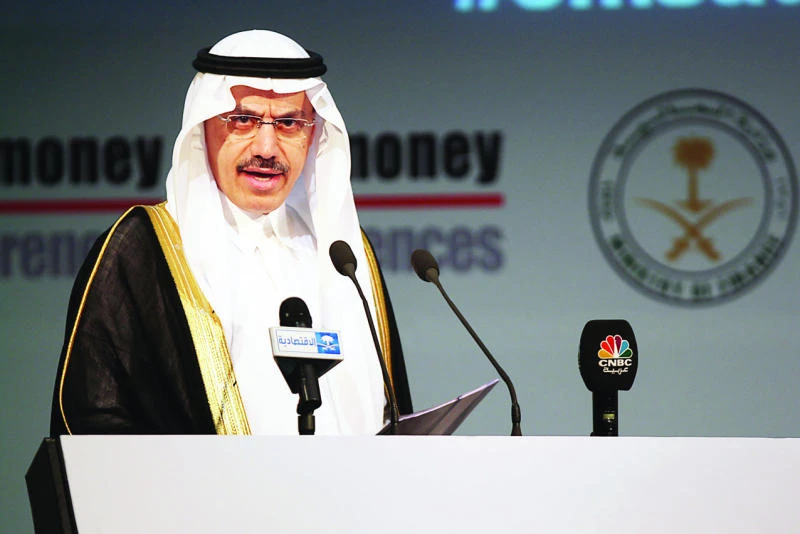
Saudi Arabia has entered the longest period of sustained growth in its modern history, said Majid Al-Moneef, secretary general of the Supreme Economic Council.
Al-Moneef was speaking at the 9th Euromoney Conference held in Riyadh.
“What is known in the economic history of the Kingdom as the first and the second boom, in the 70s and early 80s of the last century, each lasted two to three years,” he said, pointing out that the boom had continued throughout the past 10 years.
“Our challenge is to make such boom less dependent on the oil market cycle and its achievements well utilized toward an economy more diversified and dynamic.”
“Over the past 10 years, the Saudi economy grew by an annual average of 6.5 percent which is three times higher than the average recorded during the two preceding decades. The average growth rate of the non-oil sector grew by an annual average of 7.8 percent that is around four times higher than the average recorded the preceding two decades.”
“The increases in government revenue and expenditures by an annual average of 19 percent and 14 percent respectively and the latter’s components certainly contributed to such growth, especially that capital expenditure grew by an annual average 28 percent compared to 12 percent annual average growth for current expenditure,” he said.
He, however, said the current boom had its concomitant relations and challenges that should be addressed for the sustainability of the growth pattern and the productivity of the economy.
“The young population, the favorable financial position of the government and the inherent structural socio economic characteristics all have raised expectations,” he said.
Addressing the event, Moufarrej bin Saad Al-Haqbani, deputy minister of labor, explored key initiatives and programs in the Saudi labor market with special emphasis on the creation of more jobs for young Saudi nationals at private sector companies.
He said the Ministry of Labor had taken realistic steps whereby to empower Saudi women in the labor market through launching a number of legislatives and comprehensive programs.
The ministry has also introduced the Hafiz Program which is aimed at providing financial assistance to job-seekers in accordance with the set regulations in addition to training chances to them, he said.
Mindful of the intensive presence of foreign manpower in the market, he said the Ministry has launched and applied a series of measures aimed at improving market efficiency, especially recruitment of foreign workers, easy transfer of foreign workers through the application of “Ajeer” system, increase of work permit levy for foreigners to SR2,400 to rationalize recruitment and encourage national (Saudization) process, improvement of procedures and measures related to labor disputes, and signing of a series of deals with countries exporting manpower to the Kingdom to secure rights and duties of such workers.
He briefed the delegates on major and positive outcome of these initiatives such as the application of Nitaqat Program has led to the increase of Saudi (male and female) employees in the private sector companies from 724,000 in 1432 to roughly 1.5 million in 1435.
Female Saudi employees in the private sector firms grew to 402,000 in April 2014 compared to 56,000 in 2010.
The number of Saudi employees who are withdrawing monthly salary of SR3,000+ increased from 376,000 before the application of Nitaqat Program to more than 1.3 million currently.
In his speech, Housing Minister Shwaish Al-Dowaihy said the coming period will witness enormous growth in housing sector in the light of generous support given by the government to the sector to meet the growing demand in this regard.
The ministry has finalized the national strategy on housing by focusing on challenges and the required solutions to the housing issue. The ministry has also completed some of housing projects in a number of regions whereas other projects are being implemented, he said.
To support its programs, he stressed that the Ministry has launched an e-portal for rental services which is aimed to streamline house rental services between landlords, tenants and brokers, he said.
He stressed on the importance partnership with the private sector firms and real estate developers. A series of workshops were organized with developers to explore funding, legislative and marketing issues, he said.
The Minster also urged banks and other funding institutions to inject more funds into housing projects and provide loans to developers and citizens as well.
Minister Al-Jasser highlighted the Kingdom’s efforts to improve competitiveness to own sustainable generation of wealth. Saudi Arabia has increased the budgets of universities and research centers and the King Abdulaziz City for Science and Technology (KACST) to enable them to step up their research and development activities and to assume a key role in improving the innovation environment in the Kingdom.
KSA pledges diversified and dynamic economy