The extensive Saudization efforts have added 622,000 new jobs in the private sector during 2011-2013, a staggering 74 percent gain, and the number is bound to rise further this year to bring Saudis’ participation close to the 2 million mark, says a post-budget report released by the National Commercial Bank (NCB).
“Even though we still believe that restraining growth in current expenditures is highly needed to mitigate fiscal sustainability concerns, the success of the recent Saudization drive will be favorable budget-wise especially that it can contain the need for public sector employment as well as the rise in allocations for unemployment (Hafiz) and social benefits,” says the NCB’s research team.
Saudi Arabia might have decoupled from the rest of the world during the financial crisis whether it be on the macroeconomic or the banking front. However, the next five years might prove to be a challenging time for policy making, according the NCB’s Saudi Budget Report.
Range-bound crude oil prices between $70/bbl and $100/bbl might materialize during the medium-term horizon, which will weigh negatively on oil revenues and will reverse the hefty fiscal and current account surpluses of recent years. The higher budget break-even oil prices will make the government more prudent and conservative, said the report.
Nevertheless, the substantial net foreign assets and the unutilized debt capacity will act as countercyclical buffers that smooth out the business cycle if it surprised to the downside, an unlikely scenario, given the resilience of the corporate sector.
The sluggish contribution by the oil sector will be offset by nonoil GDP growth that is expected to average around 4.3 percent during 2015-2019, as most sectors, mainly manufacturing and construction, continue to reap the benefits of the myriad projects still coming on-stream from the 2008-2013’s SR1.2 trillion capital expenditures boom.
Yet, the relative deceleration compared to 2003-2013 time-frame will be attributed to the petrochemical sector that follows similar oil dynamics and an expected slower pace of increase in government expenditures.
Since the royal decrees announced in 2011, the annual growth in government expenditures had fell from a staggering 26.4 percent to 12.7 percent coupled by a similar reduction in the budget overrun from 42.5 percent to 28.7 percent, in 2011 and 2014, respectively. Hence, it is believed that government expenditures will plateau, resulting in a relatively lower direct and indirect stimuli.
The NCB report projects real GDP growth of 3.4 percent in 2015.
The contraction in the oil sector, given an expected reduction in crude production by around 200,000 b/d will largely be offset by the nonoil private sector, which is estimated to grow by 4.0 percent, driven by the private sector, mainly construction, trade and manufacturing, added the report.
The Council of Ministers endorsed the government’s budget for 2015 on Thursday and announced the final outcome of fiscal operations and macroeconomic performance for 2014.
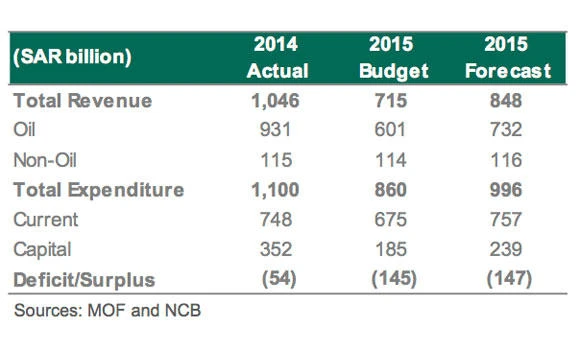
The fiscal balance recorded the first deficit since 2009 at SR54 billion in 2014, approximately 1.9 percent of GDP, affected by lower oil revenues and increased expenditures.
Based on 2010 prices, the Saudi economy accelerated by 3.6 percent during 2014, outperforming 2013’s growth of 2.7 percent. Ostensibly, the nonoil sector underpinned the economy by growing around 5.2 percent.
Importantly, the nonoil private sector increased by 5.7 percent Y/Y, driven by construction, trade, and manufacturing that grew by 6.7 percent, 6.0 percent and 6.5 percent, respectively
The 2015 budget estimates revenues at SR715 billion and expenditures at SR860 billion, projecting the first deficit since 2009. The budget continued to emphasize both human and physical capital expenditures to support sustainable and balanced growth.
The next five years might prove to be a challenging time for policy making. Range-bound crude oil prices between $70-$100/bbl might materialize during the medium-term horizon, which will weigh negatively on oil revenues and will reverse the hefty fiscal and cur- rent account surpluses of recent years.
“We project total revenues at SR848 billion and expenditures at SR996 billion, predicting a deficit of SR147 billion in 2015. Our forecast is based on an average Arabian light oil price of $80/bbl for 2015,” said the report.
It said the Kingdom’s domestic debt continues to reflect a strong and healthy economy as it reached SR44.1 billion, 1.6 percent relative to GDP.
Even though the government is able to pay off the entirety of its debt, it opted out from such direction given the low cost of servicing debt.
The preference is to finance expenditure plans at home or to diversify investments abroad.
“In our opinion, a certain level of sovereign debt is necessary as a monetary tool to manage money supply and as a benchmark for pricing corporate bonds and sukuk. The result of Saudi Arabia’s policy decisions have been reaffirmed by Fitch as they upgraded the economy from AA- to AA with a stable outlook for the Kingdom,” said the NCB researchers.
SAMA continues to use various tools to implement its prudent policies such as issuing T-bills to control liquidity. The pace of issuances have increased this year by 32.7 percent Y/Y for 11M2014 as T-bills reached SR224.6 billion by November, said the report.
According to the report, the government is adamant in pursuing expansionary policy to diversify the economy and ensure sustainable growth. The 2015’s budget continues to reflect the government’s focus on long-term sustainable development that requires investment in infrastructure, education, health care, and social and economic development projects.
As expected, education and training continued to be central to the aforementioned strategy, receiving 25.2 percent of total allocations, with health accounting for 18.6 percent of the budget. The 2015 budget release estimates revenues and expenditures at SR715 billion and SR860 billion, respectively, projecting another deficit for 2015 as suppressed oil markets pressure the Kingdom’s balances.
“Based on previous years, we believe that these figures are underestimated, and the government will overrun the budget and record a larger deficit on the back of higher current expenditures, notably for wages and salaries, and continued funding for mega projects. However, in our opinion the actual expenditures growth will fall into negative territory, well below the 13 percent average registered during 2003-2013 as the government uses its huge foreign reserves prudently,” said the research team.
“Oil prices will be the main drag on Saudi’s balances. Although the budget press release does not provide oil price and production level assumptions, we believe that both revenues and expenditures are understated,” said the report.
“Based on announced revenues, government assumed next year’s oil prices to average $61/bbl. With our forecast of $80/bbl for the Arabian light spot price average and a 9.5 MMBD for oil production average in 2015, we project revenues and expenditures at SR848 billion and SR996 billion, respectively. This would lead to a budget deficit of SR147 billion, or 5.5 percent of estimated GDP in 2015,” said the report.
Nonoil GDP growth to average around 4.3% during 2015-2019