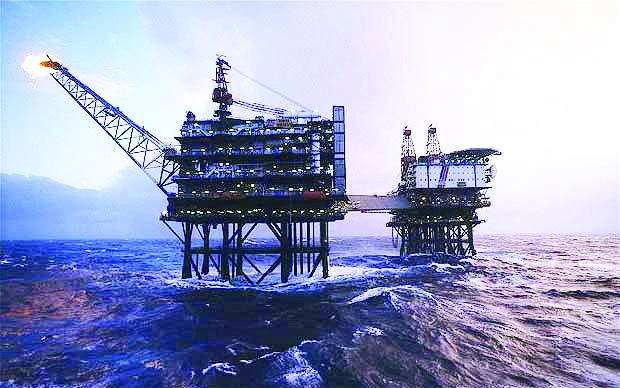
LONDON: Britain's North Sea oil and gas operators are mounting an impressive lobbying campaign to win tax concessions and other government help ahead of the final budget of this parliament on March 18.
In an editorial in Thursday's Financial Times newspaper endorsed the idea of "a new deal to keep North Sea oil flowing". The newspaper wants the complex system of tax allowances to be simplified, rates cut, and more risk-sharing between exploration companies and taxpayers.
It also wants the government to find ways to defer the decommissioning of old platforms, pipeline systems and other infrastructure — originally built to exploit giant fields like Forties and Brent discovered in the 1970s and 1980s — which are now key to the profitable exploitation of smaller finds made in recent years.
The newspaper insists "this would not be a return to a 1970s-style industrial policy, when government subsidized dying industries such as shipbuilding that were more rationally conducted overseas. It is a perfectly sensible way of maximizing the value of the UK's endowment of oil reserves and also preserving the country's energy security. It would also be a way to keep existing infrastructure up and running as old wells expire."
A more cynical observer might conclude that it is exactly a return to industrial policy. And the more apt comparison is not with shipbuilding but the coal industry, which was allowed to wither in the 1980s and 1990s when it could not compete with the surge of cheap North Sea gas.
The North Sea has already produced 42 billion barrels of oil and gas, but could have as much as 24 billion barrels left, according to FT columnist Nick Butler ("Don't abandon the North Sea" Feb 22).
For North Sea operators and their supporters, the remaining reserves provide a compelling economic reason to keep producing to avoid leaving value locked in the ground.
The reserves represent tens of billions of dollars in profits, wages and tax revenues that would be lost if the North Sea fields are abandoned prematurely. North Sea reserves have a strong political dimension because most operators and service companies are based in Scotland, where separatist sentiment remains strong despite the rejection of independence in last year's referendum.
The economic reality is more complicated. The notional value of the oil and gas that would remain locked in the ground is not a convincing reason why it should be developed. In a market-based economy, resources are developed only if they can be extracted profitably.
And there are many instances where resources have been left in the ground or abandoned because it was no longer possible to exploit them profitably.
The distinction between exhaustion and profitability was central to the year-long dispute between the National Union Mineworkers (NUM) and the Conservative government led by Margaret Thatcher, the defining moment in Britain's modern economic history.
In the early 1980s, Britain's state-owned coal company wanted to close mines that were no longer profitable while the NUM resolved "to re-affirm the union's opposition to all pit closures other than on grounds of exhaustion."
The NUM demanded that pits remain open as a source of employment and national energy security as long as there was valuable coal underground ("Crisis management in the power industry" 1995).
Ironically, coal's nemesis came from the giant gas fields found in the North Sea between the 1950s and 1970s, which threatened coal's dominance in power generation ("Energy, the State and the Market" 2003).
Once the government's support for coal was removed after the strike was broken, construction of coal-fired power plants ended and power producers raced to build cheaper gas-fired facilities to capitalize on the cheaper fuel.
By the end of the 1990s, nearly all of Britain's pits had closed, although there were still billions of tonnes of coal left underground. Twenty years later, Britain's gas supplies are dwindling, and the country increasingly relies on imported gas from overseas, raising concerns about "energy security".
If energy security had been the clinching argument, the government would have intervened to keep more pits open. Instead, Britain chose a market-based approach. There is no reason why North Sea oil and gas producers should be treated any differently.
Britain's oil and gas producers are among the victims of the North American shale revolution and the price war between OPEC and the US shale industry.
— John Kemp is a Reuters market analyst. The views expressed are his own.
North Sea oil and gas firms must look to future abroad