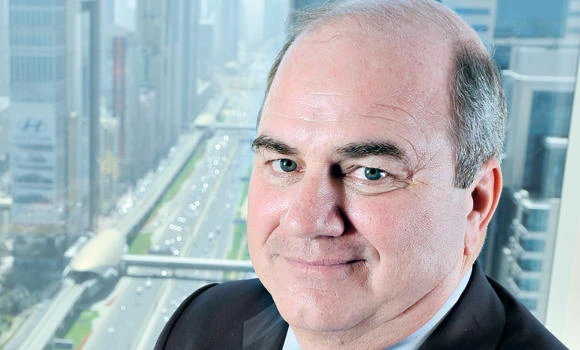
Saudi Arabia sets a high standard in terms of the volume of infrastructural development and demands world-class quality from project managers and contractors. “For many years, the Kingdom has been a key market for us with immense growth potential. Not only are we able to provide the most technologically innovative products to meet increasing demands of contractors, but due to Otis’ size, scope and experience, we are able to provide tailor-made solutions and after-sales service,” Rick Pulling, director for key projects and worldwide sales at Otis, told Khalil Hanware of Arab News in an exclusive interview.
To foster the technical crave of the Saudi students, Otis Saudi Arabia has taken the lead to work in coordination with the Technical & Vocational Training Corporation (TVTC) and add “Basics of Elevator” as one of the subjects in its syllabus. “We are also planning to invest in a training facility here in Saudi Arabia,” Pulling said.
Otis is involved in a number of major projects in Saudi Arabia. “We will install our Gen2 lifts in the Haramain high speed rail stations across Makkah, Madinah and Jeddah, high-speed lifts in the Lamar Towers in Jeddah and double-deck lifts at the King Abdullah Financial District in Riyadh,” said Pulling who has worked with the Otis elevator company for 28 years.
“Owing to the importance of Saudi Arabia as a key market, we are delighted to be in the Kingdom to celebrate the 160th anniversary of our company,” said Pulling.
How has been Otis' journey in the last 160 years?
Since Elisha Otis installed the first elevator in 1853, our journey has been one of safety, innovation and continued success. Our company was founded with the development of a safety elevator, which resulted in the evolution of a goods and freight moving device to a vehicle for moving people. From steam and hydraulic elevators, to more recent electric and automatic elevator, these 160 years have been focused on safely transporting people higher and faster. As economies have expanded and development has spread around the globe, Otis has continued to be partner in some of the most iconic building projects worldwide, such as the Empire State Building in New York, Petronas Towers in Kuala Lumpur and the Burj Khalifa in Dubai. We have built a strong team over the last 160 years, employing 60,000 people across the globe.
What is the market for Otis products in Saudi Arabia and other GCC countries?
Among the major markets in the world, Saudi Arabia sets a high standard in terms of the volume of infrastructural development and the quality demanded. For many years, the Kingdom has been a key market for us with immense growth potential. Not only are we able to provide the most technologically innovative products to meet increasing demands of contractors, but due to Otis' size, scope and experience, we are able to provide tailor-made solutions and after sales service. In fact, Otis has been involved in a number of major projects in Saudi Arabia, including the installation of escalators and travolators (moving walkways) at Al-Jamarat Bridge and Metro Almashaer Almugadasa in Makkah with 9 stations, which at certain times of the year have carried up to 3.2 million people. We will install our Gen2 lifts in the Haramain high speed rail stations across Jeddah, Makkah and Madinah, high-speed lifts in the Lamar Towers in Jeddah and double-deck lifts at the King Abdullah Financial District in Riyadh.
What's the purpose of your tour of Saudi Arabia. Do you have any specific business strategy for the Kingdom?
Owing to the importance of Saudi Arabia as a key market, we are delighted to be in the Kingdom to celebrate the 160th Anniversary of our company. In addition, my aim is to support the Otis team here in Saudi Arabia on current and future projects by assessing and understanding the needs of the Saudi market and developing new products to satisfy their requirements, especially in the huge infrastructure projects invested by the Saudi government in health care and education.
In 2013, Otis introduced an energy-efficient Gen2 Switch elevator. Can you tell us about this new product?
Gen2 Switch is one of the newest innovations in our Gen2 product range. Gen2 Switch is a battery-powered elevator that does not require three phase power, but rather uses single phase power such as plugging into a wall to charge the battery. The benefits of this product are particularly significant in areas that experience frequent power interruptions or shortages, as the battery system enables the elevator to continue running until power is restored. Since it uses a level of installed power that's 18 times less than a standard gearless elevator, Gen2 Switch uses less power overall, leading to lower bills. In fact, Gen2 Switch's installed power requirement is less than a vacuum cleaner, hair dryer or microwave oven. Three-phase power is also relatively expensive, whereas the utilization of single-phase power reduces overall costs while simplifying and accelerating the construction process making the Gen2 Switch elevator a great option for existing buildings.
How many manufacturing sites Otis has worldwide?
In 2013, Otis will officially open its three newest manufacturing facilities - in Brazil, the United States and India. These new facilities will bring the total number of Otis manufacturing sites to 20 worldwide.
I believe Otis' presence is strong in the Middle East. Are you planning any manufacturing plant in the region?
Otis evaluates its manufacturing capabilities on an ongoing basis. Our goal is to have facilities at key locations to support our customer needs. At the moment, we will support our customers in the Gulf with our manufacturing sites in Turkey, Spain, France, Germany and China. While our manufacturing facilities support our new equipment business, people are the key to our service business. Otis will continue to invest in developing the highly-skilled service engineers which we need to meet our customer needs in the region. To foster the technical crave of the Saudi students, Otis Saudi Arabia has taken the lead to work in coordination with the Technical & Vocational Training Corporation (TVTC) to add the 'Basics of Elevator' as one of the subjects in its syllabus. We are also planning to invest in a training facility here in Saudi Arabia.
What is Otis’ e-Business strategy?
The strategy of e-Business is becoming increasingly important in this age. We are currently investigating a number of platforms to use as a means of communicating and interacting with our various stakeholders - architects and engineers, contractors, business owners - in a way that is relevant and accessible to them. Resources, information, layouts and product data need to be readily and easily available. The challenge in the elevator business is that the buildings vary in terms of height, configuration and a number of other factors. This means that products need to be manufactured to meet individual requirements. However, as construction standards become more standardized, the ability to order products online will continue to evolve. On the service side, Otis will begin a global roll-out of a new service product that extends our e-Service offering with a new iPhone and Android application. This new app will allow building managers and owners to monitor elevators and order service for multiple locations from their smart phones.
Otis elevators are in the Burj Khalifa, Dubai, the tallest building in the world at 2,722 ft. Over the past 100 years, ten buildings have held the title of "World's Tallest Tower" and Otis has provided elevators to eight of the ten. Which are they?
The Empire State Building held the title for the "World's Tallest Tower" for the longest period (40 years) over the last century, and we are proud to say that to this day, the tower is fitted with Otis elevators, which we are currently in the process of modernizing. In addition, we have installed elevators in the World Trade Center, Shanghai and World Financial Center, Petronas Towers 1&2.
Otis installed its first elevators in China in 1888 — a country that today accounts for half of all global elevator sales. What is Otis' share in the Chinese market now?
China, like the Middle East, represents a huge growth opportunity for Otis. The Chinese market is geographically dispersed and is served by the major players in the elevator industry, but also by many local Chinese manufacturing companies, making it difficult to accurately gauge market shares. However, Otis is a leading supplier of lifts to the Chinese market. Otis also goes to market with four brands in China that include Otis, Xizi Otis, Express and Sigma.
How is the after-sales service of Otis?
We are very proud of every element of service provided by Otis, and consider this to be one of our core strengths. Effective service requires extensive infrastructure with highly trained and skilled workers, and an effective supply and logistics operation to ensure that necessary parts and supplies are available to perform preventive maintenance. Otis has made significant investments in technology to support service teams' efforts to respond in a timely manner, in troubleshooting and implementing corrective actions. Remote Elevator Monitoring (REM) and Elite Service are two key areas of investment for Otis. REM, an Otis first, constantly monitors the elevator and can identify potential issues before the customer is aware, allowing a mechanic to be dispatched to correct the problem. Elite Service enhances this system and allows for certain issues to be corrected remotely, without the need for a mechanic to be dispatched. This intervention is accomplished by a team of experts remotely located, who are able to investigate, diagnose and, in many cases, restore an elevator to service safely and reliably without sending a mechanic to the building.