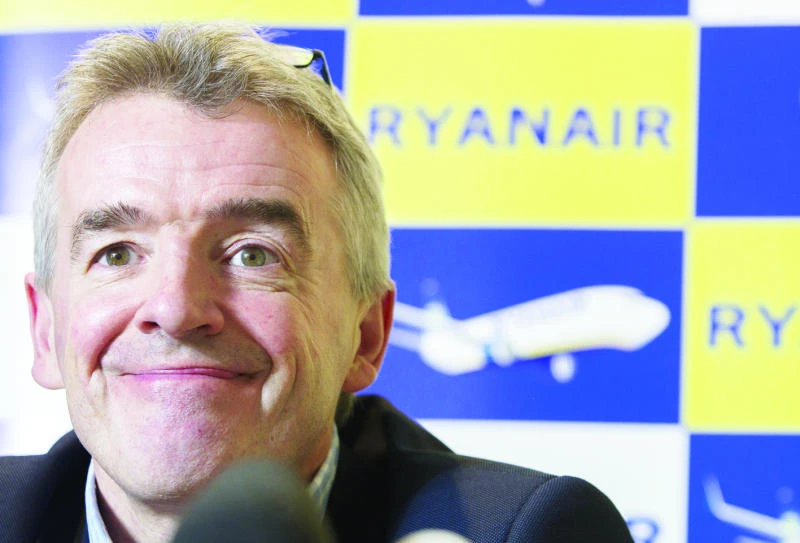
DUBLIN: Ryanair trumpeted the success of its image makeover after soaring passenger numbers helped the Irish airline to post a 66 percent rise in full-year profit.
The budget carrier, whose outspoken CEO Michael O’Leary softened his notoriously no-frills business model last year, said passenger numbers grew nearly three times faster than original estimates thanks to a combination of improved service and lower fares.
Management forecast a further 10 percent increase in the coming year and said the growth would not come at the cost of lower fares this summer, easing concerns that had hit share prices across the sector in recent weeks.
Most of the growth was attributed to Ryanair’s Always Getting Better program, aimed at turning round its reputation for poor customer service to better compete with rival easyJet and Europe’s flag carriers.
“Always Getting Better is the key. It has been very well received,” said finance chief Neil Sorahan, crediting lower fees, flexible tickets for business travelers and a move away from small regional airports for boosting the number of passengers per flight by 5 percent.
The company’s full-year results lifted its share price 5.4 percent by 1041 GMT, against a 0.4 percent gain for easyJet.
“I think that momentum will continue as it’s almost like a hurdle’s been removed and people can appreciate the low cost,” said Mark Denham, European equities fund manager at Aviva Investors, one of Ryanair’s 10 biggest shareholders.
Some investors took fright when easyJet warned this month that revenue per seat would be down by about four percentage points in the three months to June, sparking fears of aggressive price cuts by Ryanair.
But Sorahan said its fares would be “broadly flat” in the six months to September.
“Everyone was holding their breath for the past fortnight, waiting for the largest low-cost carrier to show the way ... The sector can exhale now,” Investec analyst Robert Murphy said.
Ryanair’s shares have surged since it announced it would compete for passengers who are less price-sensitive. The shares are up 58 percent on a year ago, compared with an increase of 1 percent at easyJet.
However, analysts said that Ryanair’s growth is not necessarily bad news for easyJet because it competes directly only on about 5 percent of routes and retains a big lead on serving primary airports.
“Ryanair has learnt some lessons from easyJet’s success and is not abashed about copying good ideas, but nonetheless starts with a significant cost advantage over easyJet,” said Pauline McPherson, co-fund manager at the Kames Global Equity Fund.
Ryanair said half of its additional 10 million passengers this year would be flying from primary airports.
Passenger numbers increased 11 percent to 90 million in the year to March 31, compared with the 4 percent targeted at the start of the year. Management had also set a target of 100 million passengers for the current financial year.
Profit after tax hit 867 million euros ($948 million) and would reach between 940 million and 970 million this year, the company said. A Reuters poll of analysts had forecast profit of 866 million euros.
Sorahan said there could be some upside on the profit forecast if expected “irrational fare cuts” by competitors don’t materialize.
CEO O’Leary described the profit guidance as cautious but also warned that he is not afraid to cut fares if necessary.
“We’ll take whatever price they’ll pay us, as long as we fill our flights to 90 percent,” he said.
Ryanair reaps rewards of image makeover with 66% profit leap