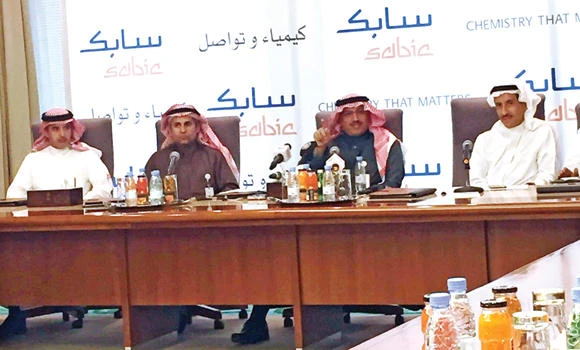
RIYADH: Saudi Basic Industries Corporation (SABIC) has set up a committee to promote the SMEs in the Kingdom, said Yousef Al-Benyan, its acting vice-chairman and CEO, said here on Monday.
Al-Benyan was speaking to newsmen while presenting the fourth quarter and full year results for 2015 of the organization.
He said the committee will function with the cooperation of the Ministry of Commerce and Industry to create downstream industries, which would also provide employment opportunities for the youths.
He pointed out that despite challenges, SABIC will forge ahead with new plans that will be unveiled shortly for the year 2016. “We want to increase our presence in countries such as Indonesia, Malaysia and Vietnam, and in Africa,” he added.
“We will intensify our efforts to focus on the need for increased competitiveness locally, across the GCC and globally, to ensure increased growth. We will also give special attention to technology and innovation, increasing our efficiency and solutions offering to customers. We will further broaden our market appeal by increasing our product portfolio,” he noted
During the press conference, SABIC announced its fourth quarter and full year results for 2015. The net profit for the quarter stood at SR3.08 billion ($821.60 million), a decrease of around 29.36 percent from same quarter in the previous year, when the net profit was SR4.36 billion ($1.16 billion).
“The profitability of SABIC’s business held up well in the last quarter of last year despite the challenging global economic environment. Part of the decline in profits in the last quarter of 2015 is attributed to a sharp fall in the price of metal products. However, our metals operations are running at full capacity and our customer base is loyal.”
The net profit for SABIC in 2015 was SR18.78 billion ($5.01 billion), 19.57 percent lower than 2014, when net profit was SR23.35 billion ($6.23 billion).
“Industries that use oil or gas as a feedstock, such as petrochemicals, go through cycles as prices rise and fall — this is a natural part of the business,” Al-Benyan said. “SABIC is well placed to deal with these cycles having been through five or six in its history. However, in 2015, SABIC increased production by one percent and sales volume by four percent compared to 2014, which is clear proof of SABIC’s ability to communicate with its customers and leverage its global presence, growth and competitiveness.
“In addition to this, product demand has slowed because of diminished growth in the emerging economies of Asia and the mature economies of Europe,” he added.
“The good news is that SABIC is undergoing a transformation process to make it more fit to tackle these challenges and the benefits will continue to filter through to our organization and contribute to even greater profitability,” he said.
“The project is making us more agile, cost efficient and better prepared for today’s fast moving business environment,” he said, adding that the transformation involves evaluating our businesses to make them ever more closely aligned to customer needs and requirements.
To date this has led to a reduction in the number of our strategic business units (SBUs) from six to five. These steps are consistent with the strategy of optimizing our existing portfolio while continuing to invest in innovation and our work force, to
“In addition, we continue on the path set by our 2025 strategy to become more integrated in our operations, global in our outlook and focused on working with customers to deliver the solutions that will help them to achieve their ambitions, make sure they have the skills to lead the industry,” Al-Benyan said.
“This is ‘Chemistry that Matters’ and the reason we look to the future with confidence. We will intensify our efforts to focus on the need for increased competitiveness locally, across the GCC and globally, to ensure increased growth. We will also give special attention to technology and innovation, increasing our efficiency and solutions offering to customers,” he added.
SABIC sets up committee to promote SMEs in KSA