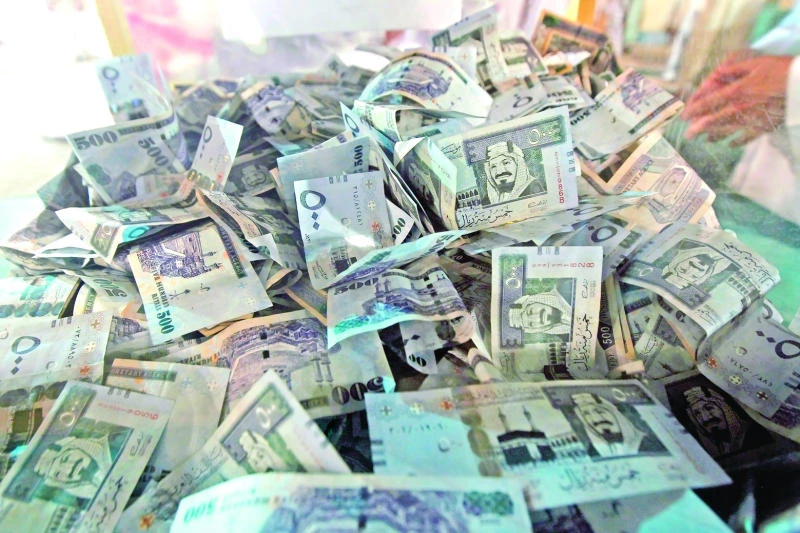
Saudi Arabia’s monetary system continues to be awash with liquidity over the past few years as elevated oil prices and increased production resulted in higher revenues.
Following 32 months of consecutive annual gains, the monetary base (M0) recorded its annual contraction of 9.7 percent, settling at SR302.5 billion.
While the base effect greatly contributes to the decline, M0 also declined on a monthly basis by 0.9 percent, the National Commercial Bank (NCB) said in its latest report.
Saudi bank reserves recorded a large drop during October, falling by 19.6 percent. Banks’ deposits with Saudi Arabian Monetary Agency (SAMA), which constitute over 80 percent of bank reserves, dropped by SR35.8 billion over the past twelve months. Moreover, cash in vault settled 10.6 percent lower on an annual basis to SR24.2 billion, the NCB report said.
By the end of last year, banks’ excess reserves ratio which is represented by deposits with SAMA other than statutory deposits reached 64.6 percent given the liquid state of the market. The ratio plunged to 40.5 percent during October as banks opt to utilize their assets by offering credit coupled with the government’s attempt to contain liquidity by issuing T-bills. Additionally, currency outside banks reached SR144.2 billion, an increase of 4.5 percent annually, as the crackdown on illegal workers spiked cash handling.
As for the money supply (M3), the NCB report said, growth decelerated accordingly to 10.4 percent Y/Y from 13.4 percent during the previous month. Demand deposits, the largest component of M3, was the main driver as it expanded by 16.4 percent during October. The non-yielding asset is favored by businesses and individuals as time and savings deposits were almost stagnant with a minor increase of 0.4 percent annually.
As the US contemplates tapering in the next couple of months, the bank said time and savings deposits to remain relatively stable as investors assess the effects on interest rates and the bonds market. The smallest component of M3, other quasi-monetary deposits, accelerated by 9.2 percent Y/Y.
The NCB report said, SAMA was able to expand their net foreign assets by 13.1 percent annually to reach a record SR2.66 trillion. The financial system’s position is reasonably strong to withstand any external shocks whether regional or global as SAMA’s prudent guidelines directed banks to safer grounds.
The rebased headline inflation rate recorded its third annual deceleration as the index posted a 3.0 percent annual rise. Domestic consumer prices have been somewhat contained and within an acceptable range given the economic expansion experienced in the local economy. The Reuters/Jefferies CRB index, a global commodities gauge, dropped 2.7 percent during October. Accordingly, the foodstuff sub-index decelerated to 5.2 percent, the lowest level in eleven months. The category of housing and utilities also slowed to 3.5 percent Y/Y during October. The education sub-index increased to 3.7 percent from 1.7 percent during the previous month. Private schools have increased their tuition fees to cover rising costs. This academic year, 49 percent of private schools filed to raise their fees with only 21 percent of applicants approved. The range of price hikes was between 5 percent-20 percent, according to the General Manager of Private and Foreign Education from the Ministry of Education.
SAMA’s foreign assets expand by 13% to SR2.66 trillion