JEDDAH: A new era of fiscal consolidation and adjustment had commenced with this year’s budget to avoid a repeat of the 1980s and 1990s. Indeed, the entitlement nature of wages and salaries that constitute more than 30 percent of total actual expenditures makes it difficult to adjust, but rather contain via the reduction of allowances that have reached around SR75 billion in 2014 and represent a 24 percent share of wages and salaries. Additionally, operating expenditures are naturally expected to edge higher necessitated by the SR1.4 trillion capital expenditure boom during 2008-2014, according o budget report released by the National Commercial Bank (NCB).
The issue of subsidies, notably energy subsidies estimated at around SR200 billion, has been a widely debated topic, nevertheless, scrapping the “subsidies for all” model toward a more targeted arrangement that reaches lower income groups in real need of government support will be more efficient.
Assertively, the government announced a series of revisions on energy subsidies to increase revenues, enhance environmental awareness, and reduce waste and irrational use while directing and maintaining support to low and middle income segments. Prices on gasoline have returned back to 2006’s levels with the 91 and 95 octanes raised by 30 halalas to SR0.75/L and SR0.90/L, respectively. Other fuels which have been heavily subsidized have also been raised such as gas, diesel, and kerosene, yet, they remain substantially lower than their regional and international counterparts.
Additionally, the prices of electricity have been adjusted, targeting all industrial & commercial consumption as well as the higher consumption tranches for residential use. Similarly, prices of water have been raised to better target the lower income brackets and enforce conservation of natural resources. The price of feedstock was also raised on energy-intensive industries, notably the ethane feedstock from $0.75 Mbtu to $1.75 Mbtu. The extensive nature of reducing/streamlining subsidies will continue over a 5-year time frame, ensuring a gradual rather a shock therapy approach.
On an medium to long-term note, the NCB report said government will adopt a 5-year privatization plan that will involve a range of sectors and economic activities, which will ensure efficiency and raise non oil revenues. The government had underscored also its full commitment to applying the GCC-wide value added tax. Institutionally, the government had established a debt management unit under the MoF to diversify its debt issuances locally and internationally. The NCB report said 2016 budge is the start of a new era of fiscal consolidation and reforms that will ensure a sustainable and viable economy.
The year 2016 will continue to be a challenging time for policy making. The broader international economic environment will remain volatile next year with countries, mostly emerging markets, adjusting to the normalization of US monetary policy by the Federal Reserve. Asset classes across the board including commodities will be pressured, especially that a stronger dollar will reduce the appeal of commodities as alternative investments.
The interest rate environment will adjust upward, resulting in a tighter and more costly external borrowing. Looking ahead, over a five-year forecast horizon, a moderation in the business cycle is the most likely out- come, with real GDP expected to average below 3 percent per annum.
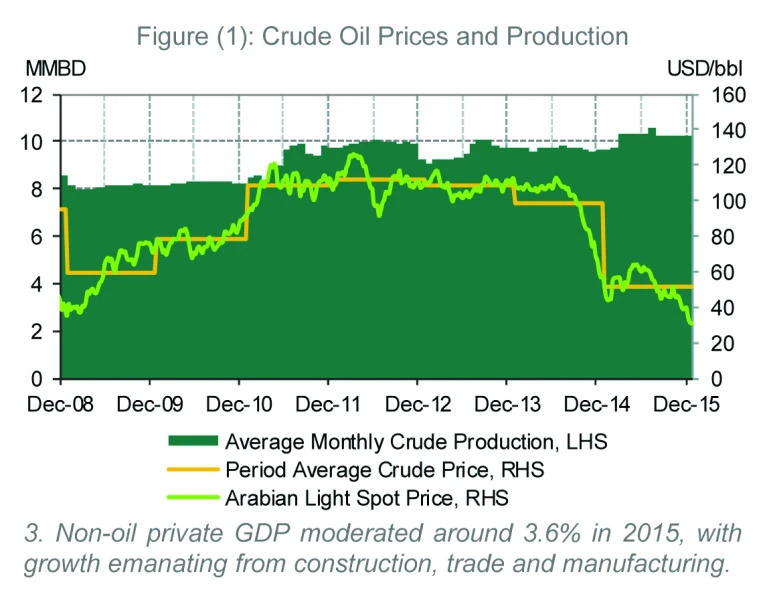
Even though the government has been adamant in enhancing the absorptive capacity of the economy and aiming toward diversifying away from hydrocarbons, the oil story remains pivotal and valid, with crude still representing around 80 percent of fiscal and export revenues. The baseline scenario for the medium-term projects lower oil prices and slower growth in Saudi crude production. Oil markets are expected to remain in a lower range around $40-80 per barrel during 2016-2020, with a bias to the downside, especially that oil lacks strong up- side momentum with markets oversupplied. Lower compliance among OPEC members and higher supplies from Iran and Iraq are expected to surpass demand growth emanating from China that will not be able to generate the 40-50 percent of total incremental oil demand of previous years. However, fiscal reforms and streamlining subsidies will ensure the resilience of government finances by propping up the non-oil revenues.
As for 2016, NCB projects real GDP growth of 2.3 percent, the slowest pace since 2009. The oil sector will be a drag especially with no expected increase in crude production that will stabilize around 10.2 million barrels per day. The nonoil sector, which is estimated to moderate around 3.5 percent, will not be able to offset the lack of growth in the oil sector.
Saudi reforms to ensure a sustainable and viable economy