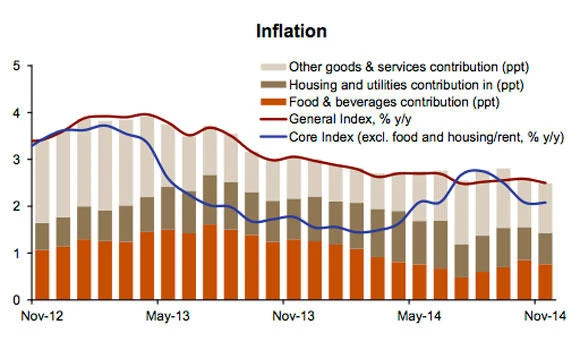
Inflation further cooled off in Saud Arabia during November as both the food and housing components slowed, according to a report released by Jadwa Investment.
Food inflation slowed for the first time since July, while rental inflation — the major subgroup of the housing component – recorded a mild slowdown. Other components of the core index recorded mixed results, said the report.
Components of the core index recorded mixed results, with communication continuing to be in the negative territory for the third consecutive month, states Jadwa’s Saudi Chartbook of January 2015.
According to the report, new data released by the Central Department of Statistics and Information showed a change in the base year (from 1999 to 2010) used to estimate real growth, as well as a revision to sectoral shares of real GDP. This resulted in the oil sector getting a larger share of overall GDP, with most other sectors seeing declines in their share.
The recently introduced changes have resulted in lower real GDP growth in recent years mainly owing to the oil sector’s larger share of overall GDP, which increased significantly to 45.1 percent under the new classification, while the breakdown by kind of economic activity shows declining shares to all other nonoil sectors, said the chart book.
Using 2010 as the new base year, real GDP growth improved in 2014 as growth in the oil sector was higher than anticipated, while the nonoil sector continued its healthy expansion. The nonoil private sector recorded robust growth, continuing to be the main driver of overall GDP growth, added the report.
Using 2010 as the new base year, real GDP growth accelerated from 2.7 percent in 2013 to 3.6 percent last year. Oil production increased slightly, year-on-year, leading to marginal oil sector growth of 1.7 percent in 2014.
According to Jadwa, nonoil GDP growth retained its position as the main contributor to overall GDP growth, with private sector continuing to play a vital role in this regard.
November data showed a rebound in consumer spending compared to the previous month.
While the PMI index slowed for the second consecutive month, it still points to an expanding economy. Year-to-November cement sales were almost at the same level compared to last year, said the report.
Year-on-year growth in point of sale transactions and cash withdrawals from ATMs rebounded strongly to 30 and 19 percent respectively, following a dip in the previous month.
PMI fell for the second consecutive month in November, but remained at healthy levels, pointing to a sustained growth and a continued expansion in the non-oil economy, according to the chartbook.
It also said that year-to-November cement sales stood at 50 million tons, remaining unchanged compared to the same period in 2013.
Month-on-month bank lending to the private sector recorded in November its first negative growth (-2 percent) since December 2011. This was mostly due to a larger base effect given the previous month’s significant bank financing of NCB’s IPO subscriptions.
“The commencement of new mortgage lending rules also played a role in our view,” said the Jadwa economists.
Annual growth of time and savings deposits slowed in November for the second consecutive month, but maintained its strong double digit growth in 2014. The loan-to-deposit ratio fell back to its September level of 81.2, down from its 2014 peak in October at 82.5.
According to the report, the current account surplus fell to $22.4 billion in the third quarter, down from $31.9 billion in the second quarter.
“We believe that the annual surplus would be lower than the $106.4 billion announced in the budget statement,” said the Jadwa researchers. Both imports and exports fell in the third quarter compared to the second quarter. The larger fall in imports caused the trade balance to slightly improve from $53 billion to $54 billion.
For the second time in 2014, the services account reached its highest deficit on record. The majority of the deficit again came from the government goods and services account, which is likely to be related to elevated levels of external financial aid and assistance granted to other Middle Eastern countries.
Brent crude oil fell to a five and half year low below $57 per barrel in December as ample global supply outweighed lost production from Libya. WTI came under pressure as both US crude and gasoline stocks surged, month-on-month. The count in US land oil rigs fell for the second month in a row to December.
Saudi crude output declined only slightly in November, month-on-month, as competition over market share intensified. Internal conflict caused Libyan production to decline, month-on-month, in November, said the chart book.
Investor sentiment continues to be negatively affected by lower oil prices but seasonal factors, such as the holiday period in most parts of the world, also dampened investor appetite during December. Seasonality was partially behind the negative performance in most major indices, apart from China.
The Tadawul All Share Index (TASI) dropped for the fourth consecutive month to December, as sentiment was again affected by lower oil prices although an expansionary Saudi budget for 2015 provided some good news, helping limit monthly losses.
With the real estate market struggling in China, investors ploughed money into the stock market resulting in a disconnect with global trends.
According to the Jadwa report, average daily turnover jumped by 19.8 percent in December, month-on-month, reversing the negative trend of the three previous months. Banks and insurance sectors dominated daily turnover with insurance turnover relative to market capitalization also the highest.
The insurance sector frequently has high monthly turnover and turnover to market capitalization levels, as it is a sector in which retail investors look to make quick profits.
The decline in the TASI during December saw valuations recover, month-on-month, although price to earnings (P/E) still remain below the two year average. TASI valuations have improved in recent months, and are more competitive, but remain on the lower end when compared to selected regional benchmarks.
P/E recovered in December but is sitting below the two 18 year average of 16.9 bringing the TASI in line with major developed and emerging market indices. Dividend yields are competitive but slightly below regional indices.
The drop in TASI during December meant that only three sectors saw positive performance during the month. Agriculture & food was the largest gainer as the sector benefitted from the conclusion of an acquisition deal.
Three of the 15 sectors saw positive performance in December. All sectors saw sell-offs in the first half of December, said the report.
Saudi rental inflation shows mild slowdown