As family businesses in the GCC, especially in Saudi Arabia, seek to address new challenges and transition to future generations, women have the opportunity to take on more active roles than before, according to a new study.
The joint study undertaken by Al-Sayedah Khadijah Bint Khawilid Center of Jeddah Chamber of Commerce and Industry, and Strategy &, formerly Booz & Company, investigates the role of women in family businesses across the GCC.
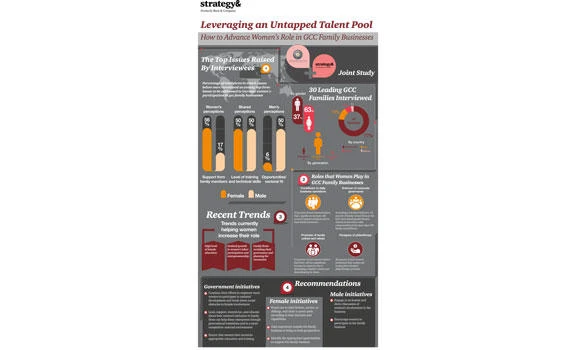
The comprehensive study is based on insights from extensive client work, publicly available information and interviews conducted with stakeholders in 30 leading family businesses based in Saudi Arabia and the rest of GCC in the past 12 months.
The study emphasizes that an environment empowering the increase of women’s participation in national development is steadily emerging in Saudi Arabia, which will lead to them playing a bigger role in family businesses.
Positive measures such as improved educational opportunities, provision of foreign scholarships in various fields, and state policies which strongly call for women’s participation in national economic development, are already under way. These factors make it conducive for women to take on more leadership roles within their family businesses.
According to the study, in the next five to 10 years, a large number of Saudi and GCC family businesses are expected to face a transition to the third generation. Succession planning is one of the most critical challenges that family businesses face but it can also be a great opportunity to draw from the entire talent pool, not only the male members of the family. As female family members become shareholders via inheritance, they tend to request a role in the governance and oversight of the business.
Basmah M. Omair, CEO of Al-Sayedah Khadijah Bint Khawilid Center, said: “This is a propitious time for family businesses as all of the GCC countries have made female economic inclusion a top priority. The value of diverse perspectives from all members of the family is gaining more widespread recognition as most family businesses in the GCC are facing transition from the second to the third generation of ownership. As a result, there is a supportive environment for family businesses to take advantage of the contribution that their women can make. GCC family businesses are also looking at global best practices and finding that female family members are increasingly becoming a vital force within their foreign counterparts.”
Omair added: “A number of other trends have contributed to women’s growing leadership over the past two decades, which include changing social conditions, such as smaller family sizes and higher average age of marriage; increasing efforts from women to acquire the skills that would make them eligible for a wider spectrum of roles in business; and growing social acceptance that encourages women to be more involved in the family business.”
The study reveals the major obstacles to women’s participation in family businesses, which include the cultural perceptions of a patriarchal society, misalignment between the requirements of the business and the extent of women’s education or training, women’s lack of interest or motivation to be active in the family business and fierce competition within large families for a limited number of senior roles, in which women are at a disadvantage as they must develop comparable skills to their male counterparts.
Ramy Sfeir, partner with Strategy& leading the family business platform in the Middle East, said: “In order for these companies to access their female talent pool, there is an urgent need for male family members to understand women’s aspirations and for female family members to calibrate the expectations of male members of the family. GCC women’s roles in family businesses tend to exist in two spheres: Core business activities, such as management and corporate governance, and enabling business activities, such as promoting family values and preparing the next generation to join the business. Within each of these spheres, women are already playing clearly defined roles.”
The study outlines three important trends that can support an increase in women’s participation in GCC family businesses - the high level of female education, the gradual growth in women’s labor participation and entrepreneurship, and family firms revisiting their governance and planning for succession.
Saudi women have ‘opportunity to become active in family businesses’