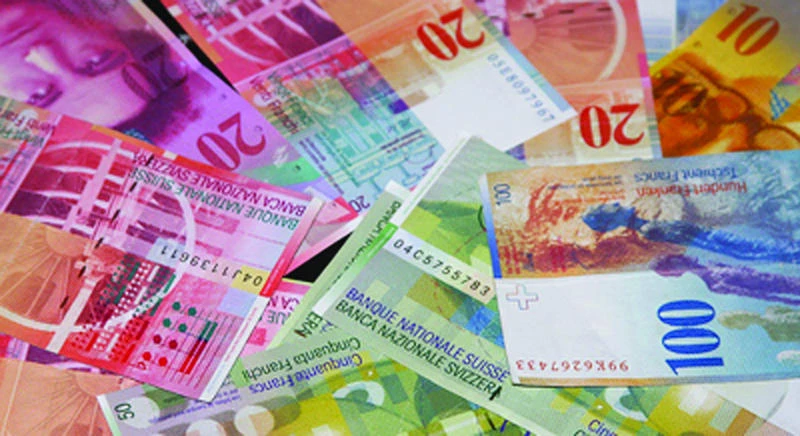
ZURICH: The Swiss National Bank predicted consumer prices will drop next year and said the risk of deflation has increased as it vowed to defend its cap on the franc.
The central bank kept its ceiling of 1.20 per euro and the target range for its benchmark interest rate at zero to 0.25 percent at its quarterly meeting Thursday, as predicted by economists. Officials cut their forecasts for inflation for the next two years, while raising this year's projection for economic growth.
"Our new conditional inflation forecast has been revised downward once again," SNB President Thomas Jordan told reporters in Bern. "Above all, the appreciably lower oil price will push inflation into negative territory during the next four quarters."
The possibility of broad-based asset purchases by the European Central Bank has helped push the franc toward the SNB's upper limit. Officials have held out the prospect of further steps — including a charge on sight deposits — to reinforce the cap it introduced three years ago.
"Very low inflation, which starts to filter through to softening nominal wage growth in Switzerland, gives the SNB room for additional policy easing," said Evelyn Herrmann, European economist at BNP Paribas in London. Still, officials "will try to avoid additional policy measures as long as possible," she said.
After refraining from quantitative easing for the euro area last week, ECB President Mario Draghi has pledged to "reassess" the situation in early 2015. Governing Council members expect to consider a proposal that will include purchases of sovereign debt at a Jan. 22 meeting.
Last month, the franc hit a 26-month high versus the euro as investors braced for more easing in the euro area, as well as a referendum that would have impeded SNB policy making by forcing it to boost its gold holdings. Voters rejected the measure on Nov. 30. The franc has gained roughly 2 percent against the euro so far this year.
"Overall, the global economic outlook is still dominated by downside risks -- the most important of which are the continuing difficult conditions in the euro area and a possible escalation in geopolitical tensions," the SNB said in its statement. "If required, the SNB will take further measures immediately."
Such measures could include negative rates, SNB President Jordan said Thursday, adding that this implies a charge on sight deposits plus a benchmark-rate target below zero.
According to a survey by Bloomberg News, all but one of 27 economists forecast the SNB will step up interventions should pressure on the cap intensify. Seventeen see it introducing a negative deposit rate, following the ECB's June move to charge banks for overnight deposits, according to the poll conducted Dec. 4-8.
With permanent excess liquidity in the Swiss financial system exceeding 300 billion francs ($307 billion), negative rates would have a bigger impact in Switzerland than they did in the euro area, SNB Board Member Fritz Zurbruegg said last month.
"If pressure on the franc becomes unbearable again, the SNB will likely implement a dual response of currency intervention and a negative deposit rate," said Bernard Yaros, associate economist at Moody's Analytics. "Both measures come with their risks, but the SNB does not have many other choices to protect the currency cap."
The SNB raised its gross-domestic-product forecast to 1.5 percent to 2 percent for this year, compared with a previous prediction of "just below" 1.5 percent. It sees GDP increasing about 2 next year.
Officials cut forecasts for consumer prices for 2014 and the following two years. They predict a drop of 0.1 percent next year before a gain by 0.3 percent in 2016. Previously they saw increases of 0.2 percent and 0.5 percent for each year respectively.
A drop globally in the price of crude oil has complicated central bankers' efforts to stoke inflation.
The SNB's cap, introduced in September 2011 to shield the economy from deflation and a recession, will be lifted no earlier than 2017, according to 70 percent of the economists surveyed — a prediction made by 56 percent the previous month.
Adding to the SNB's concerns, residential property prices have risen strongly in recent years, with its loose monetary policy keeping mortgages cheap. Policy makers have repeatedly warned banks to allot credit prudently and were behind the government's bid to curb risky lending by forcing banks to hold more capital as a buffer.
SNB sees risk of deflation as it vows to defend cap on the franc