JEDDAH: Saudi bank credit to the private sector recorded a monthly acceleration in May following a slowdown in each of the previous four months, according to a report.
The government also maintained support for development with an elevated level of spending in May, stated the Saudi Chartbook for July 2015 from Jadwa Investment.
Month-on-month falls in foreign exchange reserves continued to shrink, boosted in part by the partial recovery to oil prices and revenues, it added. Government accounts remained negative at $15.4 billion in May. This came on the back of a net withdrawal from the government deposits and reserve accounts, totalling $20.5 billion in May, according to the chartbook.
It said that key consumption indicator data was up in May, month-on-month, as a seasonal uptick ahead of Ramadan pushed up consumer spending.
The report said that ATM withdrawals and point of sale transactions increased by 7.8 percent, and 10 percent, year-on- year, respectively.
PMI fell to 57, its lowest level in 2015, owing to slower seasonal activity ahead of Ramadan.
Cement production and sales grew in May by 9 percent, and 7.1 percent year-on-year respectively, but are likely to fall in coming months due to slower seasonal activity in Ramadan.
Bank credit to the private sector recorded a monthly acceleration in May following a slowdown in each of the previous four months, according to the chartbook.
Both net credit issued and bank profits broke their five year maximum levels for the month of May, reaching SR17.2 billion and SR3.8 billion respectively.
Bank credit to the private sector accelerated to 1.3 percent, month-on-month. Newly issued credit reached a record level at SR17.2 billion compared to the five year maximum for the month of May, said the Jadwa report.
Monthly profits also reached a five-year high for the month of May, increasing by SR3.8 billion.
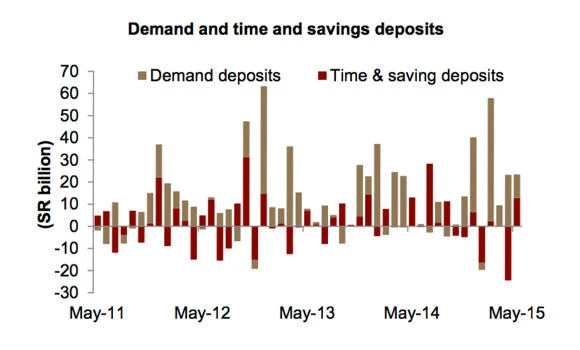
In May, total bank deposits increased by SR20.1 billion, month-on-month. Both demand deposits and time and savings deposits rose.
The growth in total deposits also spanned both the government and private sectors. Healthy growth in both credit and deposits caused the loan-to-deposit ratio to rise marginally in May.
Demand deposits rose by SR10.7 billion month-on- month, while time and savings deposits recorded a SR12.8 billion increase, the highest in ten months. The growth in deposits spanned both the government and private sectors, according to the chartbook.
It said that the healthy growth in both credit and deposits resulted in marginal increase in the loan-to-deposit ratio to 79.3 in May, up from 79.2 in the previous month.
In May, Saudi CPI rose to 2.1 percent year-on-year, its first rise in nine months, but this was mainly due to a lower base effect. Food price inflation recorded a small year-on-year rise, but showed a deceleration in monthly terms. Subdued food inflation is affected in part by a continued deflationary trend in international food prices, stated the Jadwa report.
In April, nonoil exports increased slightly from the previous month but remained 16 percent lower year-on-year. Imports fell by $2 billion, month-on-month, to reach $13 billion, but volumes imported increased slightly. New LOCs opened point to a likely fall in imports in coming months, according to the chartbook.
It also said that the Tadawul All-Share Index (TASI) fell, month-on-month, in June due to the beginning of Ramadan and weaker sentiment related to a possible Greece default. Although a downturn in stock market activity is normally observed during Ramadan, this has been exacerbated by events unfolding in Greece.
The TASI has trended downward for two consecutive months. Subdued trading during the start of Ramadan led to traded volumes dropping by 19 percent, month-on-month, in June. Traded volumes usually average their lowest in the year during Ramadan as retail investors become less focused on the stock market, according to the report.
Lower trading activity and a sell-off in shares during the month of Ramadan has seen price-to-earnings (PE) in the TASI drop toward its two year average, although it is still comparatively expensive to regional markets.
Total bank deposits in KSA rose by SR20.1bn in May