Saudi Arabia’s trade and hospitality sector holds the most positive outlook among all the nonhydrocarbon sectors in the second quarter of 2014 due to improvement in expectations on all parameters, according to a survey.
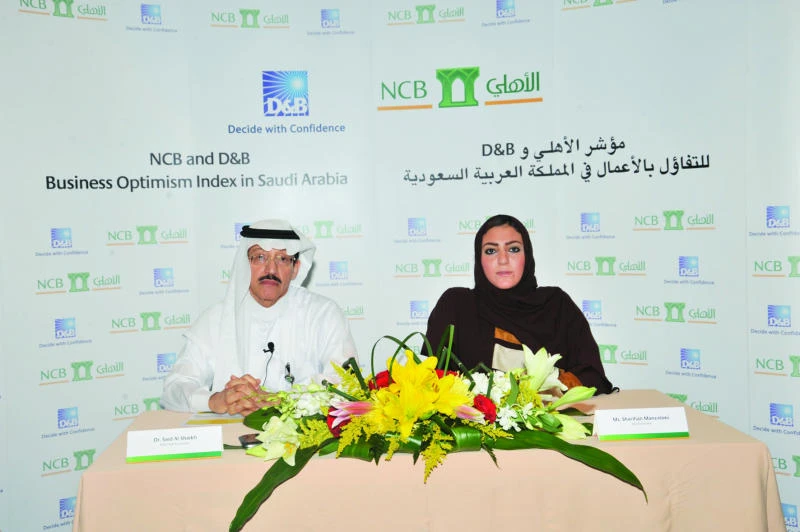
The National Commercial Bank (NCB) launched the second quarter NCB and Dun & Bradstreet Business Optimism Index (BOI) report 2014 at a press conference in Jeddah.
Saudi business community is reflecting optimism for this quarter, according to economists.
The composite Business Optimism Index (BOI) for the nonhydrocarbon sector has posted a modest upswing of 3 points from the first quarter to stand at 50 in the second quarter, primarily due to a higher optimism on sales volumes, new orders and profitability.
After reaching a two-year high to stand at 50 in Q1, the BOI for the hydrocarbon sector tracked sideways to a value of 49 in Q2 (still considerably higher than the BOI in the last nine quarters).
The trade and hospitality sector holds the most positive outlook among all the nonhydrocarbon sectors in this quarter due to improvement in expectations on all parameters
Fifty-three percent of hydrocarbon sector firms and 62 percent of non-hydrocarbon sector firms do not foresee any obstacles impacting business operations in Q2; while competition, government regulations and availability of skilled labor are viewed as the most important challenges amongst the remaining firms
The survey indicates a moderation in investment outlook; 47 percent of the nonhydrocarbon sector respondents (vis-a-vis 59 percent in Q1) and 55 percent of the hydrocarbon sector respondents (vis-a-vis 63 percent in Q1) are planning expansion in Q2.
Dun & Bradstreet South Asia Middle East Ltd. (D&B), in association with the National Commercial Bank, released the Business Optimism Index survey.
The survey reveals a moderation in overall optimism level.
The second quarter survey also examined responses of the effect of the government’s new labor laws in the country and the impact of the same.
The intensity of the labor policies on business operations is stable in Q2, 2014.
Similar to the last quarter, 59 percent of the respondents reported that the new labor policy has no negative impact on the business.
The top concerns affecting the business community due to the labor policies include:
Increasing cost of labor:
As compared to the previous quarter, a marginally higher proportion of firms (14 percent in Q2, 2014 versus 12 percent in Q1, 2014) indicated that an increasing cost of labor, primarily due to Saudization, is a key concern relating to the labor policies.
Availability of skilled labor:
Twelve percent of the firms indicated that availability of skilled labor is a key concern for their business. However, the number of firms indicating shortage of skilled labor as a concern has been declining q-o-q from 23 percent in Q4 2013 to 16 percent in Q1 2014 to 12 percent in Q2 2014.
Government policy/regulations:
Another 12 percent of the respondents have reported that government policies and regulations affect them in terms of acquiring visas and work permits for manpower from other countries. The lengthy and expensive visa acquiring process has impacts business operations and profitability.
According to the survey, the overall business environment in the nonhydrocarbon sector is stable, with 62 percent of the nonhydrocarbon sector respondents reporting that they will not be impacted by any negative factors in Q2 2014.
The top challenges faced by the remaining respondents are similar to the ones faced in the previous quarter.
These include government regulations, competition and the lack of skilled labor due to the ongoing intensification in the country’s labor laws primarily driven by the nationalization agenda.
Within the hydrocarbon sector, 53 percent of the respondents indicated that there will be no negative factors affecting their business in the second quarter.
Another 13 percent indicated competition to be their key business challenge while around 10 percent pointed at difficulty/shortage in availing skilled labor as the key business challenge impacting their operations.
Notably, there is a marked improvement in the perception of respondents being impacted adversely due to government regulations (8 percent this quarter versus 18 percent in Q1).
The overall outlook for investments in the nonhydrocarbon sector reflects that companies are cautious with respect to business expansion; 47 percent plan to invest in expansion in Q2 compared to 59 percent in Q1.
From a sectoral perspective, the trade and hospitality sector is the most optimistic with respect to expansion plans, followed by the manufacturing sector.
The cautious approach to toward business expansion is also observed within the hydrocarbon sector, as reflected in a drop in the proportion of respondents planning to invest ( 55 percent respondents cited plans to invest in business expansion in Q2, as compared to 63 percent in Q1)
Commenting on the findings of the latest survey Prashant Kumar, associate director, Dun and Bradstreet South Asia Middle East Ltd., said:
“Positive traction in Saudi Arabia’s hydrocarbon as well as nonhydrocarbon sector is expected to boost the overall economic growth through the coming quarters. This is also reiterated by the results of BOI survey for Q2 2014. While the BOI for the nonhydrocarbon sector is up by a modest 3 points to reach a value of 50, the BOI for the hydrocarbon sector has tracked sideways to close at 49 points (1 point lower than the value recorded in the last quarter, which was also the highest value recorded in the last 2 years).”
The trade and hospitality sector is the most optimistic among all the nonhydrocarbon sectors due to improved expectations on all parameters constituting the index.
While 62 percent and 53 percent of the business units surveyed in the nonhydrocarbon and hydrocarbon sectors, respectively, do not anticipate any negative factors to impact their operations in Q2; the top concerns cited by the remaining survey respondents include impact of government regulations, competition and availability of labor.
According to the report, Saudi Arabia’s overall hydrocarbon GDP contracted by 0.6 percent in 2013 and is expected to post modest gains in 2014.
The contraction in 2013 was due to a decline in crude oil production (from an average of 9.76 million bpd in 2012 to 9.64 million bpd in 2013, according to OPEC data.
However, an increase in natural gas liquids and natural gas output offered some offsetting support to compensate for this decline.
Saudi Arabia’s oil production increased from 9.64 million bpd in 2013 to 9.77 million bpd in January 2014 and 9.85 million bpd in February.
Going forward, crude oil output in Saudi Arabia is expected to remain at elevated levels for the first half of 2014 on the assumption that problems in other oil producing countries (such as Libya, Iran and few other countries in the MENA region) are likely to persist, while the global demand for crude is expected to improve. However, the outages in other oil producing countries are likely to gradually iron out during the course of the year, which will lead to easing back of the Saudi production.
Despite this, the average output for 2014 should be higher than last year which is enough to give a boost to the oil/hydrocarbon driven GDP.
In addition to the gains in the oil GDP, the Saudi Arabian economy is expected to perform well throughout the coming quarters, on the back of the growing strength of its non-hydrocarbon sector.
The non-=hydrocarbon sector is expected to gain impetus from sustained domestic demand due to the Kingdom’s rapid population growth and the government’s ongoing infrastructure spending.
On the other hand, the government’s recent intensification of the workforce nationalization agenda poses a downside risk to the overall economic outlook since such measures are likely to add to operating costs for the private sector over the coming quarters, in addition to leading to project delays due to constraints in manpower.
In addition to this, in its recently announced budget for 2014, the government has slowed the pace of planned spending increase from 20 percent in 2013 to just 4.3 percent for 2014. Although this is a marked decline in growth rate, the spending levels are still robust enough to sustain growth in the nonoil sector and to ensure growth in domestic demand.
The hydrocarbon sector’s index value for Q2 2014 reflects a significant improvement on a y-o-y basis (BOI score of 49 in Q2 2014 versus 31 in Q2 2013); however the BOI has tracked sideways by a single point compared to the previous quarter, when the index had reached a two year high.
The indicator continues to register a favorable outlook as many businesses expect to get new projects in the second quarter.
The survey also shows that a higher business confidence on selling prices is offset by lower optimism levels for profitability and hiring.
The BOI for selling prices is 8 points higher than the previous quarter since 48 percent of firms plan to increase their selling prices in order to offset increases in raw material and operational costs. On the other hand, the optimism on profitability is lower by 4 points compared to the previous quarter due to a rise in raw material and labor costs.
The BOI for hiring has reduced by 18 points to 50, as 8 percent of the respondents are found planning to reduce their employee count. Comparatively, as per the findings of the previous quarter, none of the respondents were observed to be planning on reducing their staff base.
The survey indicates a moderation in the hydrocarbon sector’s outlook on business environment; 53 percent firms in Q2 (compared to 60 percent in Q1) do not foresee any negative factors impacting business operations.
For the remaining firms, increasing competition emerges as the most critical challenge impacting operations, as cited by 13 percent of the firms; this is followed by constraints in availability of skilled labor, as cited by 10 percent of the respondents. Next in the pecking order, government regulations and an increasing cost of raw materials were cited as other concerns by 8 percent and 7 percent of the survey respondents, respectively.
The survey also points to a weakening in the hydrocarbon sector’s investment outlook, with 55 percent respondents citing expansion plans, compared to 63 percent in the previous quarter.
Non-hydrocarbon sector
The survey indicates a modest upswing in the nonhydrocarbon economy, with the composite business optimism index up by 3 points to 50 from the previous quarter’s level of 47.
The rise in expectations is on account of higher optimism levels in terms of sales volumes, new orders and profitability.
A significant majority (70 percent) of the respondents foresee an increase in sales in Q2, backed by expectations of new projects / contracts from the government as well as the private sector coupled with favorable economic conditions, supporting this forecast.
This positive outlook has led to a 10 points rise in the BOI for Volume of Sales, from the last quarter to reach a value of 64 in Q2.
Additionally, the BOI for New Orders has increased from 55 in Q1 to 59 in Q2. Continuing the last quarter’s trend, a majority (65 percent) companies expect stability in their price levels.
A higher optimism for demand has resulted in a marginally higher BOI for Net Profits; the index stands at 55 in Q2 versus 53 in Q1, with 62 percent of the companies expecting an increase in their bottom lines.
The hiring outlook remains strong in Q2 with almost half of the firms (i.e. 48 percent respondents) planning to increase their employee count in the second quarter.
Sector-wise analysis
The trade and hospitality sector holds the most positive outlook in Q2 2014 due to improvement in expectations on all parameters, particularly sales volumes.
The composite BOI stands at 53 in Q2 2014, compared to score of 40 in Q1 2014.
The BOI for Volume of Sales increased by 22 points from the last quarter to 70, with 77 percent respondents expecting an increase in economic activity on the back of a seasonal pick-up in demand, expectations of new projects (for trading firms supplying to railways, health care and other government projects) and overall improvement in market conditions.
Both the Trade and Hospitality segments have a more positive outlook for Q2, 2014 compared to the last quarter with BOI scores of 52 and 58, respectively (BOI scores for Trade and Hospitality in Q1 were 37 and 47 respectively).
Manufacturing firms in Saudi Arabia have displayed a steady outlook; the composite BOI stands at 49 in Q2, just a point higher than in Q1. Manufacturers expect a steady inflow of new projects, both from the government and private sectors as well as from the domestic and exports markets, coupled with a stable economic environment to support these expectations.
Within manufacturing, companies engaged in petrochemical manufacturing (BOI of 56) hold a more positive outlook, compared to their counterparts in non-petrochemical manufacturing (BOI of 47).
A slight moderation has been observed in the Composite BOI for the construction sector which now stands at 49 points from 57 in Q1.
The decline is caused by a pullback in the expectations on all parameters.
Backed by higher expectations for sales, orders, profits and employment, the composite BOI for the Transportation and Communication sector has gained 12 points q-o-q to stand at 49 in Q2.
Among all the sectors, this sector is the least optimistic in terms of the overall business environment as only 49 percent respondents (less than half of the segment cohort) do not foresee any negative factors impacting business operations in Q2 2014.
The Composite BOI for the finance, real estate and business services sector has moderated to 48 in Q2 from 52 in Q1.
The drop is due to lower expectations for new orders, selling prices, profits and hiring. The only exception to this drop is on volume of, which has gained 7 points q-o-q to stand at 62 in Q2.
Factors impacting business operations
The overall business environment in the nonhydrocarbon sector is stable, with 62 percent of the nonhydrocarbon sector respondents reporting that they will not be impacted by any negative factors in Q2 2014.
The top challenges faced by the remaining respondents are similar to the ones faced in the previous quarter.
These include government regulations, competition and the lack of skilled labor due to the ongoing intensification in the country’s labor laws primarily driven by the nationalization agenda.
Within the hydrocarbon sector, 53 percent of the respondents indicated that there will be no negative factors affecting their business in the second quarter.
Another 13 percent indicated competition to be their key business challenge while around 10 percent pointed at difficulty/shortage in availing skilled labor as the key business challenge impacting their operations.
Notably, there is a marked improvement in the perception of respondents being impacted adversely due to government regulations (8 percent this quarter versus 18 percent in Q1).
Trade and hospitality sector holds most positive outlook