LONDON: Futures prices indicate the physical market is easily absorbing the large volume of crude being supplied and global rebalancing is well underway.
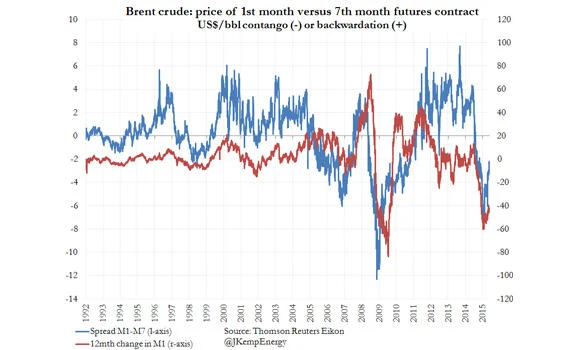
The price for storing a barrel of Brent for six months has fallen from more than $1.23 per month at the start of 2015 to just 37 cents per month on May 21.
US crude inventories are still more than 95 million barrels above the level at the end of 2014 and 115 million barrels higher than normal at this time of year.
There are also reports of a build up in stocks in China, either crude oil or refined products, some of which may have been put into long-term strategic storage.
According to most estimates, the global market has been oversupplied by between 1.5 million and 2.5 million barrels per day since the start of the year.
Yet the price for storing crude has fallen by two-thirds in the space of just four months, which indicates there is no shortage of space in tank farms and the supply-demand surplus may be being overestimated.
Strong growth in demand is helping the market absorb record crude supplies from Saudi Arabia and the US shale fields.
“Markets around the world have surprised on the upside. Demand has definitely surprised on the upside in refined products,” an executive for Vitol, the world’s largest oil trader, told a conference (“Oil market buoyed by product demand” May 20).
Casual observers focus on spot prices but physical traders are more likely to concentrate on differences between futures prices in adjacent months as an indicator of tightness or slack in the market.
Differences between the first-to-deliver futures contract and the sixth provide a good indication of expected demand for storage and by extension the direction of inventories in the short term.
The price gap hit as much as $7.40 contango in early January as traders anticipated the enormous build up in reported crude stocks during the first four months of the year.
But this week it has narrowed to $2.20 contango or less, suggesting traders expect far less demand for storage than previously.
There are a number of reasons to think the spread between nearby futures contracts is a fair indicator of near term trends in the oil market.
The first-to-sixth month spread has been closely correlated with shifts in the balance between supply and demand.
It tracked the build up and drawdown of inventories during the ìmissing barrelsî episode in the late 1990s following the Asian financial crisis.
It also tracked the tightening of the physical oil market in the run up to prices spiking in mid-2008 as well as the subsequent surplus and return to balance during the recession of 2008-2010.
And it tracked the oversupply and enormous stock build between the middle of 2014 and early 2015.
The first-to-sixth month spread is closely correlated with the rise and fall in spot prices and there is some evidence that movements in the spread anticipate movements in the spot prices by some weeks or months.
Unlike the spot market for “flat prices” which attracts a large share of financial investors and may be subject to a lot of noise, the market for “spreads” is dominated by relatively well informed insiders from oil companies, trading houses and the largest hedge funds, so it may provide a better signal about market conditions.
In the 1998 and 1999, the shift from contango to backwardation coincided with the return of the “missing barrels” to the market as the supply-demand balance tightened.
At the current contango of just 40 cents per month there are no strong incentives to store excess oil and any hidden inventories are likely to return to the market.
Most oil analysts are still bearish about the outlook for oil prices over the remainder of 2015 and into the early part of
2016.
Major bears like Goldman Sachs are concerned that the market is still heavily oversupplied and carrying an abnormally high level of inventories while the resurgence in prices will slow down the needed adjustment.
But the spreads tell a different story, and given their track record, it is not one which should be dismissed too quickly.
The market could be wrong and the recent tightening of the spreads could prove to be a false rally that gives way to renewed weakness later in the year.
The spreads are, however, consistent with reports from market participants, including Vitol and Saudi Aramco, as well as the US Energy Information Administration, all of which have pointed to the strength of fuel demand.
— The opinions expressed here are those of the author, a columnist for Reuters.
Traders watch the falling price of oil storage