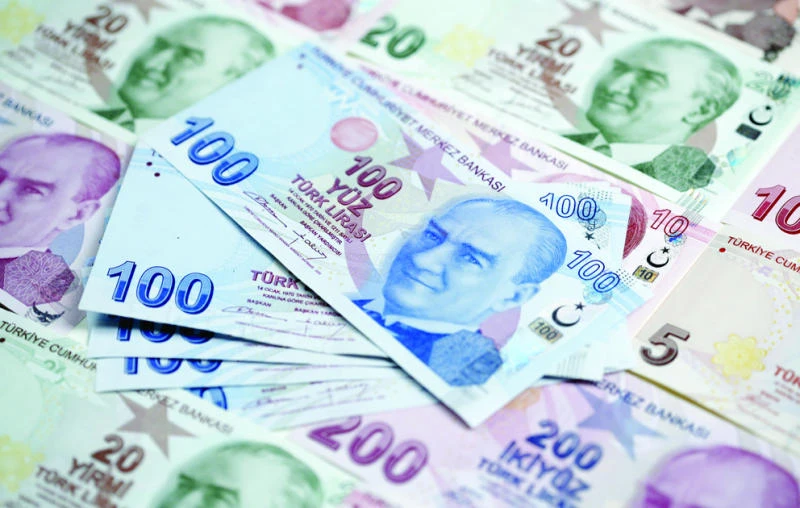
ISTANBUL: Turkey's central bank left interest rates unchanged on Tuesday after a drop in food and energy prices eased inflationary pressures, maintaining a cautious stance as political tensions drive the lira to record lows.
Prime Minister Ahmet Davutoglu is expected on Tuesday to relinquish the mandate to form the next government after coalition talks with opposition parties failed. That raises the prospect of another parliamentary election in the autumn after June's indecisive vote.
Amid the political turmoil, the lira has plunged more than 19 percent so far this year, making it one of the worst-performing emerging market currencies and underscoring, economists say, the need for a rate hike.
The bank held fire even so, keeping its benchmark one-week repo rate at 7.50 percent. But it did say it would implement a tighter liquidity policy and outlined plans to narrow its interest rate corridor as global monetary policies start to normalize.
"True to form, Turkey's steadfastly dovish central bank left its main interest unchanged in the face of a dramatic deterioration in sentiment toward Turkish assets," said Nicholas Spiro, of Spiro Sovereign Strategy.
"The central bank's decision adds insult to injury and pulls the rug out further from under the wilting lira."
The lira plumbed a new low after the decision, touching 2.8943 against the US dollar.
In a Reuters poll of 12 economists, eight had expected the key one-week rate to be left unchanged and four had forecast a 50- to 100-basis-point increase.
The bank kept its overnight borrowing rate at 7.25 percent, the overnight lending rate at 10.75 percent and the primary dealers' overnight borrowing rate 10.25 percent.
Months before the June election, President Tayyip Erdogan had exerted pressure on the central bank to cut rates to boost a flagging economy, raising concerns about its independence.
Speaking before the central bank decision, Economy Minister Nihat Zeybekci — who, like Erdogan, has repeatedly said the bank needs to cut rates — said calls for higher interest rates did no good to Turkey and that the recent appreciation of the dollar was "totally speculative".
The bank's mention of the need for tighter liquidity policy reassured markets somewhat, although it may be largely symbolic.
"There remains underlying political pressure against a rate hike and the latest inflation data showing weaker core inflation bought the bank some breathing space," said William Jackson of Capital Economics in London. "Still, there's a nod toward tightening, including paring back liquidity."
The bank also said it would narrow its interest rate corridor around the benchmark rate once global policies start to normalize, as part of a "roadmap" released separately on Tuesday to prepare for such policy shifts.
The lira is expected to remain under pressure.
Under the terms of the constitution, Erdogan could dissolve Davutoglu's caretaker cabinet and call for the formation of an interim power-sharing government to lead Turkey to a new election within months if no deal is reached by Aug. 23.
Turkey keeps rates unchanged and shrugs off weak lira