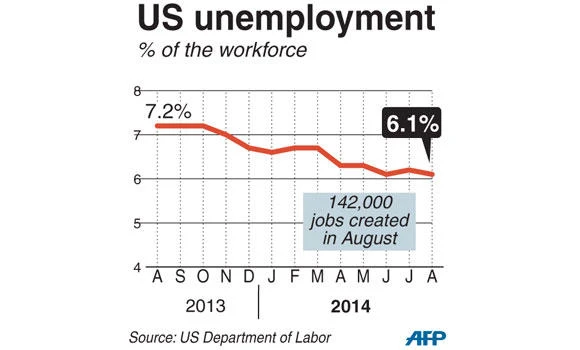
WASHINGTON: The US economy pumped out far fewer jobs than expected in August, dimming the picture for overall growth and easing pressure on the Federal Reserve to quickly raise interest rates.
The Labor Department's report Friday of only 142,000 net new jobs in August — compared to the 223,000 markets were expecting — broke a six-month streak of more than 200,000 a month that had cheered policymakers and job-seekers.
Taking into account a sharp downward revision of the previous two months' figures, 28,000 fewer positions than originally reported, the US jobs market appears weaker than it has since the beginning of the year.
Analysts were quick to note that August data is frequently volatile and possibly out of line with trends due to seasonal shifts.
And though other economic data has been mixed, the broader picture is of steady growth in economic activity.
Even so, the details of the August jobs numbers reinforced the view that the economy is growing only modestly and there is little upward pressure on wages and prices that would raise the specter of an inflationary burst.
"A disappointing employment report for August gives US policymakers more food for thought about when the economy might be capable of withstanding higher interest rates," said economist Chris Williamson at Markit.
"The slowdown in hiring certainly vindicates the Fed's cautious approach to tightening policy."
Despite the lower job creation number, the jobless rate fell a tick to 6.1 percent, helped by a slight decline in the size of the labor force, and a 268,000 jump in the number of those not in the labor force.
All three data points come from the survey of households, much more volatile and inconsistent month-to-month than the establishment survey which provides the job creation numbers.
Even so, the household survey underscored the continued softness. The labor force participation rate was 62.8 percent, still very weak and virtually unchanged since April.
The total number of unemployed remained about 9.6 million and the number of people forced to work part-time because they couldn't find full-time jobs was also only slightly lower at 7.3 million.
And nearly three million people remained in the long-term unemployed ranks, jobless for more than 27 weeks.
The establishment survey showed another key sign of slack, that workers' situations were not changing much, in terms of earnings. The average workweek remained at 34.5 hours and earnings were rising at a very modest 2.1 percent year-on-year pace.
The Federal Reserve has focused on reducing slack in the labor market as a target of its ultra-low interest rate policy.
Fed policymakers have mapped out a likely first rise in its benchmark fed funds rate from the current zero level only in the second half of next year, when they expect the economy to be growing more strongly and unemployment to be below the 6 percent mark.
But a growing minority of economists and policy makers, the inflation hawks, have warned that not moving earlier risks unleashing inflation that could become hard to control.
Most analysts said they anticipate a rebound in the jobs market in the coming months.
US jobs data ease pressure on Fed to raise rates