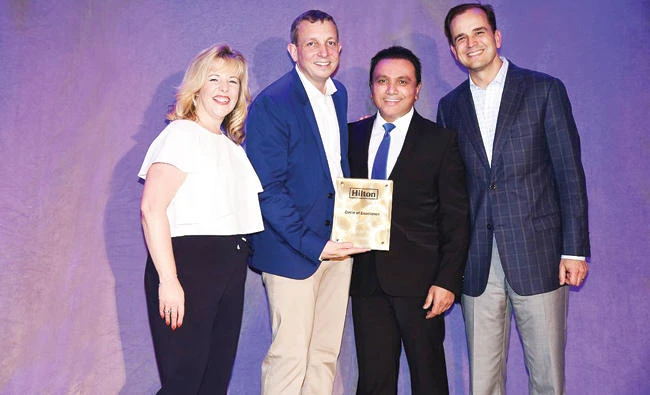
Inayat Ramjean, director of business development of the Jeddah Hilton and the Waldorf Astoria Jeddah — Qasr Al Sharq, has been awarded the Circle of Excellence for Commercial Excellence out of 58 other countries across Europe, Africa, and Middle East.
Expressing his thoughts on this occasion, Ramjean said: “Hilton is an iconic brand in hospitality on a global scale with an unmatched portfolio of high quality services and a reputation for operational excellence. It is the most acknowledged name in the industry with its commitment in authentic hospitality. Such recognition requires not only brand heritage but a team of talented individuals. Winning the award for commercial excellence is the achievement of the Jeddah Hilton and the Waldorf Astoria Jeddah — Qasr Al Sharq team collectively.
“From a personal perspective, I am honored to have received this award but it is overshadowed by my exhilaration of knowing that this award is won in Saudi Arabia among 58 other countries in Europe, Middle East and Africa... Though, it certainly raises your profile both locally and internationally, however, it also raises my personal expectation in my ability to deliver even better results.”
Ramjean said his role is about managing processes and activities that encompass analytical preparation, implementation planning, and identifying growth opportunities.
“From top level perspective, it is about achieving financial goals, long-term growth, and maintaining the brands and the image perception of the properties, ultimately benefiting all our stakeholders, both internally and externally. Though they are singular tasks, they are interconnected providing new window of opportunities for growth.
“The primary objective is to implement a growth strategy that caters to the industry as a whole, contributing to the economy of the Kingdom eventually, making it an enriching experience.
“It is worth noting that the business development function has evolved into a more matured, highly technical function as the business landscape has transformed into the global economy.
“Business development is not a one-man job, but the collective efforts of the entire team. Therefore, hiring the right person for the right position is imperative for any organization as it is the only way to ensure that every team member plays a value-added role that contributes to the success and the overall company vision.”
Speaking about his perspective of business development in the tourism and hospitality segment of Saudi Arabia, he said: “There should be an understanding not just of the industry, but where we fit within the industry both locally and on a global scale. There should be a high level of familiarity with competitors, customers, trends and behavioral changes. We have to be thinking ahead and managing our goals and plans accordingly and meeting visitors’ expectations.
“Business professionals should have business development skills with a focus on maintaining a culture that promotes growth and nurtures employees to enhance the business. Such professionals need to have an entrepreneurial mindset, as they are the ones to push the envelope and explore uncharted territories. They are the real go-getters.
“Companies that are serious about fixing the workforce diversity need strategies that address the issue and expand the talent pipeline. Organizations need to redefine what quality talents mean especially in the context of today’s business environment if they intend to tackle the source of their problems.
“Hiring quality talents should not be looked at as a cost but rather a mid-term investment which will have positive impact on your top line, strengthening your sales and revenue. It is very evident that today the market behavior is rapidly changing, consumer trends are shifting before you can realize and analyze them. Therefore, the question to ask is how do we find this untapped pool of talents and utilize their unique perspective to connect your brand better with the customers.
“To ensure that your organization is in the limelight with customers, you have to diversify the workforce. I am not only talking about diversity but multiplicity of knowledge... My suggestion is to reevaluate the sources the recruiters hire from. Most cases, you will notice that they have been tapping into the same talent pool every time expecting different results.”
Ramjean highlighted the outlook of the tourism and hospitality industry in Saudi Arabia, saying: “Over the past 60 years, tourism has experienced a continued expansion and diversification to become one of the largest and fastest growing economic sectors in the world. Tourism has boasted virtually uninterrupted growth over time, despite occasional shocks, demonstrating the sector’s strength and resilience.
“The outlook for Travel & Tourism remains robust, despite economic volatility in the wider market. The sector’s contribution to GDP growth is expected to accelerate and outpace the growth of the wider economy, and this applies to Saudi Arabia as well.
“The increasing number of destinations worldwide has opened up investment opportunities in tourism, turning it into a key driver of socio-economic progress through the creation of jobs and enterprises, export revenues, and infrastructure development.
“Saudi Arabia is transforming from an oil-based economy to a more diverse one using human capital, which includes tourism, finance, manufacturing, and advanced technology. The nation has spent the last decades successfully paving the road for such a diverse economy, full credit goes to a stable political system and a strong social safety net.
“The most valuable resources for any organization are its human assets and in this scenario, Saudi citizens are our main asset. Since Saudi Arabia has already reignited the growth engine, under the vision of Prince Mohamed bin Salman, with the Saudi Vision 2030, productive employment of the population with an improved standard of living is a viable expectation.
In line with this vision, the tourism industry, together with the relentless efforts and initiatives of the Saudi Commission for Tourism and National Heritage, is leaving no stone unturned. The tourism industry is expected to record one of the highest growth rates over the next 20 years.
“The development of the tourism industry is not only curbing unemployment but also improving the welfare, and sparking the growth of creative economy. Along with contributing to the positive quality of life, the tourism industry will actively contribute in perpetuating natural and cultural resources. This in turn would dramatically support the country’s economic performance.
“The Kingdom has already embarked on significant projects (the metro project in Riyadh, the new airport in Jeddah, the new entertainment city in Riyadh, etc.) and they will change the landscape of the country positively. For instance, the new entertainment city in Riyadh, as part of the Vision 2030 plans, spans over 334-square km. This project, almost as big as Las Vegas, will host a safari park and the Six Flags theme parks. Last year, Six Flags has announced their plan to build 3 parks in Saudi Arabia amounting to about $ 1 billion of investment.
“With such an increased number of facilities and attractions, domestic tourism is expected to grow exponentially, and upon completion of these new projects, Saudis will be more likely to spend holidays within their own borders.
“The President of the Saudi Commission for Tourism and National Heritage, Prince Sultan bin Salman, during his last speech at the executive council of the UN World Tourism Organization stated that the tourism revenue in KSA has jumped from SR57.3 billion ($15.3 billion) in 2004 to SR166.8 billion by the end of 2016. The number of licensed tourist facilities has increased from 1,402 in 2009 to 6,454 by 2016, and most notably the number of jobs has reached 936,000 in 2016, from 333,000 in 2004. By 2020, the number of job opportunities is expected to reach 1.2 million.
“Under the Vision 2030, the General Authority for Entertainment is also playing an integral part, while the private sector will have to play a more significant role by increasing its efforts and investments. They should be riding on the crest of the wave of regained dynamism in the tourism and hospitality sector by seizing the opportunity to blaze new trails and sustain long term development.
“We should analyze the growth trajectory and potential of the Saudi travel and tourism sector. The private sector should think about rolling out mega projects with leisure visitors in mind. New theme parks, multi-themed destinations, new destinations, cultural venues, themed shopping malls, and entertainment activities, could see Saudi Arabia boost its rankings further in the next travel and tourism impact report by the World Travel & Tourism Council (WTTC).
“Most governments, nowadays, have realized the importance of the tourism and hospitality industry and they are planning to achieve a greater integration of tourism development with the growing aspirations of their population for more leisure activities and a better lifestyle with better infrastructure.
“Hence, while it is vital that developing strategic marketing is necessary in achieving the objectives, stakeholders must start to think about what can be done as well.
For the fifth successive year, as per the WTTC, the growth of the travel and tourism sector in 2015 (2.8 percent) has outpaced that of the global economy (2.3 percent) and has also outpaced a number of other major sectors such as manufacturing and retail. In total, travel and tourism generated $7.2 trillion (9.8 percent of global GDP) and supported 284 million jobs.
“Internationally, the travel and tourism sector is expected to grow faster than the global economy and many other industries over the next decade. It is anticipated to support over 370 million jobs by 2026. Such strong growth will require tourism destinations across the world to provide environments that are conducive to the business development.
“On the domestic front, all the new initiatives by the Saudi government will boost the Saudi tourism economy, which will continue to grow and create jobs, bringing a wide range of economic and social benefits. Tourism will play a pivotal role in the Saudi Arabian economy, generating more revenue, with an increased percentage to the GDP, and generating more employment and contributing to a better standard of living.”
sponsored
Saudi citizens are our main asset: Inayat Ramjean